

Unit 6: Micromeritics
Particle size analysis methods, size distribution, specific surface area, porosity, flow properties, packing, and their impact on drug absorption and formulation.
Prepared by the PharmaWallah student team. Verify results with your textbook or instructor. Report an error · Editorial policy
Unit 6: Micromeritics
Introduction and Definition
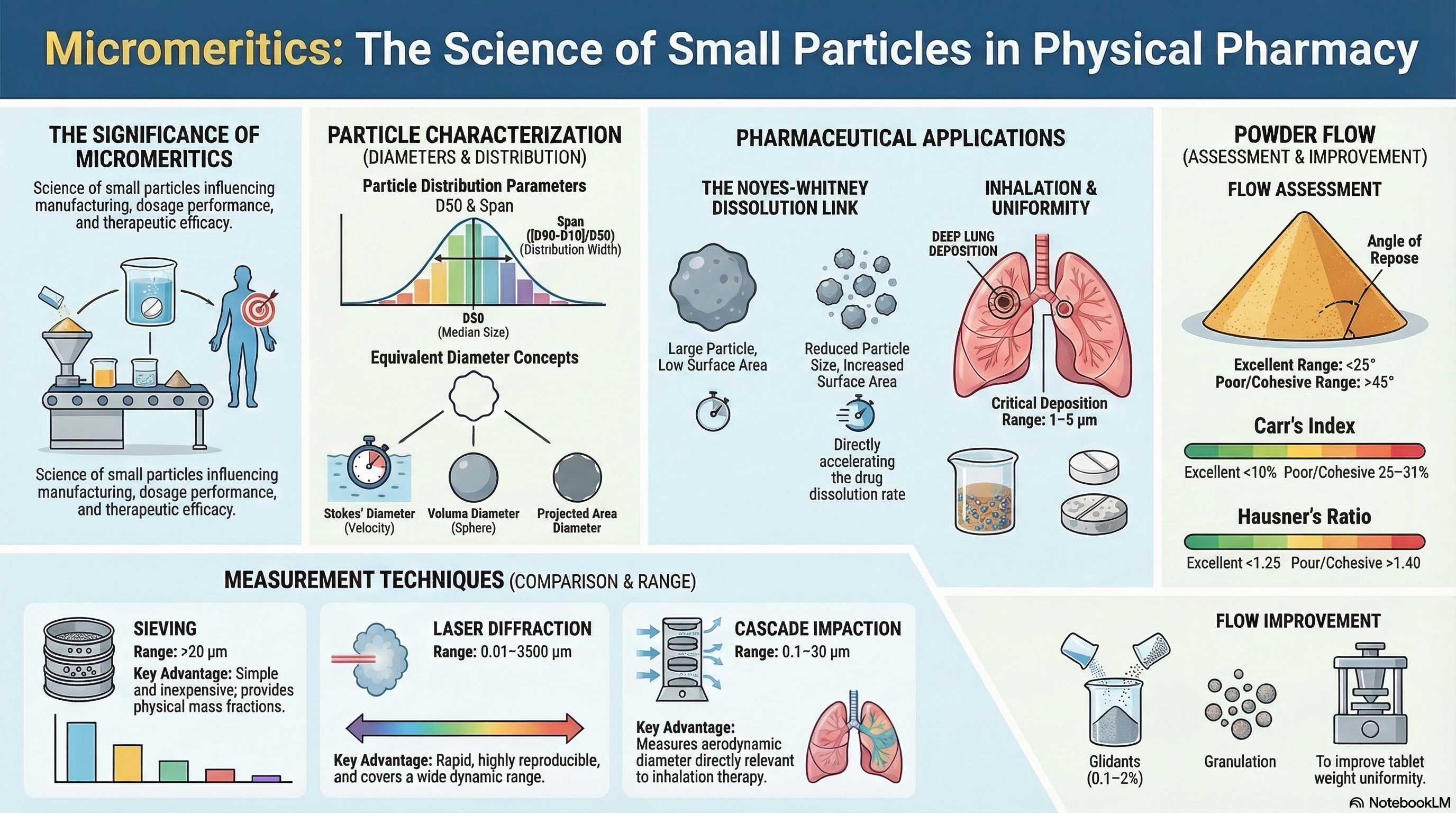
Micromeritics is the science and technology of small particles. The term encompasses the study of the fundamental and derived properties of individual particles and their assemblies, including particle size, particle size distribution, particle shape, surface area, porosity, packing properties, and flow behavior . Knowledge of micromeritics is essential in pharmaceutical sciences because the behavior of powders and granular materials directly influences manufacturing processes, dosage form performance, and therapeutic efficacy.
Particle Size and Its Distribution
Particle Size Concepts
Particle size is a linear dimension used to characterize the size of a particle. However, most pharmaceutical particles are irregular in shape, making the assignment of a single dimension challenging. Therefore, various equivalent diameters are used to describe particle size based on the measurement principle .
Common Equivalent Diameters:
| Diameter Type | Definition | Measurement Method |
|---|---|---|
| Volume diameter | Diameter of a sphere having the same volume as the particle | Electrical sensing zone, laser diffraction |
| Surface diameter | Diameter of a sphere having the same surface area as the particle | Permeametry, adsorption |
| Projected area diameter | Diameter of a sphere having the same projected area as the particle when viewed normal to a plane | Microscopy, image analysis |
| Feret's diameter | Distance between two parallel tangents on opposite sides of the particle | Microscopy |
| Martin's diameter | Length of the chord that divides the particle's projected area into two equal halves | Microscopy |
| Stokes' diameter | Diameter of a sphere having the same terminal settling velocity as the particle in a fluid | Sedimentation, elutriation |
| Aerodynamic diameter | Diameter of a unit-density sphere having the same terminal settling velocity as the particle in air | Cascade impaction, aerosol studies |
Particle Size Distribution
A powder sample typically contains particles of various sizes. The particle size distribution (PSD) describes the relative amounts of particles present according to size. PSD can be represented as:
- Frequency distribution: Number or mass of particles in each size class
- Cumulative distribution: Total percentage of particles below or above a certain size
Important Distribution Parameters:
| Parameter | Definition | Significance |
|---|---|---|
| D10 | Size below which 10% of the particles (by volume or number) fall | Indicates fines content |
| D50 | Median particle size; size below which 50% of particles fall | Central tendency |
| D90 | Size below which 90% of particles fall | Indicates coarse fraction |
| Span | (D90 - D10)/D50 | Measure of distribution width |
| Uniformity | Degree of similarity in particle sizes | Affects packing and flow |
Types of Distributions:
- Monomodal: Single peak
- Bimodal: Two distinct peaks
- Polymodal: Multiple peaks
Distribution Basis:
- Number distribution: Count of particles in each size class
- Volume (mass) distribution: Volume or mass contribution of particles in each size class
Conversion between number and volume distributions requires assumptions about particle shape and density.
Texture and Morphological Characteristics
Particle Shape
Particle shape significantly influences powder behavior. Common shape descriptors include:
| Shape Term | Description |
|---|---|
| Spherical | Rounded, equal dimensions |
| Rounded | Somewhat spherical but not perfect |
| Acicular | Needle-shaped |
| Tabular | Plate-like, flat |
| Flaky | Thin, flat plates |
| Irregular | No symmetry |
| Fibrous | Thread-like |
| Dendritic | Branched, tree-like |
Quantitative Shape Factors:
| Factor | Definition | Formula |
|---|---|---|
| Aspect ratio | Ratio of longest to shortest dimension | Length/Width |
| Circularity | How close projected area resembles a circle | (4π × Area) / Perimeter² |
| Roundness | Sharpness of corners and edges | (Average radius of corners) / (Radius of inscribed circle) |
| Sphericity (ψ) | Ratio of surface area of sphere of equal volume to actual surface area | ψ = (Surface area of sphere of same volume) / (Actual surface area) |
Surface Characteristics
Surface Roughness:
- Microscale irregularities on particle surface
- Affects interparticle friction, flow, and adhesion
- Can be quantified by profilometry or atomic force microscopy
Porosity:
- Presence of pores within particles
- Intraparticle porosity affects density, dissolution, and adsorption
- Measured by mercury intrusion porosimetry or gas adsorption
Crystallinity:
- Crystalline particles have ordered internal structure
- Amorphous regions may exist on surfaces
- Affects surface energy and interaction with excipients
Role and Importance of Micromeritics in Pharmacy
Particle size and related properties influence virtually every aspect of pharmaceutical development and performance.
1. Dissolution and Bioavailability
According to the Noyes-Whitney equation, dissolution rate is directly proportional to the surface area of the drug. Reducing particle size increases surface area, thereby enhancing dissolution rate and potentially improving bioavailability of poorly soluble drugs.
Biopharmaceutics Classification System (BCS) Implications:
- Class II (low solubility, high permeability): Particle size reduction is a key strategy to enhance absorption
- Class IV (low solubility, low permeability): Particle size reduction may help but other strategies often needed
2. Content Uniformity
In solid dosage forms (tablets, capsules), particle size affects the homogeneity of powder blends. Large particle size differences between drug and excipients can lead to segregation and content uniformity problems.
Requirement: To ensure uniform drug distribution, the drug particle size should be small enough and the particle size distribution narrow to prevent demixing during processing.
3. Flow Properties
Powder flow is critical for successful manufacturing operations such as hopper discharge, die filling, and capsule filling. Particle size, shape, and surface characteristics directly influence flow:
- Larger particles (>200 μm) generally flow well
- Fine particles (<100 μm) tend to be cohesive and flow poorly
- Spherical particles flow better than irregular or needle-shaped particles
- Surface roughness increases interparticle friction, reducing flow
4. Suspension Stability
In pharmaceutical suspensions, particle size affects sedimentation rate (Stokes' law), redispersibility, and physical stability. Smaller particles sediment more slowly but may form compact cakes if too fine. Optimal particle size (typically 1-50 μm) balances stability and redispersibility.
5. Inhalation Therapy
For pulmonary delivery, particle size determines the site of deposition within the respiratory tract:
| Particle Size | Deposition Site |
|---|---|
| >10 μm | Mouth and throat (oropharyngeal) |
| 5-10 μm | Upper airways (tracheobronchial) |
| 1-5 μm | Deep lung (alveolar) |
| <1 μm | May be exhaled |
6. Parenteral Formulations
Injectable suspensions and emulsions require strict particle size control to avoid capillary blockade and ensure safety. Particulate matter limits are specified in pharmacopoeias.
7. Tablet Compaction
Particle size affects compressibility, tablet strength, and disintegration. Fine particles may produce harder tablets but can also lead to capping or lamination. Optimal particle size distribution improves compaction properties.
8. Coating Processes
Particle size influences the efficiency and uniformity of coating operations. Size distribution affects the surface area to be coated and the amount of coating material required.
9. Stability
Particle size can affect chemical and physical stability. Smaller particles have higher surface energy and may be more reactive (oxidation, hydrolysis). In suspensions, particle growth (Ostwald ripening) occurs when particle size distribution is wide.
10. Taste Masking
Particle size reduction can increase the perception of bitter taste due to increased surface area and faster dissolution on the tongue. Conversely, larger particles or coated particles may reduce taste issues.
Methods of Particle Size Analysis
Numerous techniques are available for particle size measurement, each with its own principles, advantages, and limitations. Selection depends on particle size range, sample characteristics, and information required.
1. Sieving
Principle: Sieving is the oldest and most widely used method for particle size analysis. Particles are separated by passing them through a series of woven-wire sieves with progressively smaller openings. The mass retained on each sieve is weighed, and the size distribution is calculated.
Sieve Types:
- Woven-wire sieves: Standard mesh sizes (e.g., ASTM, BS, ISO)
- Electroformed sieves: Precision micro-sieves for finer sizes (down to 5 μm)
Procedure:
- Stack sieves with the largest opening on top
- Place a known weight of powder on the top sieve
- Agitate (mechanically or by air jet) for a specified time
- Weigh the material retained on each sieve and the pan
Advantages:
- Simple, inexpensive, and reproducible
- Covers a wide size range (20 μm to 125 mm)
- Provides both size distribution and physical fractions for further testing
- No complex calibration required
Disadvantages:
- Lower limit ~20-50 μm (sieves smaller than 20 μm are fragile and clog easily)
- Time-consuming
- Not suitable for cohesive or very fine powders
- Shape-dependent: elongated particles may pass end-on or be retained
Applications:
- Quality control of granules and coarse powders
- Determination of particle size distribution for tableting blends
- USP/EP method for many pharmacopoeial tests
2. Microscopy
Principle: Microscopy allows direct visualization and measurement of individual particles. Particles are dispersed on a slide, and their dimensions are measured using a calibrated eyepiece graticule or image analysis software.
Types:
- Optical microscopy: Suitable for particles >0.5 μm
- Electron microscopy (SEM, TEM): For submicron and nanoscale particles
Measurement Parameters:
- Projected area diameter, Feret's diameter, Martin's diameter
- Shape assessment (aspect ratio, circularity)
- Agglomeration state
Advantages:
- Direct measurement of size and shape
- Ability to assess particle morphology, agglomeration, and contamination
- Small sample size required
- Absolute method (no calibration needed for size)
Disadvantages:
- Limited number of particles counted (statistically less representative)
- Time-consuming and operator-dependent
- Requires careful sample preparation to avoid bias
- 2D projection of 3D particles
Automated Image Analysis: Modern systems combine microscopy with digital image processing, enabling rapid measurement of thousands of particles and providing comprehensive size and shape data.
3. Sedimentation Methods
Principle: Particles suspended in a fluid settle at rates dependent on their size (Stokes' law). Larger particles settle faster. The change in concentration or mass of sediment with time is used to determine size distribution.
Stokes' Law: v = (d² (ρ_p - ρ_f) g) / (18 η)
where:
- v = terminal settling velocity
- d = Stokes' diameter
- ρ_p, ρ_f = particle and fluid densities
- g = gravitational acceleration
- η = fluid viscosity
Techniques:
- Gravitational sedimentation: Particles settle under gravity; suitable for 1-100 μm
- Centrifugal sedimentation: Centrifugal force accelerates settling for submicron particles (0.01-10 μm)
- Pipette method (Andreasen pipette): Samples withdrawn at specific depths and times
- Sedimentation balance: Weight of sediment collected on a pan recorded over time
Advantages:
- Measures Stokes' diameter, relevant to suspension behavior
- Relatively inexpensive equipment
- Can provide mass-based distribution
Disadvantages:
- Time-consuming (especially for fine particles)
- Requires density information and dispersion stability
- Assumes spherical particles and laminar flow
- Not suitable for particles that interact or agglomerate
4. Laser Diffraction (Low-Angle Laser Light Scattering, LALLS)
Principle: Particles passing through a laser beam scatter light at angles inversely proportional to their size. The angular intensity distribution of scattered light is measured by detectors and converted to a particle size distribution using Mie theory or Fraunhofer approximation.
Size Range: 0.01 μm to several millimeters (depending on instrument configuration)
Modes:
- Wet dispersion: Particles suspended in a liquid (with or without surfactant/sonication)
- Dry dispersion: Particles dispersed in air stream
Advantages:
- Rapid (measurement in seconds)
- Wide dynamic range
- Excellent reproducibility
- Requires minimal sample preparation
- Suitable for both wet and dry samples
- Can be automated for high throughput
Disadvantages:
- Results depend on optical model (refractive index, absorption)
- Assumes spherical particles; shape affects accuracy
- Cannot distinguish between individual particles and agglomerates without proper dispersion
- Relatively expensive instrumentation
Applications:
- Routine quality control of pharmaceutical powders
- Characterization of inhalation products
- Monitoring milling and micronization processes
5. Electrical Sensing Zone (Coulter Principle)
Principle: Particles suspended in an electrolyte solution are drawn through a small aperture. As each particle passes, it displaces its own volume of electrolyte, causing a change in electrical resistance proportional to particle volume. The number and magnitude of pulses are counted and sized.
Size Range: 0.4 μm to 1200 μm (aperture-dependent)
Advantages:
- Measures absolute number and volume of individual particles
- High resolution and accuracy
- Not dependent on optical properties
- Provides both number and volume distributions
Disadvantages:
- Requires conductive electrolyte
- Aperture blockage possible with large or agglomerated particles
- Limited to particles that are insoluble in the electrolyte
- Relatively slow compared to laser diffraction
Applications:
- Counting and sizing of parenteral particulates
- Blood cell counting (hematology analyzers)
- Calibration standard measurements
6. Photon Correlation Spectroscopy (PCS) / Dynamic Light Scattering (DLS)
Principle: Particles in suspension undergo Brownian motion. The intensity fluctuations of scattered laser light are analyzed to determine the diffusion coefficient, from which particle size (hydrodynamic diameter) is calculated using the Stokes-Einstein equation.
Size Range: 0.3 nm to 10 μm (optimal for submicron and nanoparticles)
Advantages:
- Suitable for nanoparticles and macromolecules
- Rapid measurement
- Small sample volume
- High sensitivity
Disadvantages:
- Intensity-weighted distribution (converted to volume/number using assumptions)
- Cannot resolve multimodal distributions well
- Sensitive to dust and aggregates
- Requires knowledge of viscosity and temperature
Applications:
- Nanoparticle formulations (liposomes, polymeric nanoparticles, nanocrystals)
- Protein aggregation studies
- Quality control of nano-sized drug delivery systems
7. Acoustic Spectroscopy
Principle: Ultrasonic waves are passed through a particle suspension. The attenuation and velocity of sound are measured as functions of frequency, and particle size distribution is derived from acoustic theory.
Advantages:
- Can measure concentrated suspensions (up to 50% v/v) without dilution
- No dilution artifacts
- Suitable for opaque systems
Disadvantages:
- Complex data interpretation
- Requires knowledge of physical properties (density, etc.)
- Less common in pharmaceutical labs
8. Cascade Impaction
Principle: Particles in an air stream are separated based on their aerodynamic diameter by passing through a series of stages with decreasing jet sizes. Particles inertially impact on collection plates at each stage depending on their size.
Size Range: 0.1 μm to 30 μm
Advantages:
- Measures aerodynamic diameter, directly relevant to inhalation
- Provides mass-based distribution
- Pharmacopoeial method for inhalation products
Disadvantages:
- Time-consuming and labor-intensive
- Requires chemical assay of drug collected on each stage
- Limited resolution
Applications:
- Characterization of metered-dose inhalers (MDIs)
- Dry powder inhalers (DPIs)
- Nebulizers
9. Permeametry (Air Permeability)
Principle: The resistance of a packed powder bed to fluid flow is measured and related to the surface area (or average particle size) using Kozeny-Carman equation. Not a true particle size distribution method; gives specific surface area.
Advantages:
- Simple and rapid
- Inexpensive
- Measures surface area relevant to dissolution
Disadvantages:
- Assumes uniform packing and spherical particles
- Provides only average size (not distribution)
- Affected by particle shape and porosity
Applications:
- Quality control for materials where surface area is critical
Comparison of Particle Size Analysis Methods
| Method | Size Range | Basis | Output | Advantages | Limitations |
|---|---|---|---|---|---|
| Sieving | >20 μm | Mass | Mass distribution | Simple, inexpensive, fractions obtained | Limited to coarse particles, shape bias |
| Microscopy | >0.5 μm | Number | Number distribution, shape | Direct visualization, absolute | Small sample size, time-consuming |
| Sedimentation | 0.1-100 μm | Mass (Stokes) | Mass distribution | Relevant to suspensions | Slow, density required |
| Laser diffraction | 0.01-3500 μm | Volume | Volume distribution | Rapid, wide range, reproducible | Optical properties needed, shape bias |
| Electrical sensing zone | 0.4-1200 μm | Volume | Number and volume | High resolution, absolute | Electrolyte required, aperture blockage |
| DLS | 0.3 nm-10 μm | Intensity | Intensity distribution | Nanoparticle sizing | Poor for multimodal, dust sensitive |
| Cascade impaction | 0.1-30 μm | Mass (aerodynamic) | Mass distribution | Relevant to inhalation | Laborious, assay required |
Flow Properties of Powders
Powder flow is a critical property affecting manufacturing processes such as hopper discharge, die filling, tablet compression, and capsule filling. Poor flow can lead to weight variation, content non-uniformity, and production downtime.
Factors Affecting Powder Flow
| Factor | Influence |
|---|---|
| Particle size | Larger particles (>200 μm) flow well; fines (<100 μm) are cohesive |
| Particle shape | Spherical flow best; irregular, needle, or flaky particles interlock |
| Surface texture | Smooth surfaces flow better than rough |
| Moisture content | Increased moisture increases cohesion (capillary forces) |
| Electrostatic charge | Static can cause aggregation or wall adhesion |
| Density | Higher density may improve flow (gravity-driven) |
| Hygroscopicity | Moisture uptake alters surface properties |
| Additives (glidants) | Small amounts (0.1-2%) of fine powders (silica, talc) can improve flow |
Quantitative Assessment of Flow Properties
1. Angle of Repose (θ)
Definition: The maximum angle that can be formed between the free surface of a powder heap and the horizontal plane. It reflects interparticle friction and cohesion.
Measurement: Powder is poured through a funnel onto a horizontal surface, and the height (h) and radius (r) of the conical heap are measured.
Calculation: tan θ = h / r
Interpretation:
| Angle of Repose (degrees) | Flow Character |
|---|---|
| <25 | Excellent |
| 25-30 | Good |
| 30-40 | Passable |
| 40-45 | Cohesive (poor) |
| >45 | Very cohesive (very poor) |
Limitations:
- Sensitive to method (funnel diameter, height, base material)
- Not reliable for very cohesive powders that do not form a stable heap
- Subjective interpretation
2. Carr's Index (Compressibility Index)
Definition: Measures the relative difference between tapped and bulk densities, reflecting the powder's tendency to consolidate.
Measurement:
- Bulk density (ρ_bulk): Mass of powder divided by unsettled apparent volume
- Tapped density (ρ_tapped): Mass divided by volume after mechanical tapping (standardized number of taps, e.g., 500 or 1250)
Calculation: Carr's Index (%) = [(ρ_tapped - ρ_bulk) / ρ_tapped] × 100
Interpretation:
| Carr's Index (%) | Flow Character |
|---|---|
| <10 | Excellent |
| 11-15 | Good |
| 16-20 | Fair |
| 21-25 | Passable |
| 26-31 | Poor |
| 32-37 | Very poor |
| >38 | Extremely poor |
3. Hausner's Ratio
Definition: Ratio of tapped density to bulk density. It indicates interparticle friction.
Calculation: Hausner's Ratio = ρ_tapped / ρ_bulk
Interpretation:
| Hausner's Ratio | Flow Character |
|---|---|
| <1.25 | Good flow |
| 1.25-1.4 | Moderate flow |
| >1.4 | Poor flow (cohesive) |
Relationship: Carr's Index and Hausner's Ratio are related; both derived from the same density measurements.
4. Flow Rate through an Orifice
Definition: Time required for a specified mass of powder to flow through a standardized funnel orifice.
Measurement: Powder is placed in a funnel with a specific orifice diameter, and the time for complete discharge is measured.
Interpretation:
- Shorter time = better flow
- Powders that do not flow (arching, rat-holing) are considered very cohesive
Limitations:
- Not all powders will flow through an orifice
- Orifice diameter must be chosen appropriately (typically >6× particle diameter)
- Sensitive to funnel geometry and operator technique
5. Shear Cell Testing
Principle: Measures the shear stress required to initiate flow in a consolidated powder bed under a given normal stress. Provides fundamental parameters like cohesion, angle of internal friction, and flow function.
Parameters:
- Flow function coefficient (ffc): Ratio of consolidation stress to unconfined yield strength
- Classification:
- ffc < 1: Not flowing
- 1 < ffc < 2: Very cohesive
- 2 < ffc < 4: Cohesive
- 4 < ffc < 10: Easy flowing
- ffc > 10: Free-flowing
Advantages:
- More fundamental and reproducible than empirical tests
- Applicable to cohesive powders
- Provides data for hopper design
Disadvantages:
- More complex and expensive equipment
- Requires skilled operator
Pharmaceutical Significance of Flow Properties
| Process | Flow Requirement |
|---|---|
| Hopper discharge | Must flow without arching or flooding |
| Tablet compression (die filling) | Uniform, rapid filling to ensure weight consistency |
| Capsule filling | Consistent flow into dosing chamber |
| Mixing | Good flow promotes blend uniformity; poor flow may cause segregation |
| Packaging | Flow into containers must be consistent |
Improving Flow Properties
| Method | Mechanism |
|---|---|
| Granulation | Agglomerates fine particles into larger, free-flowing granules |
| Addition of glidants | Fine particles (0.1-2%) coat surfaces, reduce interparticle friction (e.g., colloidal silica, talc, starch) |
| Spheronization | Rounds irregular particles |
| Controlled particle size distribution | Optimize to minimize fines and achieve good packing |
| Drying | Reduce moisture content |
| Anti-static agents | Reduce electrostatic charging |
Summary Tables
Table 1: Equivalent Diameters and Their Measurement Methods
| Diameter | Definition | Method |
|---|---|---|
| Volume diameter | Sphere of same volume | Coulter counter, laser diffraction |
| Surface diameter | Sphere of same surface area | Permeametry, adsorption |
| Projected area diameter | Sphere of same projected area | Microscopy, image analysis |
| Stokes' diameter | Sphere of same settling velocity | Sedimentation |
| Aerodynamic diameter | Sphere of unit density with same settling velocity | Cascade impaction |
Table 2: Particle Size Analysis Methods Summary
| Method | Principle | Size Range | Output Type | Key Advantage | Key Limitation |
|---|---|---|---|---|---|
| Sieving | Separation by mesh openings | >20 μm | Mass distribution | Simple, fractions obtained | Coarse only, shape bias |
| Optical microscopy | Direct measurement | >0.5 μm | Number, shape | Direct visualization | Small sample size |
| Sedimentation | Stokes' law | 0.1-100 μm | Mass (Stokes) | Relevant to suspensions | Slow, density needed |
| Laser diffraction | Light scattering | 0.01-3500 μm | Volume | Rapid, wide range | Optical model required |
| Coulter principle | Electrical resistance | 0.4-1200 μm | Number, volume | High resolution | Electrolyte needed |
| DLS | Brownian motion | 0.3 nm-10 μm | Intensity | Nanoparticle sizing | Multimodal limitations |
| Cascade impaction | Inertial impaction | 0.1-30 μm | Aerodynamic mass | Inhalation relevance | Laborious |
Table 3: Flow Property Classification
| Flow Character | Angle of Repose (°) | Carr's Index (%) | Hausner's Ratio |
|---|---|---|---|
| Excellent | <25 | <10 | <1.25 |
| Good | 25-30 | 11-15 | <1.25 |
| Fair | 30-40 | 16-20 | 1.25-1.4 |
| Passable | 40-45 | 21-25 | 1.25-1.4 |
| Poor | >45 | 26-31 | >1.4 |
| Very poor | - | 32-37 | >1.4 |
| Extremely poor | - | >38 | >1.4 |
Table 4: Pharmaceutical Applications of Particle Size Control
| Dosage Form | Particle Size Requirement | Reason |
|---|---|---|
| Tablets/capsules | Uniform, <100 μm for drug; granules 200-500 μm | Content uniformity, flow, compaction |
| Suspensions | 1-50 μm | Sedimentation rate, redispersibility |
| Emulsions | 0.1-10 μm | Stability, appearance |
| Inhalation aerosols | 1-5 μm (respirable fraction) | Deep lung deposition |
| Parenteral suspensions | <5-10 μm | Avoid capillary blockade |
| Ophthalmic suspensions | <10 μm | Avoid irritation, comfort |
| Topical preparations | Variable | Spreadability, sensation |
| Nanoparticulate systems | <1 μm | Enhanced dissolution, targeting |
References
-
Sinko, P. J. (2023). Martin's Physical Pharmacy and Pharmaceutical Sciences. Wolters Kluwer Health. (Chapter on Micromeritics)
-
Taylor, K., & Aulton, M. E. (2021). Aulton's Pharmaceutics: The Design and Manufacture of Medicines. Elsevier. (Chapters on Powder Properties and Particle Size Analysis)
-
Adejare, A. (2020). Remington: The Science and Practice of Pharmacy. Academic Press. (Section on Powder Technology)
-
Allen, L. V. (2021). Ansel's Pharmaceutical Dosage Forms and Drug Delivery Systems. Wolters Kluwer Health. (Chapter on Powders and Granules)
-
Brittain, H. G. (2018). Physical Characterization of Pharmaceutical Solids. CRC Press. (Chapters on Particle Size and Surface Area)
-
USP General Chapter <429> Light Diffraction Measurement of Particle Size. United States Pharmacopeia.
-
USP General Chapter <616> Bulk Density and Tapped Density of Powders. United States Pharmacopeia.
-
USP General Chapter <1174> Powder Flow. United States Pharmacopeia.
-
British Pharmacopoeia (2025). Appendix XVII N. Particle size analysis by laser light diffraction.
-
Hickey, A. J., & Ganderton, D. (2020). Pharmaceutical Inhalation Aerosol Technology. CRC Press. (Chapters on Particle Size in Inhalation)
-
Schulze, D. (2021). Powders and Bulk Solids: Behavior, Characterization, Storage and Flow. Springer. (Comprehensive coverage of powder flow)
-
Carstensen, J. T. (2020). Pharmaceutics of Solids and Solid Dosage Forms. Wiley-Interscience.
-
Rhodes, M. J. (2018). Introduction to Particle Technology. Wiley. (Fundamental principles)
-
Staniforth, J. N. (2020). Powder Flow. In Pharmaceutics: The Science of Dosage Form Design (M.E. Aulton, Ed.). Churchill Livingstone.
Recommended Textbooks for Further Reading:
- Sinko, P. J. (2023). Martin's Physical Pharmacy and Pharmaceutical Sciences. Wolters Kluwer Health. (Comprehensive coverage of micromeritics principles and applications)
- Taylor, K., & Aulton, M. E. (2021). Aulton's Pharmaceutics: The Design and Manufacture of Medicines. Elsevier. (Excellent practical coverage of powder technology)
- USP-NF. (Current edition). General Chapters on Powder Flow and Particle Size Analysis. (Official methods and standards)
End of unit 6 of 6
Check what you've learned
5 quick questions from this unit. They're optional: try them if you like, then mark the unit as read and move on.