

Unit 1: Introduction to Pharmacy and History
Origins of pharmacy practice, evolution of the pharmacist role, landmark milestones in pharmaceutical science, and the regulatory framework shaping modern pharmacy.
Prepared by the PharmaWallah student team. Verify results with your textbook or instructor. Report an error · Editorial policy
Unit 1: Introduction to Pharmacy and History
Introduction and Orientation to the Pharmacy Profession
Definition of Pharmacy
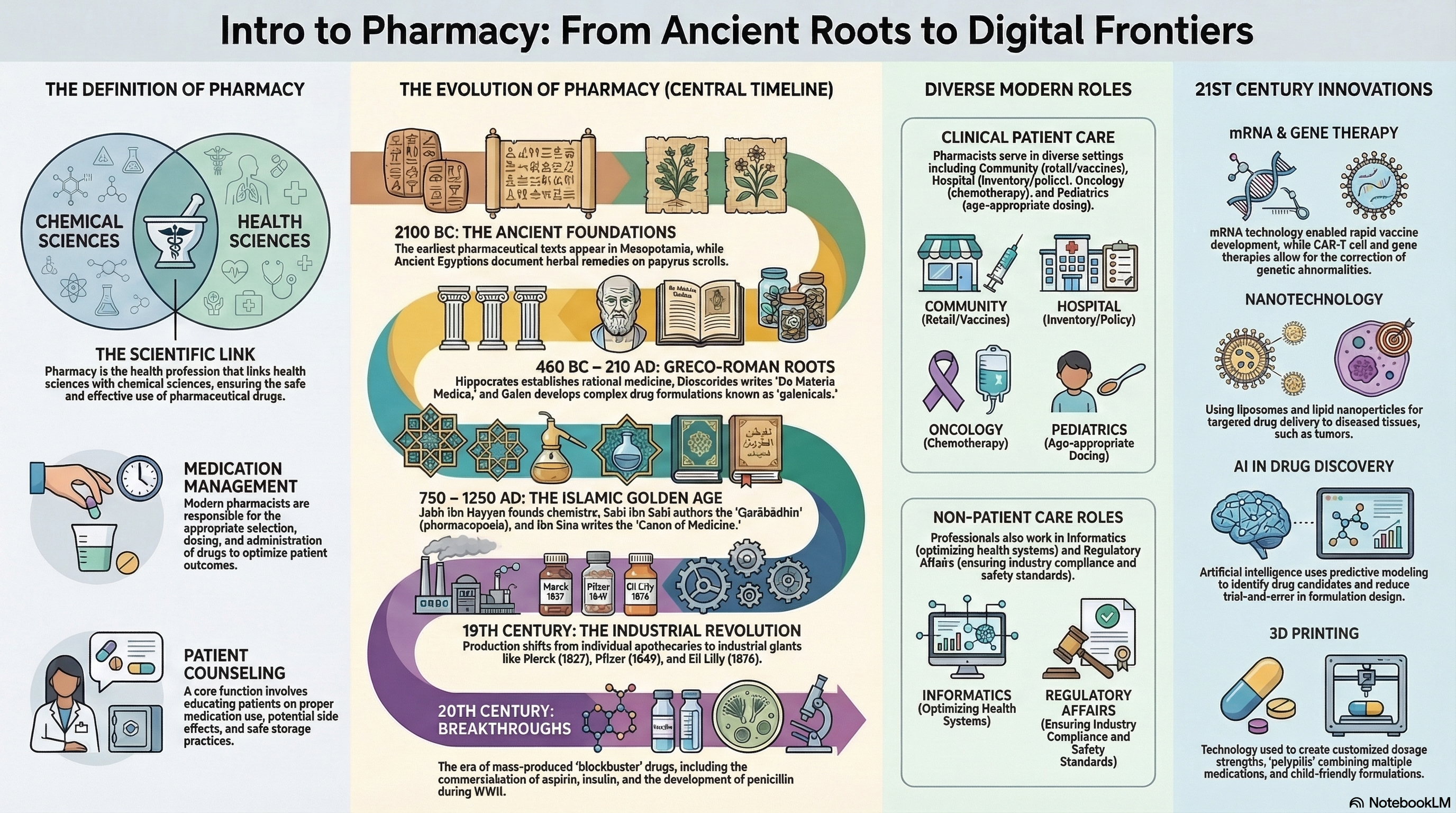
Pharmacy is the health profession that links health sciences with chemical sciences, responsible for ensuring the safe and effective use of pharmaceutical drugs. The profession encompasses the discovery, production, preparation, dispensing, and appropriate use of medications .
Core Functions of Modern Pharmacy
The pharmacy profession has evolved significantly from its historical roots. Contemporary pharmacy practice includes:
| Function Area | Description |
|---|---|
| Medication Management | Ensuring appropriate drug selection, dosing, and administration |
| Patient Counseling | Educating patients on proper medication use, side effects, and storage |
| Health Screenings | Providing vaccinations, blood pressure monitoring, and wellness checks |
| Collaborative Care | Working with physicians and healthcare teams to optimize patient outcomes |
| Drug Information | Serving as medication experts for healthcare providers and patients |
Current Scope of Pharmacy Practice
The profession now extends far beyond traditional dispensing roles :
Clinical Pharmacy Settings
- Community Pharmacists: Work in retail settings providing medication management, counseling, vaccines, and health screenings while liaising between patients, physicians, and insurance providers
- Hospital Pharmacists: Manage medications within medical facilities, monitor drug charts, participate in policy-making committees, and ensure proper medication inventory
- Clinical Pharmacists: Coordinate with physicians to provide patient-specific medication therapy, assess patient conditions, determine dosages, and monitor treatment outcomes
Specialized Clinical Roles
- Oncology Pharmacists: Specialize in cancer treatment medications, oversee complex chemotherapy regimens, and handle safety protocols
- Infectious Disease Pharmacists: Focus on antimicrobial therapy and infection management
- Critical Care Pharmacists: Work in intensive care units managing acute medication needs
- Geriatric Pharmacists: Specialize in medication needs of elderly patients
- Pediatric Pharmacists: Focus on age-appropriate dosing and formulations for children
Non-Patient Care Roles
- Pharmaceutical Research Technicians: Assist in research and development of new medicines, conduct experiments, analyze data, and maintain laboratory operations
- Regulatory Affairs Specialists: Ensure pharmaceutical companies meet all regulatory requirements and compliance standards
- Informatics Pharmacists: Combine clinical and technical expertise to optimize health information systems and medication administration technology
- Toxicologists: Study effects of chemicals and substances on human health
- Managed Care Pharmacists: Collaborate with insurance providers to deliver cost-effective care
Latest Applications in Pharmacy
The profession continues to expand with technological advancements:
- Remote Pharmacy Services: Telehealth consultations and mail-order pharmacy operations
- Compounding Services: Preparation of customized dosage forms for patients with unique needs
- Nuclear Pharmacy: Handling radioactive materials for diagnostic and therapeutic purposes
- Public Health Pharmacy: Population-level medication management and disease prevention
Historical Evolution of Pharmacy
Ancient Period Foundations
The origins of pharmacy trace back thousands of years. The earliest pharmaceutical text discovered dates to the Mesopotamians in 2100 B.C. . Early civilizations recognized medicinal properties in natural sources including leaves, seeds, bark, and insects, with specific individuals designated to transform these materials into therapeutic preparations .
Ancient Egyptian Contributions
- Documented medical practices on papyrus scrolls
- Developed extensive knowledge of herbal remedies
- Established early compounding practices
Ancient Greek Contributions The Greeks established a strong foundation that would later be built upon by Arab scholars . Key figures include:
- Hippocrates (460-370 BC): Considered the "Father of Medicine," he emphasized rational observation and the healing power of nature
- Dioscorides (40-90 AD): Wrote "De Materia Medica," a five-volume encyclopedia about herbal medicines that remained authoritative for over 1500 years
- Galen (129-210 AD): Developed complex drug formulations (galenicals) and established compounding principles still referenced today
Arab and Muslim Contributions to Pharmacy
The Greco-Arabian era represents a golden age of pharmaceutical development. During the Arab Caliphates, rulers appreciated and patronized medical knowledge acquired from Greeks and worked systematically for its advancement .
Major Contributions of Muslim Scientists
| Scientist | Contributions |
|---|---|
| Jabir ibn Hayyan (Geber, 721-815 AD) | Founded chemistry; introduced experimental methods; developed purification, distillation, and crystallization techniques |
| Yuhanna ibn Masawaih (Mesue the Elder, 777-857 AD) | Wrote extensively on pharmaceutical compounding; established quality standards for medicines |
| Sabi ibn Sahl (d. 869 AD) | Authored one of the earliest known pharmacopoeias - "Qarābādhīn" or "Aqrābādhīn" |
| Ali ibn Sahl Rabban al-Tabari (838-870 AD) | Produced comprehensive medical encyclopedias incorporating pharmaceutical knowledge |
| Abu Bakr al-Razi (Rhazes, 865-925 AD) | Distinguished measles from smallpox; pioneered the use of animal gut for sutures; wrote extensively on pharmaceutical preparations |
| Abu al-Qasim al-Zahrawi (Abulcasis, 936-1013 AD) | "Father of Surgery," but also contributed pharmaceutical knowledge including preparation of medicines by sublimation and distillation |
| Ibn Sina (Avicenna, 980-1037 AD) | Author of "The Canon of Medicine," which became the standard medical text in Europe for centuries; dedicated substantial content to pharmaceuticals and their preparation |
Qarābādhīn: The Early Pharmacopoeia
The term Qarābādhīn (also Aqrābādhīn) refers to compiled form of compound formulations or recipes - essentially the pharmacopoeia of the Greco-Arabian era . These documents:
- Contained systematic compilations of compound drug formulations
- Served regulatory and standardization purposes
- Incorporated ethical considerations in medicine preparation
- Provided foundations for present-day pharmacopoeias
Many of these manuscripts are preserved in libraries worldwide, representing the bridge between ancient Greek knowledge and modern pharmaceutical science.
Monastic Medicine Preservation
During the early Middle Ages in Europe, monasteries served as centers of learning where monks meticulously copied and preserved classical texts . Monasteries maintained large herb gardens and served as infirmaries for the sick. Notable contributors include:
- Odo of Meune (d. 1161): Produced a popular Latin poem about herb use
- Hildegard of Bingen (d. 1179): Wrote treatises on herbal remedies
The Industrial Revolution and 20th Century Pharmaceutical Development
Transition from Apothecaries to Industry
The 19th century marked a pivotal shift from traditional pharmacy to industrial pharmaceutical production :
- 1827: Heinrich Emanuel Merck initiated industrial production by manufacturing alkaloids in Darmstadt, Germany
- 1849: Two German immigrants founded Pfizer in the United States as a fine chemicals business
- 1876: Eli Lilly established his pharmaceutical company with focus on research and development
20th Century Breakthroughs
| Period | Key Developments |
|---|---|
| Early 1900s | Commercialization of aspirin by Bayer demonstrated potential for mass-produced pharmaceuticals |
| 1910 | First synthetic anti-infective medicine (for syphilis) developed by Institute of Experimental Therapy in Berlin, commercialized by private company |
| 1920s-1930s | Insulin isolation by Frederick Banting transformed diabetes from fatal to manageable condition; Eli Lilly enabled industrial production |
| 1940s | Penicillin development during World War II through collaboration including Merck, Pfizer, and Squibb; mass production techniques combined with improved biology and chemistry understanding |
| 1950s-1960s | "Golden age" of medicine development: oral contraceptives, psychiatric medications, new antibiotics; vaccines for poliomyelitis and measles |
| 1970s | Major advances in cardiovascular medicines; birth of biopharmaceuticals with synthetic insulin development |
| 1980s | "Blockbuster" medicines era (sales exceeding $1 billion annually); first was histamine receptor antagonist for gastrointestinal conditions |
Evolution of Pharmacy Practice in America
The 20th century saw dramatic changes in how pharmacy was practiced :
Soda Fountain Era (1920-1949)
- Industrialization reduced need for compounding
- Pharmacists turned to front-end sales for profitability
- Candy, household items, and fountain sodas became profit drivers
- During Prohibition, medicinal alcohol was significant revenue source
- Less than 1% of pharmacists derived over 50% of sales from prescriptions
Patient-Centered Transition (1950-1979)
- Pharmacists stepped away from soda counters
- Eugene White introduced patient-focused pharmacy model including:
- Detailed family prescription record systems
- Support staff for administration and patient care
- Increased availability for patient counseling
- Ethical standards shifted to permit direct patient consultation
Pharmaceutical Care Era (1980-2009)
- Pharmacists embraced clinical responsibilities
- Omnibus Budget Reconciliation Act of 1990 mandated patient counseling for Medicaid
- Pharmacists increased role as community immunizers
- 1986: First home delivery prescription by Express Scripts
Developments in the 21st Century
Biotechnology Revolution
The 21st century has witnessed unprecedented advances in biotechnology:
Biologics and Gene Therapies
- Monoclonal antibodies: Revolutionized cancer and autoimmune disease treatment
- CAR-T cell therapies: Engineered patient immune cells to attack cancer
- Gene therapies: Correct genetic abnormalities; demonstrated successful outcomes in inherited disorders
- mRNA technology: Enabled rapid COVID-19 vaccine development; now expanding to other applications
Personalized Medicine
- Genomics enables targeting medicines to patients with specific genetic profiles
- Enhanced treatment effectiveness and cost-effectiveness
- Biomarker-driven drug development
Nanotechnology Applications
Nanotechnology has transformed drug delivery through molecular-scale engineering :
| Nanotechnology Platform | Application |
|---|---|
| Liposomes | Targeted drug delivery to diseased tissues |
| Polymeric nanoparticles | Controlled release and enhanced bioavailability |
| Dendrimers | Precise drug targeting, gene delivery |
| Lipid nanoparticles | mRNA vaccine delivery, gene therapy vehicles |
| Nanocrystals | Improved solubility of poorly water-soluble drugs |
Nanomedicine Advances
- Oncology: Nanoparticle-based chemotherapeutics selectively accumulate in tumor regions
- Neurology: Nanoformulations overcoming blood-brain barrier for Alzheimer's and Parkinson's treatment
- Infectious disease: Lipid nanoparticles for vaccine delivery
- Diagnostics: Nanoparticle-based imaging agents
Artificial Intelligence in Pharmacy
AI and machine learning are transforming pharmaceutical sciences :
Drug Discovery and Development
- Predictive modeling for drug-target interactions
- Virtual screening of compound libraries
- Reduction of trial-and-error in formulation design
- Identification of potential drug candidates from large datasets
Clinical Applications
- Digital twin simulations for personalized therapy
- AI-powered wearable monitoring for real-time treatment adjustment
- Predictive pharmacokinetics and pharmacodynamics
Manufacturing and Quality
- Process optimization
- Quality by design implementations
- Predictive maintenance
Advanced Drug Delivery Systems
21st century innovations in drug delivery :
Long-Acting Formulations
- Monthly or biannual injectables for HIV treatment
- Insulin depots for glucose regulation without frequent injections
- Depot antipsychotics reducing relapse rates in schizophrenia
Smart Drug Delivery Systems
- Stimuli-responsive carriers (pH-sensitive, temperature-sensitive)
- Glucose-responsive insulin systems
- Wearable patches with integrated sensors and microneedles
3D Printing
- Customized release rates and dosage strengths
- Polypills combining multiple medications
- Child-friendly formulations
- Orphan drug manufacturing for rare conditions
Oral Biologics
- Protective coatings enabling oral delivery of peptides and antibodies
- Enzyme inhibitors and absorption enhancers
- Insulin pills in clinical trials
Emerging Frontiers
| Frontier Area | Description |
|---|---|
| Cell-based Delivery | Stem cells engineered as biological delivery mechanisms; CAR-T and CAR-NK therapies |
| Microbiome-based Therapies | Engineered probiotics producing therapeutic molecules; gut-brain axis applications |
| Regenerative Medicine | Tissue scaffolds with controlled growth factor release |
| Gene Editing | CRISPR/Cas9 delivery systems for correcting genetic defects |
| Digital Therapeutics | Software-based therapeutic interventions |
Regulatory and Ethical Considerations
The rapid advancement of pharmaceutical technologies brings important considerations :
Regulatory Adaptation
- Agencies adapting to novel therapeutic classes
- Ensuring safety without stifling innovation
- Accelerated approval pathways for breakthrough therapies
Ethical Challenges
- Patient privacy in genomic medicine
- Equitable access to advanced therapies
- Cost and affordability of innovative treatments
- Long-term safety monitoring for novel technologies
Summary Tables
Table 1: Historical Periods in Pharmacy Development
| Period | Key Characteristics | Major Contributions |
|---|---|---|
| Ancient (2100 BC-400 AD) | Herbal remedies; empirical knowledge | Mesopotamian texts; Egyptian papyri; Greek rational medicine |
| Greco-Roman (400 BC-200 AD) | Systematic documentation | Hippocratic Corpus; Dioscorides' De Materia Medica; Galenical formulations |
| Islamic Golden Age (750-1250 AD) | Scientific method; pharmacopoeias | Qarābādhīn; hospital pharmacies; distillation and crystallization |
| Medieval Europe (500-1500 AD) | Preservation in monasteries | Herb gardens; copied manuscripts; monastic medicine |
| Industrial Revolution (1800-1900) | Transition from apothecaries | Industrial alkaloid production; founding of pharmaceutical companies |
| 20th Century (1900-2000) | Mass production; blockbuster drugs | Antibiotics; insulin; vaccines; cardiovascular drugs |
| 21st Century (2000-present) | Biotechnology; personalized medicine | Biologics; gene therapy; nanotechnology; AI |
Table 2: Key Muslim Scientists and Their Contributions
| Scientist | Period | Key Contributions |
|---|---|---|
| Jabir ibn Hayyan | 8th century | Founded chemistry; experimental methods; distillation techniques |
| Yuhanna ibn Masawaih | 8th-9th century | Pharmaceutical compounding; quality standards |
| Sabi ibn Sahl | 9th century | Early pharmacopoeia (Qarābādhīn) |
| Al-Razi (Rhazes) | 9th-10th century | Disease differentiation; pharmaceutical preparations |
| Al-Zahrawi (Abulcasis) | 10th-11th century | Sublimation and distillation techniques |
| Ibn Sina (Avicenna) | 10th-11th century | Canon of Medicine; comprehensive pharmaceutical knowledge |
Table 3: 21st Century Technological Applications
| Technology | Primary Applications | Impact on Pharmacy |
|---|---|---|
| Biotechnology | Monoclonal antibodies; gene therapy; mRNA vaccines | Targeted therapies; curative treatments |
| Nanotechnology | Targeted drug delivery; diagnostic imaging | Enhanced efficacy; reduced side effects |
| Artificial Intelligence | Drug discovery; personalized dosing | Accelerated development; optimized therapy |
| 3D Printing | Personalized dosage forms; polypills | Customized medicines; patient-specific therapy |
| Smart Delivery Systems | Stimuli-responsive release; wearable devices | Precision dosing; improved adherence |
References
-
Ali, M. A., & Hamiduddin. (2021). Qarābādhīn (Pharmacopoeia) in Greeco-Arabian era: A historical and regulatory perspective. International Journal of Human and Health Sciences, 5(4), 388-404.
-
Philadelphia College of Osteopathic Medicine. (2025). Discover 10 career options you can pursue with a pharmacy degree. PCOM School of Pharmacy.
-
Årdal, C., Lopert, R., & Mestre-Ferrandiz, J. (2022). Overview of the market for novel medicines in the WHO European Region. In The pharmaceutical sector: An evolving market. World Health Organization.
-
Samatha. (2025). The future of medicine administration: Trends and technologies beyond 2025. Pharma Focus Europe.
-
Express Scripts Pharmacy. (2022). The history of pharmacy.
-
SAGE Publications. (n.d.). History of pharmacology: Europe, Middle Ages. In The SAGE Encyclopedia of Pharmacology and Society.
-
Massachusetts College of Pharmacy and Health Sciences. (2026). What can you do with a pharmacy degree? MCPHS.
-
MedPath. (2020). Evolution of pharmaceutical industry: From apothecaries to modern drug development giants.
-
Prajapati, R. N., et al. (2024). Recent advances in pharmaceutical design: Unleashing the potential of novel therapeutics. Current Pharmaceutical Biotechnology, 25(16), 2060-2077.
Recommended Textbooks for Further Reading:
- Sinko, P. J. (2023). Martin's Physical Pharmacy and Pharmaceutical Sciences. Wolters Kluwer Health.
- Taylor, K., & Aulton, M. E. (2021). Aulton's Pharmaceutics: The Design and Manufacture of Medicines. Elsevier.
- Adejare, A. (2020). Remington: The Science and Practice of Pharmacy. Academic Press.
End of unit 1 of 6
Check what you've learned
5 quick questions from this unit. They're optional: try them if you like, then mark the unit as read and move on.