

Unit 2: Introduction to Pharmaceutical Literature
Pharmacopoeias, formularies, drug information databases, primary and secondary literature sources, and how to critically evaluate pharmaceutical references.
Prepared by the PharmaWallah student team. Verify results with your textbook or instructor. Report an error · Editorial policy
Unit 2: Introduction to Pharmaceutical Literature
Introduction to Scientific Literature
Definition and Purpose
Scientific literature comprises published original research, review articles, and reference works that communicate findings, theories, and developments within scientific disciplines. In pharmaceutical sciences, this literature serves as the foundation for evidence-based practice, drug development, and clinical decision-making.
Primary Functions of Scientific Literature
| Function | Description |
|---|---|
| Knowledge Dissemination | Sharing research findings with the scientific community |
| Archiving | Permanent record of scientific discoveries and methodologies |
| Quality Control | Peer review ensures reliability and validity of published work |
| Building Consensus | Establishing accepted theories and practices |
| Guiding Practice | Providing evidence base for clinical and pharmaceutical decisions |
Structure of Scientific Literature
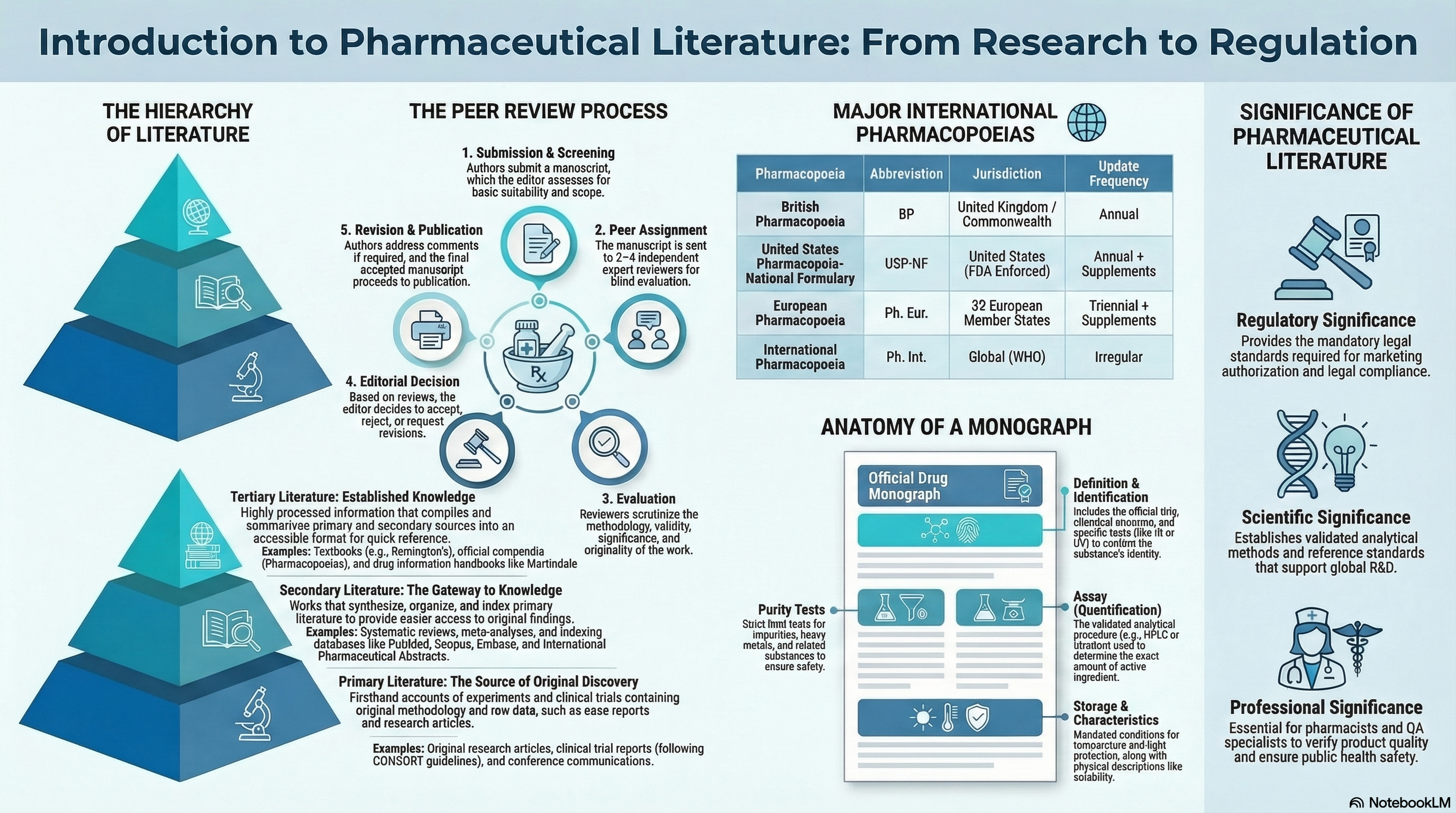
Scientific literature follows a hierarchical structure based on the level of original information and processing:
Primary Literature
- Original research reports
- Contains firsthand accounts of experiments, observations, and studies
- Includes methodology, raw data, and original conclusions
- Examples: Original research articles, case reports, clinical trial reports
Secondary Literature
- Synthesizes, organizes, and indexes primary literature
- Provides access points to primary sources
- Examples: Review articles, systematic reviews, meta-analyses, indexing databases
Tertiary Literature
- Compiles and summarizes information from primary and secondary sources
- Provides established knowledge in accessible format
- Examples: Textbooks, encyclopedias, compendia, handbooks
The Peer Review Process
Peer review is the cornerstone of scientific publishing quality control:
- Submission: Author submits manuscript to journal
- Initial Screening: Editor assesses basic suitability and scope
- Peer Assignment: Manuscript sent to 2-4 expert reviewers
- Review: Reviewers evaluate methodology, validity, significance, and originality
- Decision: Editor makes decision based on reviews (accept, revise, or reject)
- Revision: Author addresses reviewer comments if required
- Publication: Accepted manuscript proceeds to publication
Evaluating Scientific Literature
Critical evaluation of scientific literature requires assessment of:
- Authority: Qualifications and affiliations of authors
- Accuracy: Methodology, data analysis, and conclusions
- Objectivity: Potential biases, conflicts of interest, funding sources
- Currency: Timeliness of information and references
- Coverage: Scope and depth of the subject matter
Literature Types in Pharmacy
Pharmaceutical literature encompasses diverse formats serving different purposes in education, research, and practice.
Primary Literature in Pharmacy
Research Articles
Original research articles report new findings from experimental studies:
| Component | Purpose |
|---|---|
| Title | Concise description of study content |
| Abstract | Summary of objectives, methods, results, and conclusions |
| Introduction | Background, rationale, and study objectives |
| Methodology | Detailed description of experimental procedures |
| Results | Presentation of findings with statistical analysis |
| Discussion | Interpretation of results and comparison with existing knowledge |
| Conclusion | Summary of key findings and implications |
| References | Citations to relevant previous work |
Clinical Trial Reports
- Describe controlled studies of drug efficacy and safety
- Follow CONSORT guidelines for standardized reporting
- Provide essential data for regulatory approval and clinical guidelines
Case Reports and Case Series
- Describe unusual patient presentations or treatment responses
- Important for identifying rare adverse effects or novel applications
- Limited by lack of control groups and generalizability
Short Communications and Letters
- Brief reports of preliminary findings or observations
- Rapid dissemination of time-sensitive information
- Often serve as forum for scientific discussion and debate
Secondary Literature in Pharmacy
Review Articles
Review articles synthesize and evaluate multiple primary research papers:
| Type | Description |
|---|---|
| Narrative Review | Broad overview of a topic without systematic methodology |
| Systematic Review | Rigorous, comprehensive search and synthesis using predefined methods |
| Meta-analysis | Statistical combination of results from multiple studies |
| Scoping Review | Mapping existing literature on a broad topic |
Indexing and Abstracting Databases
These databases provide access to primary literature:
| Database | Coverage | Specialization |
|---|---|---|
| PubMed/MEDLINE | Biomedical literature | Life sciences, biomedical topics |
| Scopus | Multidisciplinary | Science, technology, medicine |
| Web of Science | Multidisciplinary | High-impact journals |
| Embase | Biomedical | Pharmaceutical research, pharmacology |
| International Pharmaceutical Abstracts | Pharmacy-specific | Pharmacy practice, drug information |
| Chemical Abstracts | Chemistry | Chemical and pharmaceutical sciences |
Systematic Reviews and Meta-analyses
- Represent highest level of evidence for clinical questions
- Follow rigorous, reproducible methodology (PRISMA guidelines)
- Include comprehensive literature searches and quality assessment
- May include statistical pooling of results (meta-analysis)
Tertiary Literature in Pharmacy
Textbooks
- Comprehensive coverage of established knowledge
- Authored by experts in the field
- Undergo editorial review and multiple editions
- Examples: Remington: The Science and Practice of Pharmacy, Aulton's Pharmaceutics
Reference Books
- Provide quick access to specific information
- Include drug information, chemical data, and practice guidelines
- Examples: Martindale: The Complete Drug Reference, Merck Index
Compendia and Pharmacopoeias
- Official collections of drug standards and information
- Legally recognized standards for quality, purity, and strength
- Detailed in separate section below
Drug Information Resources
| Resource | Type | Content |
|---|---|---|
| Physicians' Desk Reference (PDR) | Drug compendium | FDA-approved prescribing information |
| American Hospital Formulary Service (AHFS) | Drug information | Evidence-based drug monographs |
| Drug Interaction Facts | Reference | Drug interaction information |
| Natural Medicines Comprehensive Database | Reference | Natural product information |
| Micromedex | Electronic database | Comprehensive drug information |
Electronic and Digital Literature
Online Databases
- Provide rapid access to updated information
- Include search functionality and cross-referencing
- Examples: PubMed, Scopus, Google Scholar, Cochrane Library
E-Journals
- Digital versions of print journals
- Often include supplementary materials and multimedia
- Provide rapid publication and wide accessibility
Mobile Applications
- Drug information apps (e.g., Epocrates, Lexicomp, Medscape)
- Clinical decision support tools
- Continuing education platforms
Preprint Servers
- Online platforms sharing manuscripts before peer review
- Accelerate dissemination of research findings
- Require careful evaluation as not peer-reviewed
- Examples: medRxiv, bioRxiv, arXiv
Official Texts and Compendia and Their Significance
Definition of Official Compendia
Official compendia are legally recognized publications containing standards for drugs, dosage forms, and related articles. These standards define quality, purity, strength, and packaging requirements that must be met for pharmaceutical products to be marketed and dispensed.
Historical Development of Compendia
| Period | Development |
|---|---|
| Ancient | Informal recipes and formularies |
| Greco-Arabian Era | Qarābādhīn (early pharmacopoeias) |
| 16th Century | First city pharmacopoeias (Nuremberg, 1546) |
| 17th-18th Century | National pharmacopoeias emerge |
| 19th Century | Establishment of major pharmacopoeias (USP 1820, BP 1864) |
| 20th Century | International harmonization efforts |
| 21st Century | Digital pharmacopoeias, global harmonization |
Major International Pharmacopoeias
| Pharmacopoeia | Abbreviation | Jurisdiction | Established |
|---|---|---|---|
| British Pharmacopoeia | BP | United Kingdom | 1864 |
| United States Pharmacopeia-National Formulary | USP-NF | United States | 1820 (USP), 1888 (NF) |
| European Pharmacopoeia | Ph. Eur. | Council of Europe member states | 1964 |
| Japanese Pharmacopoeia | JP | Japan | 1886 |
| International Pharmacopoeia | Ph. Int. | World Health Organization | 1951 |
| Chinese Pharmacopoeia | ChP | China | 1930 |
British Pharmacopoeia (BP)
Overview The British Pharmacopoeia is the official collection of standards for UK medicinal products and pharmaceutical substances. It is published annually and legally enforced under the Human Medicines Regulations 2012.
Content Structure
| Volume | Content |
|---|---|
| Volume I | Medicinal substances (A-I) |
| Volume II | Medicinal substances (J-Z) and formulated preparations: general monographs |
| Volume III | Formulated preparations: specific monographs, blood-related preparations, immunological products, radiopharmaceutical preparations, surgical materials, homoeopathic preparations |
| Volume IV | Infrared reference spectra, appendices, supplementary chapters, index |
Key Components of BP Monographs
- Definition: Official title, chemical name, structural formula, molecular formula and weight
- Characteristics: Description, solubility, identification tests
- Identification: Specific tests to confirm identity
- Tests: Purity tests, assay methods, limit tests for impurities
- Assay: Quantitative determination of active ingredient
- Storage: Recommended storage conditions
- Action and use: Therapeutic category (informative only)
- Preparation: Official dosage forms available
Significance of BP
- Legal standards for medicines in the UK
- Used by manufacturers, analysts, and regulatory authorities
- Ensures consistency and quality of medicines
- Recognized in many Commonwealth countries
United States Pharmacopeia-National Formulary (USP-NF)
Overview The USP-NF is a combined volume containing the United States Pharmacopeia (USP) and the National Formulary (NF). USP contains standards for drug substances, dosage forms, and compounded preparations. NF contains excipient standards.
USP-NF Structure
| Section | Content |
|---|---|
| USP Monographs | Drug substances and finished dosage forms |
| NF Monographs | Pharmaceutical excipients |
| General Chapters | Testing procedures and general requirements |
| Dietary Supplements | Standards for dietary supplement ingredients and products |
| Reagents | Specifications for reagents used in testing |
Legal Status
- Recognized in the Federal Food, Drug, and Cosmetic Act
- FDA enforces USP-NF standards for marketed drugs
- Compliance required for interstate commerce
USP Verification Programs
- Dietary Supplement Verification Program
- Pharmaceutical Ingredient Verification Program
- Healthcare Quality & Safety programs
European Pharmacopoeia (Ph. Eur.)
Overview The European Pharmacopoeia provides legally binding quality standards for medicines in 39 European member states. It is published by the European Directorate for the Quality of Medicines & HealthCare (EDQM).
Features
- Single reference standard for all member states
- Mandatory for all medicines marketed in Europe
- Available in English and French (official versions)
- Updated regularly with supplements
Content Areas
- Monographs on substances and preparations
- General monographs on dosage forms
- General chapters on analytical methods
- Reagents and reference standards
Other Significant Compendia
Japanese Pharmacopoeia (JP)
- Official standards for Japan
- Published by the Ministry of Health, Labour and Welfare
- Includes Japanese Official Monographs for Pharmaceutical Ingredients (JMPI)
- Bilingual (Japanese and English) editions available
International Pharmacopoeia (Ph. Int.)
- Published by World Health Organization
- Provides recommended quality specifications for member states
- Particularly important for developing countries
- Not legally binding but serves as model for national standards
Chinese Pharmacopoeia (ChP)
- Official compendium for People's Republic of China
- Published in English and Chinese
- Increasingly important with China's role in pharmaceutical manufacturing
Significance of Official Compendia
Regulatory Significance
| Aspect | Importance |
|---|---|
| Legal Compliance | Mandatory standards for marketing authorization |
| Quality Assurance | Ensures consistent product quality |
| Public Health | Protects patients from substandard medicines |
| Trade Facilitation | Harmonized standards enable international commerce |
Scientific Significance
- Provide validated analytical methods
- Establish reference standards for testing
- Document approved nomenclature and specifications
- Support pharmaceutical research and development
Professional Significance
| Professional Group | Use of Compendia |
|---|---|
| Pharmacists | Verify product quality; understand official standards |
| Pharmaceutical Scientists | Formulation development; quality control |
| Analytical Chemists | Method validation; routine testing |
| Regulatory Affairs | Submission preparation; compliance documentation |
| Quality Assurance | Specification setting; audit preparation |
| Manufacturers | Production standards; release testing |
Quality Control Applications
Compendia provide essential tools for quality control:
Physical Testing
- Identification tests (IR, UV, melting point)
- Physical characteristics (solubility, polymorphism)
- Tablet tests (disintegration, dissolution, hardness)
Chemical Testing
- Assay procedures (HPLC, titration, spectroscopy)
- Limit tests for impurities
- Related substances testing
Biological Testing
- Sterility testing
- Bacterial endotoxins
- Microbial limits
- Bioassays
Harmonization Efforts
International harmonization reduces duplication and facilitates global trade:
International Council for Harmonisation (ICH)
- Brings together regulatory authorities and pharmaceutical industry
- Develops harmonized guidelines for quality, safety, and efficacy
- Promotes mutual acceptance of data across regions
Pharmacopoeial Discussion Group (PDG)
- Comprises USP, EP, JP (with observers from other pharmacopoeias)
- Works to harmonize excipient monographs and general chapters
- Reduces redundant testing for global products
Compendia in the Digital Age
Electronic Pharmacopoeias
Modern pharmacopoeias are available in digital formats:
| Feature | Benefit |
|---|---|
| Online access | Updated continuously; accessible anywhere |
| Search functionality | Rapid location of specific information |
| Cross-referencing | Hyperlinked references between sections |
| Downloadable content | Offline access; integration with laboratory systems |
| Multiple users | Simultaneous access across organization |
Future Directions
- Real-time updates and revisions
- Integration with laboratory information management systems
- Enhanced multimedia content (videos of analytical procedures)
- Artificial intelligence for standard interpretation
- Blockchain for reference standard traceability
Summary Tables
Table 1: Types of Pharmaceutical Literature
| Type | Examples | Primary Use | Currency |
|---|---|---|---|
| Primary | Research articles, clinical trials | Original research findings | Most current |
| Secondary | Reviews, systematic reviews, databases | Synthesis and access to primary literature | Moderately current |
| Tertiary | Textbooks, compendia, references | Established knowledge, standards | Less current but authoritative |
Table 2: Major International Pharmacopoeias
| Pharmacopoeia | Region | Legal Status | Update Frequency |
|---|---|---|---|
| British Pharmacopoeia (BP) | UK, Commonwealth | Legally binding in UK | Annual |
| United States Pharmacopeia (USP-NF) | USA | Legally recognized in USA | Annual with supplements |
| European Pharmacopoeia (Ph. Eur.) | Europe | Legally binding in member states | Triennial with supplements |
| Japanese Pharmacopoeia (JP) | Japan | Legally binding in Japan | Every 5 years with supplements |
| International Pharmacopoeia (Ph. Int.) | Global (WHO) | Recommended standards | Irregular updates |
Table 3: Compendia Monograph Components
| Component | Purpose | Example Information |
|---|---|---|
| Definition | Identify the substance | Official name, chemical name, formula |
| Characteristics | Physical description | Appearance, solubility, hygroscopicity |
| Identification | Confirm identity | IR spectrum, melting point, chemical tests |
| Tests | Verify purity | Heavy metals, related substances, loss on drying |
| Assay | Quantify content | HPLC method, titration, UV spectrophotometry |
| Storage | Maintain quality | Temperature, light protection, container |
| Impurities | Limit unwanted substances | Named impurities, acceptance criteria |
Table 4: Applications of Compendia in Pharmacy
| Application Area | Specific Use | Compendia Role |
|---|---|---|
| Manufacturing | Raw material testing | Specifications for incoming materials |
| Quality Control | Finished product testing | Assay methods, acceptance criteria |
| Formulation Development | Excipient selection | NF monographs for excipient quality |
| Regulatory Affairs | Marketing authorization | Reference for quality specifications |
| Clinical Practice | Product verification | Ensuring dispensed products meet standards |
| Compounding | Ingredient verification | USP compounding monographs |
References
-
British Pharmacopoeia Commission. (2024). British Pharmacopoeia 2025. The Stationery Office.
-
United States Pharmacopeial Convention. (2024). USP-NF 2024. United States Pharmacopeial Convention.
-
European Directorate for the Quality of Medicines & HealthCare. (2023). European Pharmacopoeia 11th Edition. Council of Europe.
-
World Health Organization. (2022). The International Pharmacopoeia, 11th Edition. WHO Press.
-
Ministry of Health, Labour and Welfare, Japan. (2021). Japanese Pharmacopoeia 18th Edition. Pharmaceutical and Medical Device Regulatory Science Society of Japan.
-
Adejare, A. (2020). Remington: The Science and Practice of Pharmacy. Academic Press.
-
Taylor, K., & Aulton, M. E. (2021). Aulton's Pharmaceutics: The Design and Manufacture of Medicines. Elsevier.
-
Sinko, P. J. (2023). Martin's Physical Pharmacy and Pharmaceutical Sciences. Wolters Kluwer Health.
-
International Council for Harmonisation of Technical Requirements for Pharmaceuticals for Human Use. (2023). ICH Guidelines: Quality Guidelines. ICH.
-
Ali, M. A., & Hamiduddin. (2021). Qarābādhīn (Pharmacopoeia) in Greeco-Arabian era: A historical and regulatory perspective. International Journal of Human and Health Sciences, 5(4), 388-404.
Recommended Textbooks for Further Reading:
- Sinko, P. J. (2023). Martin's Physical Pharmacy and Pharmaceutical Sciences. Wolters Kluwer Health. (Chapter on Pharmaceutical Literature)
- Taylor, K., & Aulton, M. E. (2021). Aulton's Pharmaceutics: The Design and Manufacture of Medicines. Elsevier. (Introduction to Pharmaceutics)
- Adejare, A. (2020). Remington: The Science and Practice of Pharmacy. Academic Press. (Part 1: Introduction to Pharmacy)
End of unit 2 of 6
Check what you've learned
5 quick questions from this unit. They're optional: try them if you like, then mark the unit as read and move on.