

Unit 5: Ionization and Buffers
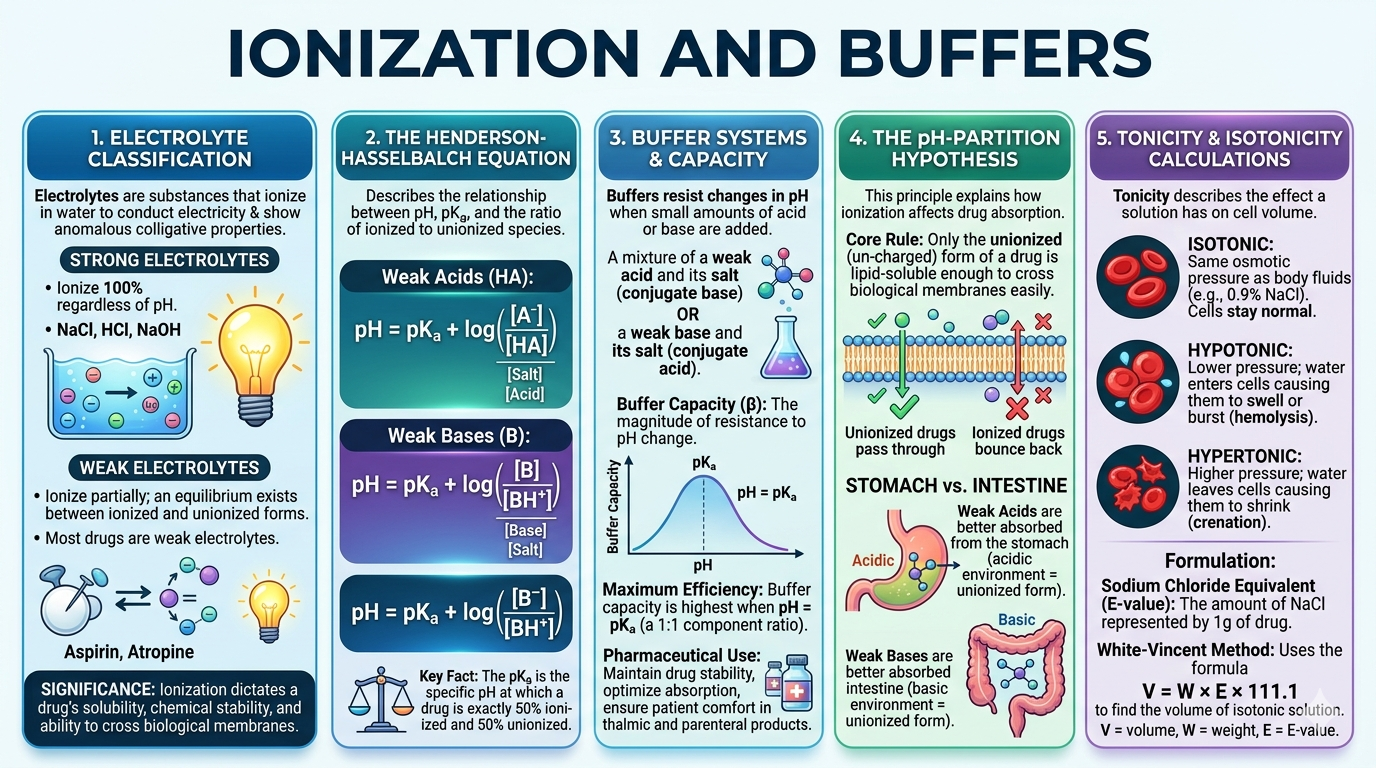
pH, pKa, Henderson‑Hasselbalch equation, buffer capacity, and the impact of ionization on drug absorption and stability.
Prepared by the PharmaWallah student team. Verify results with your textbook or instructor. Report an error · Editorial policy
Unit 5: Ionization and Buffers
Strong vs. Weak Electrolytes
Definition and Classification of Electrolytes
An electrolyte is a substance (an acid, a base, or a salt) that in an aqueous solution ionizes to form positive ions (cations) and negative ions (anions) . For example, sodium chloride (NaCl) in aqueous solution forms Na⁺ (a cation) and Cl⁻ (an anion), creating two independent entities per molecule .
Electrolytes exhibit three important properties that differentiate them from nonelectrolytes :
- They exhibit anomalous colligative properties compared with nonelectrolytes
- They can conduct an electrical current
- They tend to show rapid chemical reactions compared with nonelectrolyte solutions
Nonelectrolytes are substances that do not ionize in water at all and therefore do not conduct an electric current in solution. Examples include sucrose, fructose, urea, and glycerol .
Strong Electrolytes
Definition: Strong electrolytes are substances that are completely ionized in water . Their degree of ionization is pH-independent and essentially 100% under normal conditions.
Characteristics:
- Complete dissociation in aqueous solution
- High electrical conductivity
- Maximum colligative property effects (van't Hoff factor i equals number of ions)
- No equilibrium between ionized and unionized forms
Examples of Strong Electrolytes:
| Category | Examples |
|---|---|
| Strong acids | Hydrochloric acid (HCl), sulfuric acid (H₂SO₄), nitric acid (HNO₃) |
| Strong bases | Sodium hydroxide (NaOH), potassium hydroxide (KOH) |
| Salts | Sodium chloride (NaCl), potassium chloride (KCl), most soluble salts |
Weak Electrolytes
Definition: Weak electrolytes ionize only partly in water . Most drugs are weak electrolytes, including atropine, phenobarbital, and sulfadiazine .
Characteristics:
- Partial dissociation (typically <50%)
- Existence of equilibrium between ionized and unionized forms
- Degree of ionization depends on pH of the environment
- Lower electrical conductivity than strong electrolytes
- van't Hoff factor i less than theoretical maximum
Examples of Weak Electrolytes:
| Category | Examples |
|---|---|
| Weak acids | Acetic acid, benzoic acid, phenobarbital, aspirin |
| Weak bases | Ammonia, atropine, ephedrine, most alkaloids |
| Some salts | Mercuric chloride, lead acetate |
Pharmaceutical Significance of Electrolyte Classification
The distinction between strong and weak electrolytes is critically important in pharmacy because :
-
Drug Absorption: Many drugs are organic weak electrolytes. Their degree of ionization is an important physicochemical property with extensive physiologic implications . Depending on the pH of the environment, weak electrolytes can exist in either ionized or unionized forms, which dramatically affects their ability to cross biological membranes.
-
Formulation Development: The ionization behavior determines appropriate pH adjustments, buffer selection, and salt form decisions.
-
Stability Considerations: Ionized and unionized forms may have different chemical stability profiles.
-
Solubility: Weak electrolytes show pH-dependent solubility, which can be exploited in formulation design.
pH, pKa, and Buffer Systems
The pH Scale
pH is defined as the negative logarithm (base 10) of the hydrogen ion concentration:
pH = -log [H⁺]
The pH scale typically ranges from 0 to 14:
- pH < 7: Acidic solution
- pH = 7: Neutral solution
- pH > 7: Alkaline (basic) solution
Ionization Constants (Ka and pKa)
Acid Ionization Constant (Ka): For a weak acid (HA) that ionizes as: HA ⇌ H⁺ + A⁻
The equilibrium constant is: Ka = [H⁺][A⁻] / [HA]
Base Ionization Constant (Kb): For a weak base (B) that ionizes as: B + H₂O ⇌ BH⁺ + OH⁻
The equilibrium constant is: Kb = [BH⁺][OH⁻] / [B]
pKa and pKb: pKa = -log Ka pKb = -log Kb
The pKa value indicates the pH at which a drug is 50% ionized and 50% unionized.
Relationship Between pKa, pKb, and pKw
For a conjugate acid-base pair: pKa + pKb = pKw = 14 (at 25°C)
Where pKw is the negative logarithm of the ion product of water (1.0 × 10⁻¹⁴ at 25°C).
Factors Affecting pKa
| Factor | Effect |
|---|---|
| Molecular structure | Electron-withdrawing groups decrease pKa of acids; electron-donating groups increase pKa |
| Temperature | pKa values change slightly with temperature |
| Ionic strength | High ionic strength can affect ionization constants |
| Solvent composition | Organic solvents alter pKa compared to water |
Buffer Systems
Definition: A buffer solution resists changes in pH when small amounts of acid or base are added or when dilution occurs .
Components of a Buffer: A buffer consists of a mixture of :
- A weak acid and its conjugate base (salt of the weak acid), OR
- A weak base and its conjugate acid (salt of the weak base)
Mechanism of Buffer Action:
When acid (H⁺) is added to a buffer containing weak acid (HA) and its conjugate base (A⁻):
- The added H⁺ combines with A⁻ to form HA
- The pH change is minimized because H⁺ is removed from solution
When base (OH⁻) is added:
- The added OH⁻ reacts with HA to form A⁻ and H₂O
- The pH change is minimized because OH⁻ is consumed
Pharmaceutical Applications of Buffers :
- Most pharmaceutical solutions are pH-controlled using an appropriate buffer system
- Buffers maintain drug stability by preventing pH-induced degradation
- Buffers ensure patient comfort (e.g., ophthalmic solutions must have appropriate pH)
- Buffers optimize drug absorption by maintaining the drug in its absorbable form
Henderson-Hasselbalch Equation
Derivation of the Equation
The Henderson-Hasselbalch equation is derived from the acid dissociation constant expression .
Starting with: Ka = [H⁺][A⁻] / [HA]
Rearranging: [H⁺] = Ka × [HA] / [A⁻]
Taking negative logarithms: -log [H⁺] = -log Ka - log ([HA]/[A⁻])
Therefore: pH = pKa + log ([A⁻]/[HA])
For a weak base: pH = pKa + log ([B]/[BH⁺])
Where pKa in this case refers to the pKa of the conjugate acid (BH⁺).
The Equation Forms
| System | Henderson-Hasselbalch Equation |
|---|---|
| Weak acid and its salt | pH = pKa + log ([salt]/[acid]) |
| Weak base and its salt | pH = pKa + log ([base]/[salt]) |
| For any buffer | pH = pKa + log ([conjugate base]/[weak acid]) |
Applications in Drug Formulation
1. Calculating Percent Ionization
For weak acids: % ionized = 100 / [1 + 10^(pKa - pH)] For weak bases: % ionized = 100 / [1 + 10^(pH - pKa)]
2. Determining the Ratio of Ionized to Unionized Forms
Rearranging the Henderson-Hasselbalch equation:
For weak acids: [A⁻]/[HA] = 10^(pH - pKa) For weak bases: [B]/[BH⁺] = 10^(pH - pKa)
3. pH Partition Hypothesis
The pH-partition hypothesis states that :
- The unionized form of a drug is preferentially absorbed across biological membranes
- The absorption rate depends on the fraction of unionized drug at the absorption site
- The lipid-water partition coefficient of the unionized form determines its membrane permeability
Physiologic Implications :
- Weak acids are better absorbed from acidic environments (stomach) where they are unionized
- Weak bases are better absorbed from basic environments (intestine) where they are unionized
- This principle applies to drug absorption, transport, and excretion
4. Formulating Buffer Solutions
To prepare a buffer with a specific pH:
- Select a weak acid with pKa close to desired pH (ideally within ±1 pH unit)
- Calculate required salt/acid ratio using Henderson-Hasselbalch equation
- Weigh appropriate amounts of weak acid and its salt
Example Calculation: To prepare an acetic acid buffer at pH 5.0 (pKa of acetic acid = 4.76):
log ([salt]/[acid]) = pH - pKa = 5.0 - 4.76 = 0.24 [salt]/[acid] = 10^0.24 = 1.74
Thus, the ratio of sodium acetate to acetic acid should be 1.74:1.
Limitations of the Henderson-Hasselbalch Equation
- Assumes ideal behavior (activity coefficients = 1)
- Most accurate for dilute solutions
- Does not account for ionic strength effects
- Limited accuracy at extremes of pH or concentration
- Does not consider temperature effects on pKa
Buffer Capacity
Definition
Buffer capacity (β) is defined as the magnitude of the resistance of a buffer to pH changes . Quantitatively, it is the ratio of the increment of strong acid (or base) added to the change in pH produced:
β = dC / dpH
Where:
- β = buffer capacity
- dC = small increment of acid or base added (in equivalents per liter)
- dpH = corresponding small change in pH
Factors Affecting Buffer Capacity
| Factor | Effect on Buffer Capacity |
|---|---|
| Concentration | Higher concentration = greater buffer capacity |
| Ratio of components | Maximum when [salt] = [acid] (ratio = 1:1) |
| pKa relative to pH | Maximum within ±1 pH unit of pKa |
| Temperature | Minor effect through pKa changes |
| Ionic strength | May affect activity coefficients |
Buffer Capacity Range
A buffer is most effective when the pH is within ±1 unit of the pKa of the weak acid . Outside this range, buffer capacity decreases significantly.
Relative Buffer Capacity at Different Ratios:
| [Salt]/[Acid] Ratio | pH relative to pKa | Relative Buffer Capacity |
|---|---|---|
| 10:1 | pKa + 1 | 0.48 |
| 5:1 | pKa + 0.7 | 0.65 |
| 2:1 | pKa + 0.3 | 0.90 |
| 1:1 | pKa | 1.00 (maximum) |
| 1:2 | pKa - 0.3 | 0.90 |
| 1:5 | pKa - 0.7 | 0.65 |
| 1:10 | pKa - 1 | 0.48 |
Pharmaceutical Significance of Buffer Capacity
Recent research has demonstrated the critical importance of buffer capacity in physiological systems. A study investigating drug precipitation in physiological bicarbonate buffer solutions (BCB) found that :
-
pH and buffer capacity affect drug precipitation: As buffer capacity (β) was increased, drug precipitation in BCB became faster
-
Physiological range: In the small intestines, β values range from 2.2 to 17.6 mM/ΔpH
-
Surface pH effects: At pH values where a drug is ionizable, the surface pH of precipitating particles can differ from bulk pH due to slow hydration process of CO₂
-
Buffer selection matters: Drug precipitation in phosphate buffer was faster than in bicarbonate buffer and less affected by pH and buffer capacity
These findings emphasize that buffer capacity is not just a theoretical concept but has direct implications for drug performance in physiological environments.
Hypo, Hyper, and Isotonic Solutions
Fundamental Concepts
Tonicity refers to the effect a solution has on cell volume when cells are immersed in the solution. It is determined by the concentration of non-penetrating solutes that cannot cross the cell membrane.
Osmotic Pressure: The pressure required to prevent the flow of solvent across a semipermeable membrane. The osmotic pressure relationship between solutions and biological fluids determines the isotonic nature of pharmaceutical preparations .
Osmolarity vs. Tonicity:
- Osmolarity: Total solute concentration expressed as osmoles per liter of solution (theoretical)
- Tonicity: Effective osmotic pressure exerted by non-penetrating solutes (practical)
Classification of Solutions Based on Tonicity
| Solution Type | Definition | Effect on Cells |
|---|---|---|
| Isotonic | Same effective osmotic pressure as body fluids | No net movement of water; cells maintain normal shape |
| Hypotonic | Lower effective osmotic pressure than body fluids | Water enters cells; cells swell and may lyse (hemolysis) |
| Hypertonic | Higher effective osmotic pressure than body fluids | Water leaves cells; cells shrink (crenation) |
Isotonic Solutions
Definition: Isotonic solutions have the same osmotic pressure as body fluids, particularly blood plasma and tears . When administered, they cause no net movement of water across cell membranes.
Reference Values:
- Blood plasma has osmotic pressure corresponding to 0.9% NaCl solution
- 0.9% NaCl is isotonic with blood and tissue fluids
- 5% dextrose solution is also isotonic (dextrose is metabolized, leaving hypotonic solution)
Common Isotonic Pharmaceutical Solutions :
| Solution | Composition | Characteristics |
|---|---|---|
| 0.9% Sodium Chloride (Normal Saline) | NaCl 9 g/L | Acidifying solution; high chloride content (154 mEq/L) |
| Lactated Ringer's Solution (LRS) | Na⁺ 130, K⁺ 4, Ca²⁺ 3, Cl⁻ 109, lactate 28 mEq/L | Alkalinizing; uses lactate as bicarbonate precursor |
| Normosol-R / Plasmalyte 148 | Contains acetate and gluconate as buffers | Alkalinizing; contains magnesium |
| 5% Dextrose in Water (D5W) | Dextrose 50 g/L | Initially isotonic; dextrose metabolized leaving free water |
Clinical Applications of Isotonic Solutions :
- Fluid resuscitation in shock
- Rehydration therapy
- Replacement of isotonic fluid losses
- Vehicle for drug administration
Hypotonic Solutions
Definition: Hypotonic solutions have lower osmotic pressure than body fluids .
Examples :
- 0.45% Sodium Chloride (half-strength saline)
- 0.45% Sodium Chloride with 2.5% Dextrose
- Normosol-M
- D5W (after dextrose metabolism)
Characteristics :
- Rapidly distribute within total body water
- Leave very little in intravascular space
- Used for replacing free water loss (hypernatremia)
- Used for maintenance fluid therapy
Contraindications :
- Should never be used for fluid resuscitation from shock
- Do not provide meaningful expansion of intravascular volume
Hypertonic Solutions
Definition: Hypertonic solutions have higher osmotic pressure than body fluids .
Examples:
- 3% Sodium Chloride
- 7% Sodium Chloride (Hypertonic Saline)
- 23% Sodium Chloride (MUST be diluted before use)
- Solutions with high dextrose concentrations (>5%)
Characteristics of Hypertonic Saline (7% NaCl) :
- Used for rapid expansion of intravascular volume
- Pulls fluid primarily from interstitial compartment
- Small volumes required to increase intravascular volume quickly
- Volume expansion is short-lived as sodium redistributes
- Anti-inflammatory effects documented
Clinical Applications :
- Treatment of head trauma patients
- Shock resuscitation
- Should be administered no faster than 1 mL/kg/min (risk of vagally mediated bradycardia)
Pharmaceutical Applications of Tonicity Control
1. Parenteral Formulations
- Must be isotonic to prevent pain at injection site
- Prevent hemolysis of red blood cells
- Ensure patient safety during IV administration
2. Ophthalmic Preparations
- Must be isotonic with tear fluid (equivalent to 0.9% NaCl)
- Prevent ocular tissue damage and discomfort
- Maintain corneal integrity
3. Nasal Preparations
- Isotonic solutions prevent ciliary damage
- Maintain normal mucociliary clearance
4. Parenteral Nutrition
- Tonicity must be considered for peripheral vs. central administration
- Hypertonic solutions require central venous access
Calculation Methods for Isotonic Solutions
Method 1: Sodium Chloride Equivalent Method
The sodium chloride equivalent (E-value) is the amount of sodium chloride that produces the same osmotic effect as 1 gram of the drug.
E-value = (Molecular weight of NaCl × i factor of drug) / (Molecular weight of drug × i factor of NaCl)
Where i is the van't Hoff factor (approximately 1.86 for NaCl, 1.0 for nonelectrolytes).
Steps:
- Calculate the NaCl equivalent of all ingredients
- Add these values to find total NaCl represented
- Subtract from 0.9 g (NaCl required for 100 mL isotonic solution)
- Add the difference as NaCl or other adjusting substance
Method 2: Freezing Point Depression Method
Solutions isotonic with blood and tears have freezing point depression of -0.52°C.
The amount of adjusting substance needed = (0.52 - a) / b
Where:
- a = freezing point depression of the drug solution
- b = freezing point depression of 1% adjusting substance
Method 3: White-Vincent Method
This method uses the volume of isotonic solution that can be prepared from a given amount of drug.
V = W × E × 111.1
Where:
- V = volume of isotonic solution that can be prepared (mL)
- W = weight of drug (g)
- E = sodium chloride equivalent
- 111.1 = volume of isotonic solution prepared by 1 g NaCl
Summary Tables
Table 1: Strong vs. Weak Electrolytes
| Property | Strong Electrolytes | Weak Electrolytes |
|---|---|---|
| Degree of ionization | Complete (100%) | Partial (equilibrium) |
| pH dependence | Independent | Dependent |
| Conductivity | High | Low |
| van't Hoff factor (i) | Full (2 for NaCl) | Less than theoretical |
| Examples | HCl, NaOH, NaCl | Acetic acid, atropine, phenobarbital |
| Pharmaceutical relevance | Buffers, tonicity adjusters | Most drugs |
Table 2: Henderson-Hasselbalch Equation Applications
| Application | Formula | Purpose |
|---|---|---|
| % Ionization (weak acid) | % = 100/[1+10^(pKa-pH)] | Predict absorption site |
| % Ionization (weak base) | % = 100/[1+10^(pH-pKa)] | Predict absorption site |
| Salt/acid ratio | log([salt]/[acid]) = pH - pKa | Buffer preparation |
| pH from ratio | pH = pKa + log([salt]/[acid]) | Buffer characterization |
Table 3: Buffer Capacity Characteristics
| Factor | Effect | Optimum Condition |
|---|---|---|
| pH relative to pKa | Maximum at pKa | pH = pKa ± 1 |
| Concentration | Directly proportional | Higher concentration |
| Component ratio | Maximum at 1:1 | [salt] = [acid] |
| Temperature | Minor effect via pKa | Controlled conditions |
Table 4: Tonicity Classification and Applications
| Tonicity | Osmotic Pressure | Effect on Cells | Pharmaceutical Examples | Clinical Use |
|---|---|---|---|---|
| Isotonic | Equal to plasma | No change | 0.9% NaCl, LRS, D5W | IV fluids, eye drops |
| Hypotonic | Lower than plasma | Cell swelling, hemolysis | 0.45% NaCl, D5W (after metabolism) | Hypernatremia, maintenance |
| Hypertonic | Higher than plasma | Cell shrinkage, crenation | 3% NaCl, 7% NaCl | Head trauma, shock resuscitation |
Table 5: Common IV Fluids and Their Tonicity
| Fluid | Tonicity | Comments |
|---|---|---|
| 0.9% Sodium Chloride | Isotonic | Acidifying; fluid of choice for Addisonian crisis |
| Lactated Ringer's Solution | Isotonic | Alkalinizing; contraindicated with blood products |
| Normosol-R / Plasmalyte 148 | Isotonic | Alkalinizing; contains acetate and gluconate |
| 5% Dextrose in Water | Isotonic (initially) | Becomes hypotonic after dextrose metabolism |
| 0.45% Sodium Chloride | Hypotonic | Maintenance fluids; free water replacement |
| 7% Sodium Chloride | Hypertonic | Rapid volume expansion; short duration |
References
-
Sinko, P. J., & Singh, Y. (2020). Martin's Physical Pharmacy and Pharmaceutical Sciences: Physical Chemical and Biopharmaceutical Principles in the Pharmaceutical Sciences (8th ed.). Wolters Kluwer.
-
Florence, A. T., & Attwood, D. (2016). Physicochemical Principles of Pharmacy: In Manufacture, Formulation and Clinical Use (6th ed.). Pharmaceutical Press.
-
Aulton, M. E., & Taylor, K. M. G. (2017). Aulton's Pharmaceutics: The Design and Manufacture of Medicines (5th ed.). Elsevier.
-
Rawlins, E. A. (2007). Bentley's Textbook of Pharmaceutics (8th ed.). Elsevier Health Sciences.
-
Gennaro, A. R. (Ed.). (2020). Remington: The Science and Practice of Pharmacy (23rd ed.). Academic Press.
-
Sandmann, B. J., Dash, A. K., Al-Achi, A., & Greenwood, R. (2023). Ionic Equilibria and Buffers. In AccessPharmacy. McGraw-Hill Medical.
-
Yamamoto, H., & Sugano, K. (2025). Effect of pH and Buffer Capacity of Physiological Bicarbonate Buffer on Precipitation of Drugs. Molecular Pharmaceutics. https://doi.org/10.1021/acs.molpharmaceut.4c00996
-
Raxmatillayeva, I., Oltiyeva, S., & Masharipov, D. (2025). Isotonic Solutions: Concepts and Calculation Methods. Zenodo. https://doi.org/10.5281/zenodo.15619035
-
Mahato, R. I., & Narang, A. S. (2018). Pharmaceutical solutions. In Pharmaceutical Dosage Forms and Drug Delivery. Taylor & Francis.
-
Mahato, R. I., Narang, A. S., & Kumar, V. (2024). Pharmaceutical Considerations. In Pharmaceutical Dosage Forms and Drug Delivery (4th ed.). Taylor & Francis.
-
Plumb, D. C. (2011). A refresher on IV fluid therapy. DVM360.
Recommended Textbooks for Further Reading:
- Sinko, P. J. (2023). Martin's Physical Pharmacy and Pharmaceutical Sciences. Wolters Kluwer Health. (Chapters on Ionic Equilibria and Buffers)
- Taylor, K., & Aulton, M. E. (2021). Aulton's Pharmaceutics: The Design and Manufacture of Medicines. Elsevier. (Chapters on Pharmaceutical Solutions and Tonicity)
- Adejare, A. (2020). Remington: The Science and Practice of Pharmacy. Academic Press. (Sections on Pharmaceutical Calculations and Sterile Products)
End of unit 5 of 6
Check what you've learned
5 quick questions from this unit. They're optional: try them if you like, then mark the unit as read and move on.