

Unit 4: Physico‑Chemical Principles
Solubility, partition coefficient, surface tension, viscosity, rheology, and their influence on drug formulation and delivery.
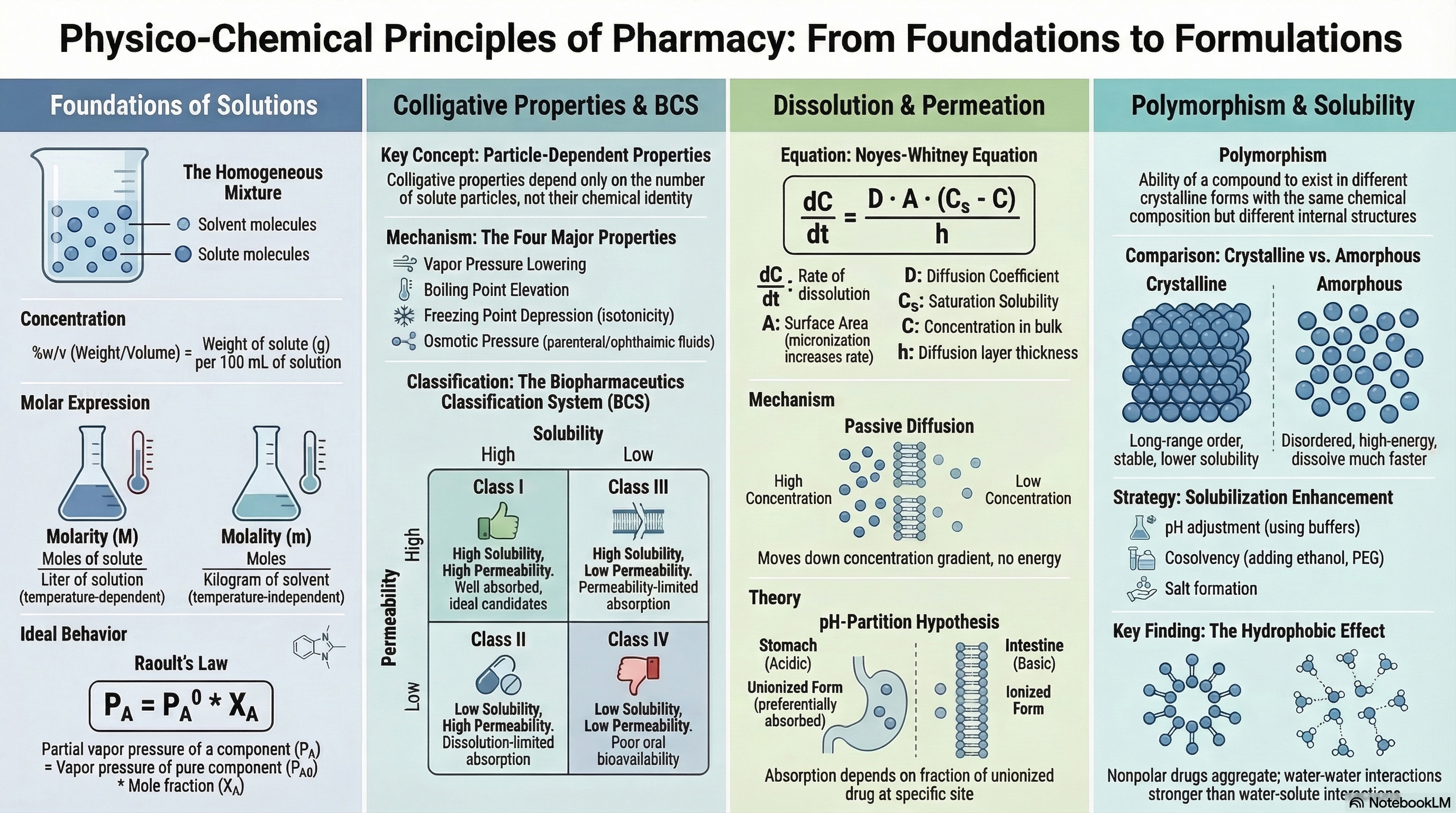
Prepared by the PharmaWallah student team. Verify results with your textbook or instructor. Report an error · Editorial policy
Unit 4: Physico-Chemical Principles
Solutions
Definition and Fundamental Concepts
A solution is defined as a chemically and physically homogeneous mixture of two or more substances . The term homogeneous implies that the mixture is uniform, meaning all parts are identical and when subjected to routine chemical and physical analysis, they test the same.
Components of Solutions
- Solute: The component that is dissolved (present in smaller amount)
- Solvent: The component that does the dissolving (present in larger amount)
- Binary solution: A mixture containing only two components
Classification of Solutions by Physical States
| Solute | Solvent | Example |
|---|---|---|
| Gas | Gas | Air |
| Liquid | Gas | Fog |
| Solid | Gas | Iodine vapor in air |
| Gas | Liquid | Carbonated water |
| Liquid | Liquid | Alcohol in water |
| Solid | Liquid | Aqueous sodium chloride solution |
| Gas | Solid | Hydrogen in palladium |
| Liquid | Solid | Mineral oil in paraffin |
| Solid | Solid | Gold-silver mixture, mixtures of alums |
Classification of Pharmaceutical Solutions by Route of Administration
| Classification | Characteristics |
|---|---|
| Oral solutions (elixir, syrup) | Taken by mouth; contain inactives for flavor, viscosity; water is usual solvent |
| Topical solutions | Applied to skin or mucous membranes; aqueous or alcoholic |
| Otic solutions (aural) | For the ear; usually non-aqueous (glycerin, propylene glycol, polyethylene glycol) |
| Ophthalmic solutions | For eye use; contain inactives for viscosity, tonicity, preservation; sterile, isotonic, particulate-free |
| Parenteral solutions | For injection (IV, IM, or SQ); minimal inactives; sterile, pyrogen-free, particulate-free |
Advantages of Solutions as Dosage Forms
- Faster onset of activity compared to solid dosage forms
- Suitable for children and elderly patients with swallowing difficulties
- Homogeneous and always uniform
- Flexible dosing adjustments
- Uniform distribution of drug
Concentration Expressions
Percentage Expressions
| Type | Definition | Formula |
|---|---|---|
| % w/w | Weight of solute per 100 g of solution | (g solute / g solution) × 100 |
| % w/v | Weight of solute per 100 mL of solution | (g solute / mL solution) × 100 |
| % v/v | Volume of solute per 100 mL of solution | (mL solute / mL solution) × 100 |
Molar Expressions
| Expression | Symbol | Definition | Formula |
|---|---|---|---|
| Molarity | M | Moles of solute per liter of solution | mol/L |
| Molality | m | Moles of solute per kilogram of solvent | mol/kg |
| Normality | N | Equivalents of solute per liter of solution | eq/L |
| Mole fraction | X | Ratio of moles of one component to total moles | n₁/(n₁ + n₂ + ...) |
| Molarity is temperature-dependent due to volume expansion/contraction; molality is temperature-independent |
Parts Expressions
- Parts per million (ppm): mg solute / kg solution or mg/L for dilute aqueous solutions
- Parts per billion (ppb): μg solute / kg solution
Conversion Between Concentration Units
Converting between different concentration expressions requires knowledge of:
- Density of solution
- Molecular weight of solute
- Relationship between mass and volume
Ideal and Real Solutions
Ideal Solutions
An ideal solution is one that obeys Raoult's law throughout the entire concentration range. In ideal solutions:
- The intermolecular forces between solute-solute (A-A), solvent-solvent (B-B), and solute-solvent (A-B) are identical
- No volume change occurs upon mixing (ΔV_mix = 0)
- No enthalpy change occurs upon mixing (ΔH_mix = 0)
- The vapor pressure follows Raoult's law: P = P⁰ × X
where P is partial vapor pressure of component, P⁰ is vapor pressure of pure component, and X is mole fraction.
Raoult's Law For a solution containing volatile components, the partial vapor pressure of each component is equal to the vapor pressure of the pure component multiplied by its mole fraction in the solution:
P_A = P_A⁰ × X_A P_B = P_B⁰ × X_B
Total vapor pressure P_total = P_A + P_B = P_A⁰ X_A + P_B⁰ X_B
Real Solutions
Real solutions deviate from Raoult's law due to differences in intermolecular forces:
| Type of Deviation | Intermolecular Forces | Characteristics |
|---|---|---|
| Positive deviation | A-B forces weaker than A-A and B-B | Higher vapor pressure than ideal; endothermic mixing; volume expansion |
| Negative deviation | A-B forces stronger than A-A and B-B | Lower vapor pressure than ideal; exothermic mixing; volume contraction |
Henry's Law For dilute real solutions, the partial pressure of a volatile solute is proportional to its mole fraction:
P = K_H × X
where K_H is Henry's law constant (specific for each solute-solvent system). Henry's law applies to the solute in dilute solutions, while Raoult's law applies to the solvent.
Colligative Properties
Definition
Colligative properties are properties of solutions that depend only on the number of solute particles (concentration) and not on the nature or chemical identity of the solute. These properties arise from the lowering of solvent chemical potential by the presence of solute.
The Four Colligative Properties
| Property | Definition | Mathematical Expression |
|---|---|---|
| Vapor pressure lowering | Reduction in solvent vapor pressure above solution compared to pure solvent | ΔP = P⁰ - P = P⁰ × X_solute |
| Boiling point elevation | Increase in boiling point of solution compared to pure solvent | ΔT_b = K_b × m |
| Freezing point depression | Decrease in freezing point of solution compared to pure solvent | ΔT_f = K_f × m |
| Osmotic pressure | Pressure required to prevent solvent flow across semipermeable membrane | π = i × M × R × T |
where:
- X_solute = mole fraction of solute
- K_b = molal boiling point elevation constant (characteristic of solvent)
- K_f = molal freezing point depression constant (characteristic of solvent)
- m = molality of solution
- i = van't Hoff factor (accounts for dissociation/association)
- M = molarity
- R = gas constant (0.0821 L·atm/mol·K)
- T = absolute temperature (K)
van't Hoff Factor (i)
The van't Hoff factor accounts for the number of particles produced per formula unit of solute:
| Solute Type | Example | Expected i | Observed i (Reason) |
|---|---|---|---|
| Nonelectrolyte | Glucose, sucrose | 1 | 1 |
| Strong electrolyte (1:1) | NaCl, KCl | 2 | ~1.9 (ion pairing) |
| Strong electrolyte (2:1) | CaCl₂, MgCl₂ | 3 | ~2.7 (ion pairing) |
| Weak electrolyte | Acetic acid | 1-2 (partial) | Concentration dependent |
Applications of Colligative Properties in Pharmacy
| Application | Colligative Property Used | Purpose |
|---|---|---|
| Isotonic solutions | Freezing point depression, osmotic pressure | Prepare solutions compatible with body fluids |
| Molecular weight determination | Any colligative property | Determine molecular weight of polymers, proteins |
| Parenteral formulations | Osmotic pressure | Ensure compatibility with blood |
| Ophthalmic preparations | Osmotic pressure | Prevent ocular tissue damage |
| Freeze-drying (lyophilization) | Freezing point depression | Optimize freezing cycle |
Solubility and Solubilization
Definition and Concepts
Solubility Defined
Solubility is the maximum amount of solute that can dissolve in a given amount of solvent at a specified temperature, forming a homogeneous mixture . Equilibrium solubility is the point at which the dissolution rate equals the precipitation rate, representing the maximum amount of substance that can be dissolved in a stable equilibrium .
Quantitative Solubility Classification (USP/BP)
| Descriptive Term | Parts of Solvent Required per Part of Solute |
|---|---|
| Very soluble | Less than 1 part |
| Freely soluble | 1 to 10 parts |
| Soluble | 10 to 30 parts |
| Sparingly soluble | 30 to 100 parts |
| Slightly soluble | 100 to 1000 parts |
| Very slightly soluble | 1000 to 10,000 parts |
| Practically insoluble | 10,000 parts or more |
Biopharmaceutics Classification System (BCS)
The BCS categorizes APIs based on solubility and permeability to predict in vivo performance :
| BCS Class | Solubility | Permeability | Characteristics |
|---|---|---|---|
| Class I | High | High | Well absorbed; ideal drug candidates |
| Class II | Low | High | Dissolution rate-limited absorption |
| Class III | High | Low | Permeability-limited absorption |
| Class IV | Low | Low | Poor oral bioavailability; challenging development |
Approximately 30-40% of marketed drugs and 70-90% of drugs in development are poorly soluble (BCS Class II and IV) .
Developability Classification System (DCS)
The DCS further differentiates Class II drugs :
- DCS Class IIa (dissolution rate-limited): Dissolution rate too slow for API to dissolve during transit through small intestine
- DCS Class IIb (solubility-limited): Solubility too low for required amount to dissolve in available GI fluid volume
Mechanism of Solubilization
The Solubilization Process
Solubilization involves three distinct steps :
- Separation: A solute molecule must be separated from the solid state by breaking solute-solute bonds (requires energy input)
- Gap creation: A cavity or gap must be created within the solvent to accommodate the solute molecule
- Incorporation: The solute molecule must be incorporated into the solvent through solute-solvent interactions
Thermodynamics of Solubilization
The solubilization of a crystalline organic compound in an aqueous medium involves two distinct thermodynamic steps :
- Crystal lattice breaking: Breaking the crystal lattice into free molecules (endothermic, requires energy)
- Solvation: Solvating these free molecules by the aqueous medium (exothermic, releases energy)
This can be quantitatively represented as: log X = log X_ideal - log γ
where:
- X = observed (mole fraction) solubility
- X_ideal = ideal solubility (determined by crystal lattice energy, same regardless of solvent)
- γ = activity coefficient of solute in the solvent medium (reflects deviation from ideality)
The Hydrophobic Effect
Aqueous solutions of organic compounds are highly nonideal because water-water interactions are much stronger than solute-solute or solute-water interactions . The tendency of nonpolar groups to aggregate in aqueous media (the "hydrophobic effect") primarily results from the strong attractive forces between water molecules rather than those between nonpolar solutes.
- Each water molecule can form up to four hydrogen bonds with neighboring molecules
- To solubilize a solute, the hydrogen bond network must be disrupted or distorted
- Ionic/polar solutes form strong ion-dipole interactions that compensate for this disruption
- Nonpolar solutes form weak interactions insufficient to compensate, making them difficult to solubilize
Factors Affecting Solubility
1. Nature of Solute and Solvent: "Like Dissolves Like"
| Solute Polarity | Suitable Solvent | Examples |
|---|---|---|
| Polar/ionic | Polar solvents | Water, glycerin, propylene glycol |
| Nonpolar | Nonpolar solvents | Oils, hexane, chloroform |
| Semipolar | Intermediate solvents | Alcohols, acetone |
2. Temperature
| Type of Dissolution Process | Effect of Temperature Increase |
|---|---|
| Endothermic (most solids in liquids) | Solubility increases |
| Exothermic (some gases in liquids) | Solubility decreases |
3. Pressure
- Significant effect only on gases in liquids
- Henry's law: C = k × P (solubility proportional to partial pressure)
- Minimal effect on solids and liquids
4. pH and pKa (for ionizable drugs)
The pH of the medium affects the ionization state of weak acids and bases, dramatically influencing solubility.
For weak acids: % ionized = 100 / [1 + 10^(pKa - pH)] For weak bases: % ionized = 100 / [1 + 10^(pH - pKa)]
5. Particle Size
For particles < 1 μm, solubility increases with decreasing particle size according to the Ostwald-Freundlich equation:
log (S/S₀) = (2γV) / (2.303 RT r)
where:
- S = solubility of small particles
- S₀ = solubility of large particles
- γ = interfacial tension
- V = molar volume
- r = particle radius
6. Polymorphism
Different polymorphic forms of the same drug exhibit different solubilities. The most stable polymorph (lowest free energy) has the lowest solubility .
7. Complexation
Formation of soluble complexes can increase apparent solubility:
- Cyclodextrin inclusion complexes
- Metal-ion complexes
- Molecular complexes
8. Cosolvents
Addition of water-miscible solvents (ethanol, propylene glycol, glycerin, PEG) can significantly increase solubility of poorly water-soluble drugs.
Solubilization Techniques
Strategies for Enhancing Solubility
| Strategy | Method | Application |
|---|---|---|
| pH adjustment | Use buffers to maintain drug in ionized form | Weak acids and bases |
| Cosolvency | Add water-miscible organic solvents | Nonpolar drugs |
| Surfactant addition | Use micellar solubilization | Hydrophobic drugs |
| Complexation | Cyclodextrins, complexing agents | Poorly soluble drugs |
| Particle size reduction | Micronization, nanonization | Dissolution rate-limited drugs |
| Polymorph selection | Use metastable polymorphs | Drugs with polymorphic forms |
| Amorphous forms | Convert crystalline to amorphous | Poorly soluble drugs |
| Solid dispersions | Disperse drug in hydrophilic carrier | BCS Class II drugs |
| Prodrug approach | Introduce ionizable groups | Drugs with suitable functional groups |
| Salt formation | Prepare soluble salts | Weak acids and bases |
Solid Dispersions
Solid dispersions consist of a hydrophobic drug dispersed in a hydrophilic carrier matrix. Recent advances include biodendrimeric solid dispersions (BDSD) using modified dendrimer-like biopolymers that create a favorable nonpolar microenvironment for solubilization .
Dissolution and Permeation
Dissolution: Definition and Concepts
Definition
Dissolution is the process by which a solid solute enters into solution. For pharmaceutical dosage forms, dissolution refers to the rate and extent at which the active pharmaceutical ingredient (API) dissolves in the dissolution medium under specified conditions.
Significance of Dissolution
- Critical for drug absorption and bioavailability
- Quality control parameter for solid dosage forms
- Predictor of in vivo performance (with established IVIVC)
- Tool for formulation development and optimization
Noyes-Whitney Equation
The Fundamental Equation
The Noyes-Whitney equation (1897) describes the rate of dissolution of a solid in a liquid:
dC/dt = k × (C_s - C)
where:
- dC/dt = dissolution rate (rate of change of concentration in solution)
- k = dissolution rate constant
- C_s = saturation solubility of the drug (concentration at the solid surface)
- C = concentration of drug in the bulk solution at time t
- (C_s - C) = concentration gradient
Modified Noyes-Whitney Equation (Nernst-Brunner)
The equation was later modified to incorporate diffusion layer theory:
dC/dt = (D × A × (C_s - C)) / (h × V)
where:
- D = diffusion coefficient of the drug
- A = surface area of the dissolving solid
- h = thickness of the diffusion layer (unstirred boundary layer)
- V = volume of the dissolution medium
Key Parameters Affecting Dissolution Rate
| Parameter | Effect on Dissolution Rate | Pharmaceutical Application |
|---|---|---|
| Surface area (A) | Directly proportional | Micronization, nanonization |
| Diffusion coefficient (D) | Directly proportional | Temperature, viscosity control |
| Concentration gradient (C_s - C) | Directly proportional | Sink conditions |
| Diffusion layer thickness (h) | Inversely proportional | Agitation, hydrodynamics |
| Solubility (C_s) | Directly proportional | Formulation strategies |
Sink Conditions
Sink conditions exist when the drug concentration in the bulk solution (C) is maintained at less than 10-20% of saturation solubility (C_s). Under sink conditions, C_s - C ≈ C_s, and the dissolution rate becomes essentially constant:
dC/dt = (D × A × C_s) / (h × V)
Model-Free Noyes-Whitney Integral Equation
Recent advances have proposed a model-free Noyes-Whitney integral equation to characterize dissolution profiles without assuming specific models . This approach allows for the analysis of complicated heterogeneous dissolution processes, particularly when disintegration occurs simultaneously with dissolution.
Factors Affecting Dissolution
1. Physicochemical Factors Related to the Drug
| Factor | Effect |
|---|---|
| Solubility | Higher solubility increases dissolution rate |
| Particle size | Smaller particles increase surface area |
| Polymorphic form | Different polymorphs have different solubilities |
| Amorphous vs. crystalline | Amorphous forms dissolve faster |
| Salt form | Salts generally dissolve faster than free acid/base |
| Wettability | Poor wetting reduces effective surface area |
2. Formulation Factors
| Factor | Effect |
|---|---|
| Excipients | Hydrophilic excipients can enhance dissolution |
| Disintegrants | Promote tablet breakup, increase surface area |
| Binders | May retard dissolution if they form a gel layer |
| Lubricants | Hydrophobic lubricants may reduce wettability |
| Manufacturing process | Compression force, granulation method affect dissolution |
3. Medium-Related Factors
| Factor | Effect |
|---|---|
| pH | Affects ionization and solubility of ionizable drugs |
| Temperature | Increases diffusion coefficient and solubility |
| Viscosity | Higher viscosity reduces diffusion coefficient |
| Surfactants | Can enhance wetting and micellar solubilization |
| Ionic strength | May affect solubility (salting in/out) |
| Volume | Affects concentration gradient and sink conditions |
4. Hydrodynamic Factors
| Factor | Effect |
|---|---|
| Agitation intensity | Decreases diffusion layer thickness |
| Apparatus type | Different apparatus produce different hydrodynamics |
| Flow rate (flow-through cell) | Affects concentration gradient |
Permeation: Definition and Concepts
Definition
Permeation is the process by which drug molecules move across biological membranes. It is a critical determinant of drug absorption, distribution, and elimination.
Mechanisms of Drug Permeation
| Mechanism | Description | Energy Requirement | Examples |
|---|---|---|---|
| Passive diffusion | Movement down concentration gradient | No energy required | Most drugs |
| Facilitated diffusion | Carrier-mediated down gradient | No energy required | Glucose,某些 amino acids |
| Active transport | Carrier-mediated against gradient | ATP required | Certain nutrients, drugs |
| Paracellular transport | Between cells through tight junctions | No energy required | Small hydrophilic molecules |
| Transcytosis | Vesicular transport across cells | Energy required | Large molecules, proteins |
Fick's Laws of Diffusion
First Law (Steady State): J = -D × (dC/dx)
where:
- J = flux (amount crossing unit area per unit time)
- D = diffusion coefficient
- dC/dx = concentration gradient
Second Law (Non-Steady State): dC/dt = D × (d²C/dx²)
Permeability Coefficient
The permeability coefficient (P) combines diffusivity and partitioning:
P = (D × K) / h
where:
- K = partition coefficient between membrane and aqueous phase
- h = membrane thickness
The flux can then be expressed as: J = P × (C₁ - C₂)
Factors Affecting Permeation
1. Physicochemical Properties of the Drug
| Property | Effect on Permeation |
|---|---|
| Lipophilicity (log P) | Optimal log P 1-3 for oral absorption |
| Molecular weight/size | Inverse relationship; <500 Da optimal |
| Ionization state (pKa) | Unionized forms permeate better |
| Hydrogen bonding capacity | High H-bonding reduces permeation |
| Molecular flexibility/rigidity | Affects membrane interaction |
pH-Partition Hypothesis
The pH-partition hypothesis states that:
- The unionized form of a drug is preferentially absorbed
- The absorption rate depends on the fraction of unionized drug at the absorption site
- The lipid-water partition coefficient of the unionized form determines its membrane permeability
For weak acids: Maximum absorption in acidic environments (stomach) For weak bases: Maximum absorption in basic environments (intestine)
2. Membrane Factors
| Factor | Effect |
|---|---|
| Membrane thickness | Inverse relationship |
| Lipid composition | Affects fluidity and partitioning |
| Protein content | May provide carrier systems |
| Pore size | Affects paracellular transport |
| Regional differences | GI tract segments have different permeability |
3. Formulation Factors
| Factor | Effect |
|---|---|
| Permeation enhancers | Increase membrane fluidity or open tight junctions |
| Vehicle effects | Affect thermodynamic activity of drug |
| Viscosity | May reduce diffusion to membrane surface |
| pH modifiers | Alter ionization state at absorption site |
| Particle size | Affects dissolution prior to permeation |
4. Biological Factors
| Factor | Effect |
|---|---|
| Blood flow | Maintains concentration gradient |
| Membrane transporters | Can enhance or limit absorption |
| Metabolism | First-pass effect reduces availability |
| Disease states | May alter membrane integrity |
| Food effects | Can enhance or inhibit absorption |
Polymorphism
Basic Concepts and Terminology
Definition
Polymorphism (or crystal polymorphism) is the ability of a chemical compound in the solid state to exist in different crystalline forms having the same chemical composition . The difference in internal crystal structure can be attributed to differences in molecule packing arrangements and/or different molecular conformations.
Related Terms
| Term | Definition |
|---|---|
| Polymorphs | Different crystalline forms of the same chemical compound |
| Amorphous | Non-crystalline solid with disordered molecular arrangement |
| Solvates | Crystal forms containing stoichiometric or non-stoichiometric quantities of solvent |
| Hydrates | Solvates where the incorporated solvent is water |
| Pseudopolymorphs | Older term for solvates/hydrates (usage discouraged) |
| Isostructural/isomorphic | Different forms with the same overall crystal packing |
| Desolvated solvate | Form obtained by removing solvent without significantly changing crystal structure |
| Co-crystals | Crystalline materials composed of two or more different molecules associated by nonionic bonds |
Hydrate Classification
Hydrates can be classified into three categories :
- Class I: Water molecules exist at isolated sites
- Class II: Channel hydrates (water in channels throughout crystal structure)
- Class III: Ion-coordinated site hydrates (water forms ion-water bonds stronger than hydrogen bonds)
Lattice Structure and Crystal Forms
Crystal Lattice
A crystal lattice is a three-dimensional arrangement of atoms, ions, or molecules in a repeating pattern. The smallest repeating unit is called the unit cell.
Crystal Habit vs. Crystal Form
- Crystal form (polymorph): Different internal crystal structure (different unit cell arrangement)
- Crystal habit: Different external shape of crystals with the same internal structure
Variations in crystal habit may indicate the presence of polymorphism but do not necessarily prove different polymorphic forms.
Factors Influencing Polymorph Formation
| Factor | Effect |
|---|---|
| Temperature | Different polymorphs stable at different temperatures |
| Pressure | High pressure may induce polymorphic transitions |
| Solvent | Different solvents may yield different polymorphs |
| Concentration | Affects nucleation of specific forms |
| Rate of crystallization | Fast cooling may yield metastable forms |
| Seeding | Presence of crystals promotes same form |
| Impurities | May inhibit or promote specific forms |
Thermodynamic Relationships
Stability Relationships
- The form with the lowest free energy is the most thermodynamically stable at a given temperature and pressure
- All other forms are in a metastable state
- At standard temperature and pressure, a metastable form may remain unchanged or may transform to a more stable form
Enantiotropic vs. Monotropic Systems
| Characteristic | Enantiotropic | Monotropic |
|---|---|---|
| Definition | Each form is stable within a specific temperature range | Only one form is stable over entire temperature range |
| Transition | Reversible, with a transition temperature | Irreversible |
| Free energy curves | Cross below melting point | Do not cross before melting |
| Heat of fusion rule | High melting form has lower heat of fusion | High melting form has higher heat of fusion |
| Example | Sulfur | Glyceryl stearates |
Physicochemical Properties Affected by Polymorphism
| Property Category | Specific Properties |
|---|---|
| Packing properties | Molar volume, density, refractive index, hygroscopicity |
| Thermodynamic properties | Melting point, enthalpy, entropy, free energy, solubility |
| Spectroscopic properties | Electronic, vibrational, and nuclear spin transitions |
| Kinetic properties | Dissolution rate, rates of solid-state reactions |
| Surface properties | Surface-free energy, interfacial tensions |
| Mechanical properties | Hardness, tensile strength, compactibility, flow |
Significance in Pharmaceuticals
Why Polymorphism Matters
-
Bioavailability Impact: Different polymorphs have different solubilities and dissolution rates, directly affecting drug absorption and therapeutic efficacy
-
Stability Concerns: Transformation to a more stable polymorph during storage can alter product performance
-
Manufacturing Consistency: Different polymorphs may have different flow properties, compressibility, and processing characteristics
-
Regulatory Requirements: Control of polymorphic form may be required in regulatory submissions
-
Patent Considerations: Novel polymorphs can extend patent protection
When Polymorphism is Critical
| Situation | Criticality |
|---|---|
| Readily soluble API in solution dosage form | Non-critical (exceptions: concentration near solubility limit, solvate formation with excipients) |
| API processed to amorphous form | Original form non-critical |
| Solid dosage forms with poorly soluble drugs | Critical - affects bioavailability |
| Suspensions | Critical - polymorphic transformation possible during storage |
| Inhalation products | Critical - affects particle size and deposition |
| Products with long shelf-life | Critical - stability monitoring required |
Case Study: False Negative in Biological Testing
A recent case study demonstrated how unexpected crystallinity can lead to false negative results in biological testing . Two samples of the same tyrosine kinase inhibitor (compound 1) appeared similar but produced contradictory biological results:
| Sample | Characteristics | Biological Activity |
|---|---|---|
| IQS016 | Amorphous/partially crystalline | Active against several kinases |
| PB1 | Microcrystalline | Completely inactive |
X-ray powder diffraction confirmed that PB1 was microcrystalline while IQS016 was primarily amorphous/partially crystalline. DSC analysis revealed a 16°C difference in onset melting temperature. The crystalline PB1 sample had lower solubility, explaining its lack of biological activity .
This case highlights the critical importance of characterizing solid-state form before biological testing, particularly in early drug discovery.
Amorphous vs. Crystalline Solids
Comparison of Properties
| Property | Crystalline | Amorphous |
|---|---|---|
| Molecular order | Long-range order, repeating pattern | Disordered, random arrangement |
| Thermodynamic state | Stable or metastable | High energy, thermodynamically unstable |
| Solubility | Lower | Higher (may be 10-1000 fold higher) |
| Dissolution rate | Slower | Faster |
| Physical stability | Stable | Tends to crystallize over time |
| Glass transition temperature (Tg) | Not applicable | Critical parameter for stability |
| Hygroscopicity | Generally lower | Often higher |
| Mechanical properties | Brittle, well-defined | May be ductile, viscoelastic |
Advantages and Challenges of Amorphous Forms
| Advantages | Challenges |
|---|---|
| Enhanced solubility and dissolution rate | Physical instability - tendency to crystallize |
| Potential for improved bioavailability | Chemical stability may differ |
| May enable oral delivery of poorly soluble drugs | Hygroscopicity may be higher |
| Can be produced by various methods (spray drying, hot melt extrusion, lyophilization) | Requires stabilization strategies (polymers, etc.) |
Detection and Characterization of Amorphous Content
- X-ray powder diffraction (absence of sharp peaks)
- Differential scanning calorimetry (glass transition temperature)
- Dynamic vapor sorption (increased moisture uptake)
- Solid-state NMR
Role in Dissolution
Mechanism of Dissolution Rate Differences
The higher dissolution rate of metastable polymorphs and amorphous forms is due to:
- Higher free energy (greater thermodynamic activity)
- Lower crystal lattice energy barrier to dissolution
- Potentially better wettability
Practical Implications
| Application | Polymorphism Consideration |
|---|---|
| Formulation development | Select polymorph with optimal balance of solubility and stability |
| Manufacturing | Monitor for processing-induced transformations |
| Quality control | Ensure consistent polymorphic form batch-to-batch |
| Stability testing | Monitor for polymorphic transitions during storage |
| Regulatory submission | Provide polymorph characterization data |
Control Strategies
The International Pharmacopoeia recommends :
- Control of polymorphic form when bioavailability, stability, or processability are impacted
- Use of specific analytical techniques (X-ray diffraction, DSC, solid-state NMR)
- Monitoring during processing and in finished product when critical
- Understanding thermodynamic relationships between forms
Analytical Techniques for Polymorphism
**Common Techniques for Studying Polymorphs **
| Technique | Information Provided |
|---|---|
| X-ray powder diffraction (XRPD) | Crystal structure fingerprint, definitive proof of polymorphism |
| Single crystal X-ray diffraction | Complete 3D structure determination |
| Differential scanning calorimetry (DSC) | Melting points, transition temperatures, enthalpy changes |
| Thermogravimetric analysis (TGA) | Solvent loss, decomposition, solvate/hydrate identification |
| Hot-stage microscopy | Visual observation of transitions |
| Infrared spectroscopy (IR) | Molecular environment, hydrogen bonding |
| Raman spectroscopy | Molecular vibrations, complement to IR |
| Solid-state NMR | Local molecular environment, dynamics |
| Dynamic vapor sorption (DVS) | Hygroscopicity, hydrate formation |
| Solubility/dissolution studies | Performance differences between forms |
Technique Selection Considerations
- Multiple complementary techniques are often necessary
- XRPD is currently regarded as providing definitive evidence of polymorphism
- Sample preparation must avoid inducing transformations (heat, pressure, grinding)
Summary Tables
Table 1: Solution Types and Concentration Expressions
| Solution Type | Components | Example | Pharmaceutical Application |
|---|---|---|---|
| Solid in liquid | Solid + liquid | NaCl in water | Most oral and parenteral solutions |
| Liquid in liquid | Liquid + liquid | Alcohol in water | Elixirs, spirits |
| Gas in liquid | Gas + liquid | CO₂ in water | Carbonated beverages, effervescent products |
| Concentration Expression | Formula | Units | Use |
| % w/v | (g/100 mL) × 100 | g/100mL | Most common for solids in liquids |
| % w/w | (g/100 g) × 100 | g/100g | Ointments, semisolids |
| % v/v | (mL/100 mL) × 100 | mL/100mL | Liquids in liquids |
| Molarity | mol/L | mol/L | Chemical calculations, IV fluids |
| Molality | mol/kg solvent | mol/kg | Freezing point depression |
Table 2: Colligative Properties and Pharmaceutical Applications
| Colligative Property | Mathematical Expression | Pharmaceutical Application |
|---|---|---|
| Freezing point depression | ΔT_f = K_f × m | Isotonicity calculations, lyophilization |
| Boiling point elevation | ΔT_b = K_b × m | Concentration processes, sterilization |
| Vapor pressure lowering | ΔP = P⁰ × X_solute | Storage stability, packaging |
| Osmotic pressure | π = i × M × R × T | Parenteral/ophthalmic formulations |
Table 3: Factors Affecting Solubility and Dissolution
| Factor | Effect on Solubility | Effect on Dissolution |
|---|---|---|
| Temperature | Variable (endo/exothermic) | Increases rate (diffusion) |
| pH (ionizable drugs) | Marked effect | Marked effect |
| Particle size | Minimal (>1 μm) | Significant |
| Polymorphism | Significant | Significant |
| Surfactants | Increases (micellization) | Increases (wetting) |
| Viscosity | Minimal | Decreases |
| Agitation | No effect | Increases |
Table 4: Noyes-Whitney Equation Parameters
| Parameter | Symbol | Effect on Dissolution | How to Modify |
|---|---|---|---|
| Surface area | A | Directly proportional | Micronization, nanonization |
| Diffusion coefficient | D | Directly proportional | Temperature, viscosity |
| Saturation solubility | C_s | Directly proportional | Salt formation, polymorph selection |
| Diffusion layer thickness | h | Inversely proportional | Agitation rate |
| Concentration gradient | C_s - C | Directly proportional | Maintain sink conditions |
Table 5: Permeation Mechanisms and Characteristics
| Mechanism | Direction | Energy | Carrier | Kinetics | Examples |
|---|---|---|---|---|---|
| Passive diffusion | Down gradient | No | No | First-order | Most lipophilic drugs |
| Facilitated diffusion | Down gradient | No | Yes | Michaelis-Menten | Glucose,某些 amino acids |
| Active transport | Against gradient | ATP | Yes | Saturable | Levodopa, certain vitamins |
| Paracellular | Down gradient | No | No | First-order | Small hydrophilic molecules |
| Transcytosis | Bidirectional | Yes | Vesicles | Complex | Proteins, large peptides |
Table 6: Polymorphism Classification and Properties
| Solid Form | Molecular Order | Energy | Solubility | Stability | Detection Method |
|---|---|---|---|---|---|
| Stable polymorph | Ordered crystalline | Lowest | Lowest | Most stable | XRPD, DSC, melting point |
| Metastable polymorph | Ordered crystalline | Intermediate | Intermediate | May transform | XRPD, DSC |
| Amorphous | Disordered | Highest | Highest | Least stable | XRPD (halo), Tg by DSC |
| Hydrate/solvate | Ordered with solvent | Variable | Often lower | Variable | TGA, Karl Fischer, XRPD |
References
-
Sinko, P. J. (2023). Martin's Physical Pharmacy and Pharmaceutical Sciences. Wolters Kluwer Health. (Chapters on Solutions, Solubility, Dissolution, and Solid-State Properties)
-
Taylor, K., & Aulton, M. E. (2021). Aulton's Pharmaceutics: The Design and Manufacture of Medicines. Elsevier. (Chapters on Drug Solubility, Dissolution, and Permeation)
-
Filippa, M. (2023). Physical Pharmacy. In Advanced Pharmacy. Bentham Science Publishers.
-
Solubilization of poorly water-soluble drugs through partition/association equilibrium: Thermodynamic insights using isothermal titration calorimetry. (2025). Journal of Pharmaceutical Sciences.
-
Hattori, Y., Haruna, Y., & Otsuka, M. (2013). Dissolution process analysis using model-free Noyes-Whitney integral equation. Colloids and Surfaces B: Biointerfaces, 102, 227-231.
-
The International Pharmacopoeia Twelfth Edition. (2024). Supplementary information: Notes for guidance: Polymorphism. World Health Organization.
-
Sandmann, B. J., Al-Achi, A., & Greenwood, R. (2023). Physical Properties of Solutions. In AccessPharmacy. McGraw-Hill Medical.
-
Improving API Solubility - by Merck. (2023). Pharma Excipients.
-
When Unsuspected Crystallinity Ruins Biological Testing in Early Discovery: A Case Study. (2024). Pharmaceuticals, 17(3), 284.
-
Alam, M. M., & Alam, M. T. (2023). Physical and Analytical Chemistry for Pharmacy Students. Springer.
Recommended Textbooks for Further Reading:
- Sinko, P. J. (2023). Martin's Physical Pharmacy and Pharmaceutical Sciences. Wolters Kluwer Health. (Comprehensive coverage of all Unit 4 topics)
- Taylor, K., & Aulton, M. E. (2021). Aulton's Pharmaceutics: The Design and Manufacture of Medicines. Elsevier. (Excellent integration of theory and practice)
- British Pharmacopoeia Commission. (2024). British Pharmacopoeia 2025. (Official standards for pharmaceutical substances)
- United States Pharmacopeial Convention. (2024). USP-NF 2024. (Official compendia standards including dissolution testing)
End of unit 4 of 6
Check what you've learned
5 quick questions from this unit. They're optional: try them if you like, then mark the unit as read and move on.