

Unit 3: Types of Reactions
Substitution (SN1, SN2), elimination (E1, E2), addition, condensation, and oxidation-reduction reactions. Reaction mechanisms, intermediates, energy diagrams, and catalysis.
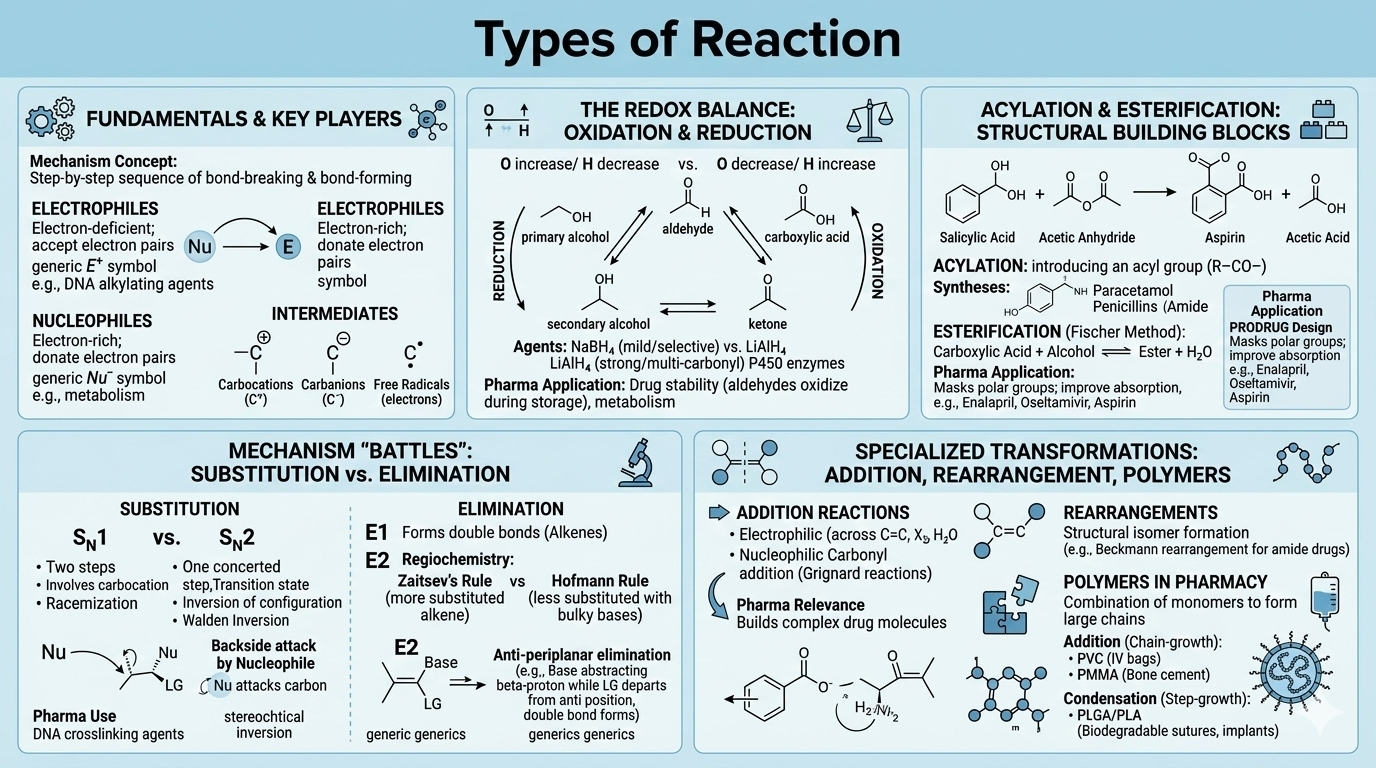
Prepared by the PharmaWallah student team. Verify results with your textbook or instructor. Report an error · Editorial policy
Unit 3: Types of Reactions
Introduction to Organic Reaction Mechanisms
Organic reaction mechanisms describe the step-by-step sequence of bond-breaking and bond-forming events that occur during a chemical transformation. Understanding mechanisms is essential for predicting reaction outcomes, designing synthetic routes for drug molecules, and understanding drug metabolism and degradation pathways.
Key Concepts in Reaction Mechanisms:
| Concept | Definition | Pharmaceutical Relevance |
|---|---|---|
| Electrophile | Electron-deficient species that accepts electron pairs | Many drugs act as electrophiles in alkylating DNA (anticancer agents) |
| Nucleophile | Electron-rich species that donates electron pairs | Functional groups in drugs (amines, OH) act as nucleophiles in metabolism |
| Leaving group | Atom or group that departs with bonding electrons | Important in prodrug activation and drug degradation |
| Carbocation | Positively charged carbon intermediate | Involved in many drug synthesis steps and metabolic rearrangements |
| Carbanion | Negatively charged carbon intermediate | Involved in carbon-carbon bond formation in drug synthesis |
| Free radical | Species with unpaired electron | Involved in lipid peroxidation, drug-induced oxidative stress |
1. Oxidation Reactions
Definition
Oxidation in organic chemistry involves:
- Increase in oxygen or decrease in hydrogen
- Loss of electrons
- Increase in oxidation state of carbon
Common Oxidation Reactions in Pharmaceuticals
1. Oxidation of Alcohols
| Alcohol Type | Oxidizing Agent | Product | Pharmaceutical Application |
|---|---|---|---|
| Primary alcohol | PCC (pyridinium chlorochromate) | Aldehyde | Synthesis of aldehyde intermediates |
| Primary alcohol | KMnO₄, K₂Cr₂O₇/H⁺ | Carboxylic acid | Synthesis of carboxylic acid drugs |
| Secondary alcohol | Any oxidant (PCC, CrO₃, KMnO₄) | Ketone | Synthesis of ketone-containing drugs |
| Tertiary alcohol | Resists oxidation | No reaction | Used as protecting groups |
Mechanism of Chromium-Based Oxidation:
- Formation of chromate ester
- Elimination via E2-like mechanism
- Carbonyl product formed
Pharmaceutical Example: Oxidation of secondary alcohols in steroid synthesis to produce ketone-containing hormones.
2. Oxidation of Aldehydes to Carboxylic Acids
Aldehydes are easily oxidized to carboxylic acids by:
- Tollens' reagent [Ag(NH₃)₂]⁺ (silver mirror test)
- Fehling's solution (Cu²⁺ in tartrate)
- KMnO₄, K₂Cr₂O₇
- Air oxidation (autoxidation)
Mechanism: Nucleophilic addition of water to aldehyde gives gem-diol, which is oxidized.
Pharmaceutical Relevance: Aldehyde-containing drugs may oxidize during storage, affecting stability. The body oxidizes aldehydes to carboxylic acids in metabolism (e.g., alcohol metabolism).
3. Oxidation of Alkenes
| Reaction | Reagent | Product | Pharmaceutical Application |
|---|---|---|---|
| Epoxidation | Peracids (m-CPBA) | Epoxide | Synthesis of epoxide intermediates; epoxide drugs |
| Dihydroxylation | Cold dilute KMnO₄ or OsO₄ | 1,2-diol (syn) | Synthesis of diol-containing drugs |
| Cleavage | Hot KMnO₄ or O₃ | Carbonyl compounds | Structure determination, synthesis |
Mechanism of Epoxidation: Electrophilic addition of oxygen to double bond via "butterfly" mechanism.
Pharmaceutical Example: Epoxidation of alkenes in drug metabolism (CYP450 enzymes) can lead to reactive intermediates.
4. Oxidation of Aromatic Compounds
| Reaction | Reagent | Product | Application |
|---|---|---|---|
| Side-chain oxidation | Hot KMnO₄ | Benzoic acid | Synthesis of aromatic acids |
| Phenol oxidation | Various | Quinones | Vitamin K, coenzyme Q |
Pharmaceutical Example: Oxidation of toluene side chain in synthesis of benzoic acid preservatives.
5. Baeyer-Villiger Oxidation
Definition: Oxidation of ketones to esters or lactones using peracids or peroxides.
Mechanism: Nucleophilic addition of peracid to carbonyl, followed by migration of one group to oxygen (migratory aptitude: tertiary alkyl > secondary > benzyl > primary > methyl).
Pharmaceutical Application: Synthesis of lactone-containing drugs (e.g., statins, macrolide antibiotics). Also involved in drug metabolism (CYP450-catalyzed oxidations).
6. Oxidation in Drug Metabolism
The body's cytochrome P450 enzymes catalyze various oxidations:
- Hydroxylation of aliphatic and aromatic carbons
- Epoxidation of alkenes
- N-, O-, and S-dealkylation
- Oxidation of alcohols and aldehydes
- Oxidative deamination
Pharmaceutical Significance:
- Converts lipophilic drugs to more water-soluble metabolites for excretion
- Can produce active metabolites (prodrug activation)
- May generate reactive intermediates causing toxicity
2. Reduction Reactions
Definition
Reduction in organic chemistry involves:
- Decrease in oxygen or increase in hydrogen
- Gain of electrons
- Decrease in oxidation state of carbon
Common Reducing Agents
| Reducing Agent | Strength | Selectivity | Pharmaceutical Application |
|---|---|---|---|
| NaBH₄ (sodium borohydride) | Mild | Reduces aldehydes, ketones, acid chlorides; not acids, esters | Selective reduction in drug synthesis |
| LiAlH₄ (lithium aluminum hydride) | Strong | Reduces almost all carbonyls (acids, esters, amides, nitriles) | Multi-step drug synthesis |
| H₂ with catalyst (Pd, Pt, Ni) | Variable | Hydrogenation of alkenes, alkynes, nitro, etc. | Large-scale industrial synthesis |
| DIBAL-H | Selective | Aldehydes from esters, nitriles | Controlled reductions |
| Na/NH₃ (liquid) | Specific | Reduces alkynes to trans-alkenes; Birch reduction of aromatics | Specialized reductions |
Common Reduction Reactions
1. Reduction of Carbonyl Compounds
| Substrate | Reagent | Product | Pharmaceutical Example |
|---|---|---|---|
| Aldehyde | NaBH₄ or LiAlH₄ | Primary alcohol | Synthesis of alcohol intermediates |
| Ketone | NaBH₄ or LiAlH₄ | Secondary alcohol | Synthesis of alcohol drugs (e.g., statins) |
| Carboxylic acid | LiAlH₄ only | Primary alcohol | Synthesis of alcohols from natural acids |
| Ester | LiAlH₄ | Two alcohols | Synthesis of alcohols |
| Amide | LiAlH₄ | Amine | Synthesis of amine drugs |
Mechanism of Hydride Reduction:
- Nucleophilic attack by H⁻ on electrophilic carbonyl carbon
- Formation of alkoxide intermediate
- Protonation gives alcohol
Pharmaceutical Application: Synthesis of chiral alcohols for drugs like atorvastatin (Lipitor).
2. Hydrogenation (Reduction of Multiple Bonds)
| Substrate | Catalyst | Product | Notes |
|---|---|---|---|
| Alkene | Pd/C, PtO₂, Raney Ni | Alkane | Syn addition of H₂ |
| Alkyne | Lindlar's catalyst (Pd/CaCO₃/quinoline) | cis-Alkene | Syn addition, stops at alkene |
| Alkyne | Na/NH₃ (liquid) | trans-Alkene | Dissolving metal reduction |
| Nitroarene | H₂/Pd or Fe/HCl | Arylamine | Synthesis of aniline drugs |
| Nitrile | H₂/Ni or LiAlH₄ | Primary amine | Synthesis of amine drugs |
| Imine | NaBH₃CN or H₂/catalyst | Amine | Reductive amination |
Mechanism of Catalytic Hydrogenation:
- Adsorption of H₂ on metal surface
- Adsorption of substrate
- Stepwise transfer of H atoms
- Desorption of product
Pharmaceutical Application: Large-scale hydrogenation in drug manufacturing (e.g., reduction of nitro groups in antibiotic synthesis).
3. Reductive Amination
Definition: One-pot conversion of aldehydes or ketones to amines using ammonia or amines and a reducing agent.
Mechanism:
- Carbonyl + amine → imine (or iminium ion)
- Imine reduced to amine by NaBH₃CN, NaBH₄, or H₂/catalyst
Pharmaceutical Significance:
- Most common method for synthesizing amine drugs
- Used in synthesis of antidepressants, antihistamines, etc.
- Mimics biological transamination reactions
4. Clemmensen Reduction
Definition: Reduction of aldehydes or ketones to methylene (CH₂) using zinc amalgam and HCl.
Mechanism: Involves carbenoid intermediates on metal surface.
Application: Conversion of ketones to alkyl chains in steroid synthesis.
5. Wolff-Kishner Reduction
Definition: Reduction of aldehydes or ketones to methylene using hydrazine and strong base (KOH) at high temperature.
Mechanism: Formation of hydrazone, then deprotonation, loss of N₂, and protonation.
Application: Reduction of ketones to alkanes where acidic conditions (Clemmensen) would damage sensitive groups.
6. Birch Reduction
Definition: Reduction of aromatic rings to 1,4-cyclohexadienes using Na or Li in liquid NH₃ with an alcohol.
Mechanism: Dissolving metal reduction via radical anion intermediates.
Application: Synthesis of partially reduced aromatic compounds for drug intermediates.
7. Reduction in Drug Metabolism
- Azo reduction: By gut microflora, activates certain prodrugs
- Nitro reduction: To amines (can be toxic or therapeutic)
- Carbonyl reduction: To alcohols (phase I metabolism)
- Disulfide reduction: Cleaves disulfide bonds in proteins
3. Acylation Reactions
Definition
Acylation is the introduction of an acyl group (R–CO–) into a molecule. It is a fundamental reaction in pharmaceutical synthesis for introducing amide, ester, and ketone functionalities.
Common Acylating Agents
| Acylating Agent | Reactivity | Byproduct | Pharmaceutical Application |
|---|---|---|---|
| Acid chlorides (RCOCl) | Very high | HCl | Most reactive, widely used |
| Acid anhydrides [(RCO)₂O] | High | RCOOH | Acetylation (aspirin synthesis) |
| Esters (RCOOR') | Moderate | R'OH | Transesterification, aminolysis |
| Carboxylic acids (RCOOH) | Low (needs activation) | H₂O | Fischer esterification |
| Amides (RCONH₂) | Very low | NH₃ | Rarely used directly |
Types of Acylation Reactions
1. Acylation of Alcohols (Esterification)
R–OH + R'–CO–X → R'–COO–R + HX
Mechanism (with acid chloride) :
- Nucleophilic attack of alcohol on carbonyl
- Tetrahedral intermediate
- Elimination of leaving group
Pharmaceutical Examples:
- Aspirin synthesis: Acetylation of salicylic acid with acetic anhydride
- Prodrug formation: Esterification of carboxylic acid drugs to improve bioavailability
2. Acylation of Amines (Amide Formation)
R–NH₂ + R'–CO–X → R'–CONH–R + HX
Mechanism: Similar to esterification; amines are more nucleophilic than alcohols.
Pharmaceutical Examples:
- Paracetamol synthesis: Acetylation of p-aminophenol
- Peptide bond formation in protein synthesis
- Penicillin structure contains amide bonds
3. Friedel-Crafts Acylation
Definition: Introduction of acyl group onto aromatic rings using acid chloride and Lewis acid catalyst (AlCl₃).
Ar–H + R–COCl + AlCl₃ → Ar–CO–R + HCl + AlCl₃
Mechanism:
- Formation of acylium ion (R–C⁺=O)
- Electrophilic attack on aromatic ring
- Loss of proton to restore aromaticity
Pharmaceutical Examples:
- Synthesis of aromatic ketones (e.g., propiophenone derivatives)
- Intermediate for many drug syntheses
4. Acylation of Carbon Nucleophiles
Enolates and other carbanions undergo acylation to give β-diketones, β-keto esters, etc. (Claisen condensation).
Pharmaceutical Application: Synthesis of β-diketone antibiotics (tetracyclines).
Pharmaceutical Significance of Acylation
| Application | Purpose | Example |
|---|---|---|
| Prodrug design | Mask polar groups to improve absorption | Ester prodrugs of ampicillin (pivampicillin) |
| Drug derivatization | Improve stability or modify properties | Acetylation of morphine to heroin (more lipophilic) |
| Protection of functional groups | Prevent unwanted reactions during synthesis | Acylation of amines during multi-step synthesis |
| Metabolism | Acetylation is a phase II metabolic reaction | Isoniazid acetylation in tuberculosis treatment |
| Drug synthesis | Form amide/ester bonds in APIs | Most peptide drugs, β-lactam antibiotics |
4. Esterification
Definition
Esterification is the formation of esters from carboxylic acids and alcohols. It is a specific type of acylation.
Fischer Esterification
Reaction: R–COOH + R'–OH ⇌ R–COO–R' + H₂O
Conditions: Acid catalyst (conc. H₂SO₄, HCl, or p-toluenesulfonic acid), heat, often with removal of water to drive equilibrium.
Mechanism:
| Step | Description |
|---|---|
| 1 | Protonation of carbonyl oxygen (activates carbonyl) |
| 2 | Nucleophilic attack by alcohol |
| 3 | Proton transfer |
| 4 | Loss of water (dehydration) |
| 5 | Deprotonation to give ester |
Factors Affecting Fischer Esterification:
- Alcohol structure: Reactivity: 1° > 2° > 3° (steric hindrance)
- Acid structure: Less hindered acids react faster
- Equilibrium: Can be shifted by using excess reagent or removing water
Other Esterification Methods
| Method | Reagents | Advantages |
|---|---|---|
| Acid chloride + alcohol | RCOCl + R'OH + base | Fast, irreversible, high yield |
| Acid anhydride + alcohol | (RCO)₂O + R'OH | Good for acetic esters |
| DCC coupling | RCOOH + R'OH + DCC (dicyclohexylcarbodiimide) | Mild conditions, for sensitive compounds |
| Transesterification | RCOOR'' + R'OH (catalyzed) | Exchange of alkoxy groups |
Pharmaceutical Applications of Esterification
1. Prodrug Design
Esterification of carboxylic acid or alcohol drugs to improve:
- Oral absorption (increased lipophilicity)
- Masking of unpleasant taste
- Prolonged duration of action
- Site-specific delivery
Examples:
- Enalapril: Ethyl ester prodrug of enalaprilat (ACE inhibitor)
- Bambuterol: Prodrug of terbutaline (bronchodilator)
- Oseltamivir (Tamiflu): Ethyl ester prodrug
- Aspirin: Acetyl ester of salicylic acid (improves GI tolerance)
2. Drug Stability
Esterification can protect labile groups from oxidation or other degradation.
3. Formulation
Esters are used as:
- Solvents (ethyl acetate, isopropyl myristate)
- Plasticizers in coatings
- Penetration enhancers in topical formulations
4. Metabolism
Ester hydrolysis (by esterases) is a common metabolic pathway, often activating prodrugs or inactivating drugs.
5. Nucleophilic Substitution Reactions
Nucleophilic substitution reactions involve replacement of a leaving group (L) by a nucleophile (Nu). They are among the most important reactions in organic synthesis and drug metabolism.
Types: SN1 and SN2
| Feature | SN1 (Substitution Nucleophilic Unimolecular) | SN2 (Substitution Nucleophilic Bimolecular) |
|---|---|---|
| Kinetics | Rate = k [substrate] | Rate = k [substrate][Nu] |
| Molecularity | Unimolecular | Bimolecular |
| Steps | Two steps (slow then fast) | One step (concerted) |
| Intermediate | Carbocation | Transition state (no intermediate) |
| Stereochemistry | Racemization (if chiral) | Inversion (Walden inversion) |
| Substrate reactivity | 3° > 2° > 1° (carbocation stability) | 1° > 2° > 3° (steric hindrance) |
| Nucleophile strength | Less important | Important |
| Leaving group | Important | Important |
| Solvent | Polar protic favors | Polar aprotic favors |
| Rearrangement | Possible (carbocation rearranges) | Not possible |
SN1 Mechanism
Steps:
- Slow step (rate-determining) : Leaving group departs, forming carbocation.
- Fast step: Nucleophile attacks carbocation.
- Deprotonation (if nucleophile was neutral).
Characteristics:
- Carbocation stability determines rate: 3° > 2° > 1° > methyl
- Racemization at chiral centers (attack from both sides)
- Rearrangements possible via hydride or alkyl shifts
- Favored by polar protic solvents (stabilize carbocation and leaving group)
Pharmaceutical Relevance:
- Some drug degradation pathways (e.g., hydrolysis of tertiary alkyl halides)
- Synthesis of certain drug intermediates
SN2 Mechanism
Characteristics:
- Concerted: bond formation and bond breaking occur simultaneously
- Backside attack by nucleophile
- Inversion of configuration (Walden inversion)
- Steric hindrance slows reaction: CH₃ > 1° > 2° >> 3°
- Favored by polar aprotic solvents (DMF, DMSO, acetone)
- Strong nucleophiles favored
Transition State: Pentacoordinate carbon with partial bonds to nucleophile and leaving group.
Pharmaceutical Relevance:
- Alkylation reactions in drug synthesis
- Methylation of drugs in metabolism
- Synthesis of quaternary ammonium compounds
Nucleophiles and Leaving Groups
Common Nucleophiles (in order of strength) :
| Nucleophile | Type | Pharmaceutical Relevance |
|---|---|---|
| RS⁻, R⁻ | Very strong | Rare in physiological conditions |
| I⁻, CN⁻, HS⁻ | Strong | CN⁻ used in synthesis |
| NH₃, RNH₂ | Moderate | Amino groups in drugs |
| RO⁻, OH⁻ | Moderate | Alkoxide formation |
| H₂O, ROH | Weak | Hydrolysis reactions |
| F⁻, NO₃⁻, ClO₄⁻ | Very weak | Poor nucleophiles |
Leaving Group Ability: Good leaving groups are weak bases (stable anions): I⁻ > Br⁻ > Cl⁻ >> F⁻ Also good: tosylate (OTs), mesylate (OMs), triflate (OTf)
Pharmaceutical Relevance: In alkylating agents (anticancer drugs), chloride is the leaving group that allows DNA alkylation.
Factors Affecting Nucleophilic Substitution
| Factor | Effect on SN1 | Effect on SN2 |
|---|---|---|
| Substrate structure | More substituted faster | Less substituted faster |
| Nucleophile strength | Minor effect | Major effect |
| Leaving group ability | Important | Important |
| Solvent | Polar protic favors | Polar aprotic favors |
| Concentration | Only substrate in rate law | Both substrate and Nu in rate law |
Pharmaceutical Examples
1. Synthesis of Ethers (Williamson Synthesis) : SN2 reaction of alkoxide with primary alkyl halide.
2. Alkylation of Amines : SN2 reaction of amine with alkyl halide (but overalkylation is a problem).
3. Anticancer Alkylating Agents : Nitrogen mustards (e.g., cyclophosphamide) undergo SN2 reactions with DNA bases, crosslinking DNA.
4. Prodrug Activation : Some prodrugs are activated by SN2 reactions (e.g., with glutathione).
5. Drug Degradation : Hydrolysis of alkyl halides and esters can occur via SN1 or SN2 depending on structure.
6. Elimination Reactions
Elimination reactions involve loss of two atoms or groups from a molecule to form a multiple bond (usually an alkene).
Types: E1 and E2
| Feature | E1 (Elimination Unimolecular) | E2 (Elimination Bimolecular) |
|---|---|---|
| Kinetics | Rate = k [substrate] | Rate = k [substrate][base] |
| Molecularity | Unimolecular | Bimolecular |
| Steps | Two steps (slow then fast) | One step (concerted) |
| Intermediate | Carbocation | Transition state (no intermediate) |
| Substrate reactivity | 3° > 2° > 1° | 3° > 2° > 1° (for base strength) |
| Base strength | Less important | Important |
| Leaving group | Important | Important |
| Stereochemistry | Non-stereospecific | Anti-periplanar required |
| Rearrangement | Possible | Not possible |
| Competition with substitution | SN1 competes | SN2 competes |
E1 Mechanism
Steps:
- Slow step: Leaving group departs, forming carbocation.
- Fast step: Base abstracts a β-hydrogen, forming alkene.
Characteristics:
- Same carbocation intermediate as SN1
- Follows Zaitsev's rule (more substituted alkene is major product)
- Rearrangements possible
- Favored by polar protic solvents
- Weak bases favor E1 over E2
E2 Mechanism
Characteristics:
- Concerted: Base abstracts β-H while leaving group departs
- Anti-periplanar geometry required (H and leaving group must be 180° apart)
- Strong base favors E2
- Stereospecific: gives specific alkene stereochemistry
- Follows Zaitsev's rule with small bases; with bulky bases (e.g., tert-butoxide), Hofmann product (less substituted alkene) may dominate
Transition State: Partial bonds to H (being removed) and leaving group, double bond forming.
Zaitsev's Rule vs. Hofmann Rule
| Rule | Description | Conditions |
|---|---|---|
| Zaitsev's rule | More substituted alkene is major product | Small bases, E1, E2 with small bases |
| Hofmann rule | Less substituted alkene is major product | Bulky bases (steric hindrance), E2 |
Competition: Substitution vs. Elimination
| Conditions | Favored Reaction |
|---|---|
| Strong nucleophile, 1° substrate | SN2 |
| Strong base, 3° substrate | E2 |
| Weak nucleophile/base, 3° substrate | SN1/E1 (mixture) |
| High temperature | Elimination favored |
| Bulky base | Elimination favored (Hofmann product) |
Pharmaceutical Relevance
1. Drug Synthesis: Elimination reactions are used to introduce double bonds into drug molecules (e.g., steroid synthesis).
2. Drug Degradation: Some drugs undergo elimination under basic conditions or at high temperatures, leading to loss of activity.
3. Metabolism: Dehydrogenation (oxidative elimination) is a metabolic pathway catalyzed by enzymes.
4. Prodrug Design: Some prodrugs are designed to undergo elimination to release the active drug (e.g., β-elimination of phosphate prodrugs).
7. Addition Reactions
Addition reactions occur when two molecules combine to form a single product, typically across a multiple bond (C=C, C≡C, C=O). They are the reverse of elimination reactions.
Types of Addition Reactions
1. Electrophilic Addition to Alkenes
This is the most common addition reaction, where an electrophile adds to the π bond, forming a carbocation that is then attacked by a nucleophile.
General Mechanism:
- Slow step: Electrophile adds to π bond, forming carbocation.
- Fast step: Nucleophile attacks carbocation.
Examples:
| Reaction | Reagent | Product | Regiochemistry | Stereochemistry |
|---|---|---|---|---|
| Hydrogenation | H₂/catalyst | Alkane | - | Syn addition |
| Halogenation | X₂ (Br₂, Cl₂) | Vicinal dihalide | Anti addition via halonium ion | Anti |
| Hydrohalogenation | HX | Alkyl halide | Markovnikov | Variable |
| Hydration | H₂O/H⁺ | Alcohol | Markovnikov | Variable |
| Oxymercuration | Hg(OAc)₂, then NaBH₄ | Alcohol | Markovnikov | No rearrangement |
| Hydroboration | BH₃, then H₂O₂/OH⁻ | Alcohol | Anti-Markovnikov | Syn addition |
| Epoxidation | Peracid | Epoxide | - | Stereospecific |
Markovnikov's Rule: In addition of HX to unsymmetrical alkene, H adds to the carbon with more H atoms (less substituted), and X adds to more substituted carbon. Reason: formation of more stable carbocation.
Anti-Markovnikov addition: Occurs with HBr in presence of peroxides (free radical mechanism).
Pharmaceutical Relevance:
- Synthesis of alcohol, halide, and epoxide intermediates
- Epoxidation in drug metabolism (can form reactive intermediates)
- Hydrogenation used in large-scale drug manufacturing
2. Electrophilic Addition to Alkynes
Similar to alkenes but can add one or two equivalents.
- With one equivalent HX → vinyl halide (Markovnikov)
- With two equivalents HX → geminal dihalide
- With one equivalent X₂ → dihaloalkene (trans usually)
- With two equivalents X₂ → tetrahaloalkane
3. Nucleophilic Addition to Carbonyl Compounds
Aldehydes and ketones undergo nucleophilic addition due to electrophilic carbonyl carbon.
General Mechanism:
- Nucleophile attacks carbonyl carbon.
- Tetrahedral intermediate forms.
- Protonation gives alcohol (or elimination gives derivative).
Examples:
| Nucleophile | Product | Pharmaceutical Application |
|---|---|---|
| H₂O | Gem-diol (hydrate) | Equilibrium in solutions |
| ROH | Hemiacetal, then acetal | Protecting groups, carbohydrate chemistry |
| HCN | Cyanohydrin | Synthesis of amino acids, hydroxy acids |
| Grignard reagent | Alcohol | Carbon-carbon bond formation in drug synthesis |
| NaHSO₃ | Bisulfite addition product | Purification of aldehydes/ketones |
| NH₃, RNH₂ | Imine (Schiff base) | Drug-receptor interactions, synthesis |
| NH₂OH | Oxime | Characterization, synthesis |
| Hydrazine | Hydrazone | Synthesis, drug intermediates |
| Wittig reagent | Alkene | Synthesis of alkenes from carbonyls |
Pharmaceutical Relevance:
- Imine formation is involved in many enzyme mechanisms (e.g., pyridoxal phosphate)
- Schiff bases are intermediates in drug synthesis
- Grignard reactions are fundamental in building complex drug molecules
4. Michael Addition (Conjugate Addition)
Definition: Nucleophilic addition to α,β-unsaturated carbonyl compounds (enones), where addition occurs at the β-carbon.
Mechanism: Nucleophile attacks β-carbon, forming enolate, which is then protonated.
Nucleophiles: Enolates (giving 1,5-dicarbonyls), amines, thiols, etc.
Pharmaceutical Relevance:
- Key reaction in steroid synthesis
- Involved in biosynthesis of natural products
- Some drugs act as Michael acceptors (e.g., certain anticancer agents alkylate proteins via Michael addition)
5. Diels-Alder Reaction
Definition: [4+2] cycloaddition between a conjugated diene and a dienophile (alkene or alkyne) to form a six-membered ring.
Mechanism: Concerted, pericyclic; stereospecific (cis principle retained).
Pharmaceutical Relevance:
- Synthesis of complex natural products (steroids, alkaloids)
- Synthesis of aromatic drug intermediates
- Used in combinatorial chemistry for drug discovery
8. Rearrangement Reactions
Rearrangement reactions involve migration of an atom or group from one atom to another within the same molecule, resulting in a structural isomer.
Common Rearrangements in Pharmaceutical Chemistry
1. Carbocation Rearrangements
In SN1 and E1 reactions, carbocations may rearrange via hydride shift or alkyl shift to form more stable carbocations.
Example: 3,3-dimethyl-1-butene with HCl gives rearranged product due to hydride shift.
Pharmaceutical Relevance: Explains unexpected products in drug synthesis and metabolism.
2. Pinacol Rearrangement
Definition: Acid-catalyzed rearrangement of vicinal diols (1,2-diols) to carbonyl compounds.
Mechanism: Protonation, loss of water, carbocation formation, migration of alkyl group, deprotonation.
Pharmaceutical Example: Synthesis of steroids and terpenes.
3. Beckmann Rearrangement
Definition: Acid-catalyzed rearrangement of ketoximes to N-substituted amides.
Mechanism: Protonation of oxime OH, migration of anti group to nitrogen, loss of water, formation of nitrilium ion, hydration to amide.
Pharmaceutical Application: Synthesis of caprolactam (for nylon) and amide drugs. Also involved in drug metabolism.
4. Hofmann Rearrangement
Definition: Reaction of primary amides with Br₂/NaOH to give primary amines with one less carbon.
Mechanism: N-bromination, deprotonation, migration of R group to nitrogen (with loss of CO₂), protonation.
Pharmaceutical Application: Synthesis of amine drugs from carboxylic acids.
5. Curtius Rearrangement
Definition: Thermal decomposition of acyl azides to give isocyanates, which can be trapped with nucleophiles to yield amines, urethanes, or ureas.
Mechanism: Loss of N₂, migration of R group to nitrogen, formation of isocyanate.
Pharmaceutical Application: Synthesis of amines and derivatives.
6. Claisen Rearrangement
Definition: [3,3]-sigmatropic rearrangement of allyl vinyl ethers to γ,δ-unsaturated carbonyls.
Pharmaceutical Application: Synthesis of natural products and complex molecules.
7. Cope Rearrangement
Definition: [3,3]-sigmatropic rearrangement of 1,5-dienes.
8. Fries Rearrangement
Definition: Rearrangement of phenolic esters to ortho- or para-hydroxy ketones under Lewis acid catalysis.
Pharmaceutical Application: Synthesis of hydroxy ketone intermediates.
9. Benzilic Acid Rearrangement
Definition: Base-catalyzed rearrangement of 1,2-diketones to α-hydroxy acids.
10. Wagner-Meerwein Rearrangement
Definition: Carbocation rearrangement involving migration of alkyl groups in terpene and steroid chemistry.
Pharmaceutical Significance of Rearrangements
| Rearrangement | Application in Pharmacy |
|---|---|
| Beckmann | Synthesis of amide drugs, caprolactam |
| Hofmann | Synthesis of amines from acids |
| Curtius | Synthesis of amines, urethanes (prodrugs) |
| Pinacol | Steroid and terpene synthesis |
| Claisen | Natural product synthesis |
| Fries | Synthesis of hydroxy ketones for drug intermediates |
| Benzilic acid | Synthesis of tropic acid (atropine precursor) |
9. Polymerization Reactions
Polymerization is the process of combining many small molecules (monomers) to form large chain-like molecules (polymers). In pharmacy, polymers are essential for drug delivery systems, excipients, and biomedical applications.
Types of Polymerization
1. Addition Polymerization (Chain Growth)
Monomers with double bonds (alkenes) polymerize via free radical, cationic, or anionic mechanisms.
Mechanism:
- Initiation: Formation of active center (radical, cation, anion)
- Propagation: Sequential addition of monomers
- Termination: Combination, disproportionation, or chain transfer
Examples:
| Polymer | Monomer | Pharmaceutical Application |
|---|---|---|
| Polyethylene | Ethylene | Packaging, containers |
| Polypropylene | Propylene | Packaging, medical devices |
| Polystyrene | Styrene | Tissue culture plates, labware |
| Poly(methyl methacrylate) (PMMA) | Methyl methacrylate | Bone cement, contact lenses |
| Poly(vinyl chloride) (PVC) | Vinyl chloride | IV bags, tubing |
| Poly(vinyl acetate) | Vinyl acetate | Adhesives, coatings |
| Polyacrylamide | Acrylamide | Gel electrophoresis, drug delivery |
2. Condensation Polymerization (Step Growth)
Monomers with two functional groups react with loss of small molecule (H₂O, HCl, etc.).
Examples:
| Polymer | Monomers | Linkage | Pharmaceutical Application |
|---|---|---|---|
| Polyesters | Diol + diacid | Ester | Biodegradable sutures (PLA, PGA) |
| Polyamides | Diamine + diacid | Amide | Nylon, peptide polymers |
| Polyurethanes | Diol + diisocyanate | Urethane | Catheters, implants |
| Polycarbonates | Bisphenol A + phosgene | Carbonate | Medical devices |
| Polysaccharides | Monosaccharides | Glycosidic | Natural polymers (starch, cellulose) |
3. Ring-Opening Polymerization
Cyclic monomers (lactones, lactams, epoxides) polymerize by ring opening.
Examples:
- Polylactic acid (PLA) from lactide
- Polycaprolactone (PCL) from ε-caprolactone
- Poly(ethylene oxide) from ethylene oxide
- Poly(lactic-co-glycolic acid) (PLGA) from lactide and glycolide
Pharmaceutical Applications of Polymers
| Application | Polymer Examples | Role |
|---|---|---|
| Tablet binders | PVP, HPMC, starch | Hold tablet ingredients together |
| Tablet coatings | HPMC, ethyl cellulose, Eudragit | Taste masking, controlled release |
| Sustained release matrices | HPMC, PLGA, ethyl cellulose | Control drug release rate |
| Transdermal patches | Polyisobutylene, silicones | Adhesive matrix |
| Hydrogels | PVA, PEO, crosslinked polymers | Wound dressings, contact lenses |
| Biodegradable implants | PLGA, PLA, PCL | Long-acting injectables |
| Nanoparticles | PLGA, PLA, chitosan | Targeted drug delivery |
| Micelles | Block copolymers (PEG-PLA) | Solubilization of poorly soluble drugs |
| Viscosity enhancers | Carbomers, cellulose derivatives | Ophthalmic solutions, gels |
| Packaging | Polyethylene, polypropylene | Blister packs, bottles |
Biodegradable Polymers in Drug Delivery
| Polymer | Degradation Time | Drug Delivery Application |
|---|---|---|
| PLGA | Weeks to months (tunable) | Microparticles, nanoparticles, implants |
| PLA | Months to years | Sutures, implants |
| PCL | >1 year | Long-term implants |
| Chitosan | Enzymatic degradation | Mucoadhesive delivery |
| Gelatin | Days to weeks | Hydrogels, nanoparticles |
| Alginate | Ion exchange | Beads, hydrogels |
Polymerization in Pharmaceutical Manufacturing
1. Synthesis of Polymeric Excipients: Controlled polymerization to achieve specific molecular weights and properties.
2. Cross-linking: To form hydrogels and insoluble matrices for controlled release.
3. Copolymerization: To tune properties (e.g., PLGA combines fast-degrading PGA and slow-degrading PLA).
4. Graft Polymerization: To modify surfaces or create functional polymers.
Summary Tables
Table 1: Comparison of Substitution and Elimination Reactions
| Feature | SN1 | SN2 | E1 | E2 |
|---|---|---|---|---|
| Kinetics | Rate = k[RX] | Rate = k[RX][Nu] | Rate = k[RX] | Rate = k[RX][B] |
| Steps | Two | One | Two | One |
| Intermediate | Carbocation | None (TS) | Carbocation | None (TS) |
| Stereochemistry | Racemization | Inversion | Non-stereospecific | Anti-periplanar required |
| Substrate | 3° > 2° > 1° | 1° > 2° > 3° | 3° > 2° > 1° | 3° > 2° > 1° |
| Base/Nu strength | Weak favors | Strong favors | Weak favors | Strong favors |
| Solvent | Polar protic | Polar aprotic | Polar protic | Any (but protic favors) |
| Product | Substitution | Substitution | Alkene | Alkene |
| Rearrangement | Possible | No | Possible | No |
Table 2: Common Addition Reactions to Alkenes
| Reaction | Reagent | Product | Regiochemistry | Stereochemistry | Pharmaceutical Use |
|---|---|---|---|---|---|
| Hydrogenation | H₂/catalyst | Alkane | - | Syn | Large-scale synthesis |
| Halogenation | X₂ | Dihalide | - | Anti | Intermediate synthesis |
| Hydrohalogenation | HX | Alkyl halide | Markovnikov | Variable | Intermediate synthesis |
| Hydration | H₂O/H⁺ | Alcohol | Markovnikov | Variable | Alcohol synthesis |
| Oxymercuration | Hg(OAc)₂/NaBH₄ | Alcohol | Markovnikov | Variable | No rearrangement |
| Hydroboration | BH₃/H₂O₂ | Alcohol | Anti-Markovnikov | Syn | Stereoselective |
| Epoxidation | Peracid | Epoxide | - | Stereospecific | Drug intermediates |
Table 3: Oxidation Reactions in Pharmacy
| Oxidation Type | Reagents | Product | Pharmaceutical Example |
|---|---|---|---|
| 1° Alcohol → Aldehyde | PCC | Aldehyde | Intermediate synthesis |
| 1° Alcohol → Acid | KMnO₄, CrO₃ | Carboxylic acid | Drug synthesis |
| 2° Alcohol → Ketone | PCC, CrO₃ | Ketone | Steroid synthesis |
| Aldehyde → Acid | Tollens', KMnO₄ | Acid | Metabolism simulation |
| Alkene → Epoxide | Peracid | Epoxide | Drug intermediates |
| Alkene → Diol | OsO₄, cold KMnO₄ | 1,2-diol | Drug synthesis |
| Alkene cleavage | Hot KMnO₄, O₃ | Carbonyls | Structure determination |
| Aromatic side chain | Hot KMnO₄ | Benzoic acid | Drug synthesis |
| Baeyer-Villiger | Peracid | Ester/lactone | Statin synthesis |
Table 4: Reduction Reactions in Pharmacy
| Reduction Type | Reagents | Product | Selectivity |
|---|---|---|---|
| Aldehyde → Alcohol | NaBH₄, LiAlH₄ | 1° Alcohol | High |
| Ketone → Alcohol | NaBH₄, LiAlH₄ | 2° Alcohol | High |
| Acid → Alcohol | LiAlH₄ only | 1° Alcohol | Strong |
| Ester → Alcohols | LiAlH₄ | Two alcohols | Strong |
| Amide → Amine | LiAlH₄ | Amine | Strong |
| Nitrile → Amine | LiAlH₄, H₂/Ni | 1° Amine | Strong |
| Nitro → Amine | H₂/Pd, Fe/HCl | Amine | Common in synthesis |
| Alkene → Alkane | H₂/catalyst | Alkane | Syn addition |
| Alkyne → cis-Alkene | Lindlar's | cis-Alkene | Selective |
| Alkyne → trans-Alkene | Na/NH₃ | trans-Alkene | Selective |
| Reductive amination | NaBH₃CN, H₂/catalyst | Amine | One-pot synthesis |
Table 5: Polymer Types in Pharmaceutical Applications
| Polymer Type | Examples | Degradability | Pharmaceutical Use |
|---|---|---|---|
| Polyesters | PLA, PLGA, PCL | Biodegradable | Microparticles, implants |
| Polyamides | Nylon, peptides | Variable | Sutures, drug delivery |
| Polyethers | PEG, PEO | Non-degradable | Coatings, conjugates |
| Cellulosics | HPMC, EC, MC | Non-degradable | Tablet coatings, matrices |
| Acrylics | Eudragit, Carbomer | Non-degradable | Enteric coatings, gels |
| Polysaccharides | Chitosan, alginate | Biodegradable | Hydrogels, beads |
| Silicones | Polydimethylsiloxane | Non-degradable | Implants, medical devices |
| Vinyl polymers | PVP, PVA | Variable | Binders, films |
References
-
Brown, W. H., & Bursten, M. L. (2014). Introduction to organic chemistry (8th ed.). Wiley. (Chapters on reaction mechanisms)
-
Vollhardt, K. P. C., & Schore, N. E. (2014). Organic chemistry: Structure and function (7th ed.). W. H. Freeman and Company. (Chapters 6-14 covering reaction types)
-
Carey, F. A. (2007). Advanced organic chemistry: Part A: Structure and mechanisms (5th ed.). Wiley. (In-depth coverage of reaction mechanisms)
-
Silverman, R. B. (2014). The organic chemistry of drug design and drug action (2nd ed.). Academic Press. (Chapter 4: Drug metabolism and reactions)
-
Lemke, T. L., & Williams, D. A. (2013). Foye's principles of medicinal chemistry (7th ed.). Lippincott Williams & Wilkins. (Chapters on drug metabolism and synthesis)
-
Clayden, J., Greeves, N., & Warren, S. (2012). Organic chemistry (2nd ed.). Oxford University Press. (Comprehensive coverage of reactions)
-
Patrick, G. L. (2013). An introduction to medicinal chemistry (5th ed.). Oxford University Press. (Chapter 4: Drug metabolism)
-
Smith, M. B., & March, J. (2007). March's advanced organic chemistry: Reactions, mechanisms, and structure (6th ed.). Wiley. (Definitive reference)
-
Solomons, T. W. G., & Fryhle, C. B. (2011). Organic chemistry (10th ed.). Wiley. (Student-friendly explanations)
-
McMurry, J. (2015). Organic chemistry (9th ed.). Cengage Learning. (Clear mechanisms and examples)
Recommended Textbooks for Further Reading:
- Brown, W. H., & Bursten, M. L. (2014). Introduction to organic chemistry (8th ed.). Wiley. (Excellent for foundational reaction mechanisms)
- Vollhardt, K. P. C., & Schore, N. E. (2014). Organic chemistry: Structure and function (7th ed.). W. H. Freeman and Company. (Strong on reaction mechanisms and their applications)
- Silverman, R. B. (2014). The organic chemistry of drug design and drug action (2nd ed.). Academic Press. (Connects reactions to drug action and metabolism)
- Lemke, T. L., & Williams, D. A. (2013). Foye's principles of medicinal chemistry (7th ed.). Lippincott Williams & Wilkins. (Practical applications in medicinal chemistry)
End of unit 3 of 4
Check what you've learned
5 quick questions from this unit. They're optional: try them if you like, then mark the unit as read and move on.