

Unit 1: Basic Concepts
Atomic orbitals, hybridisation (sp, sp², sp³), covalent bonding, resonance, inductive and mesomeric effects, electronegativity, acids and bases in organic chemistry, and IUPAC nomenclature.
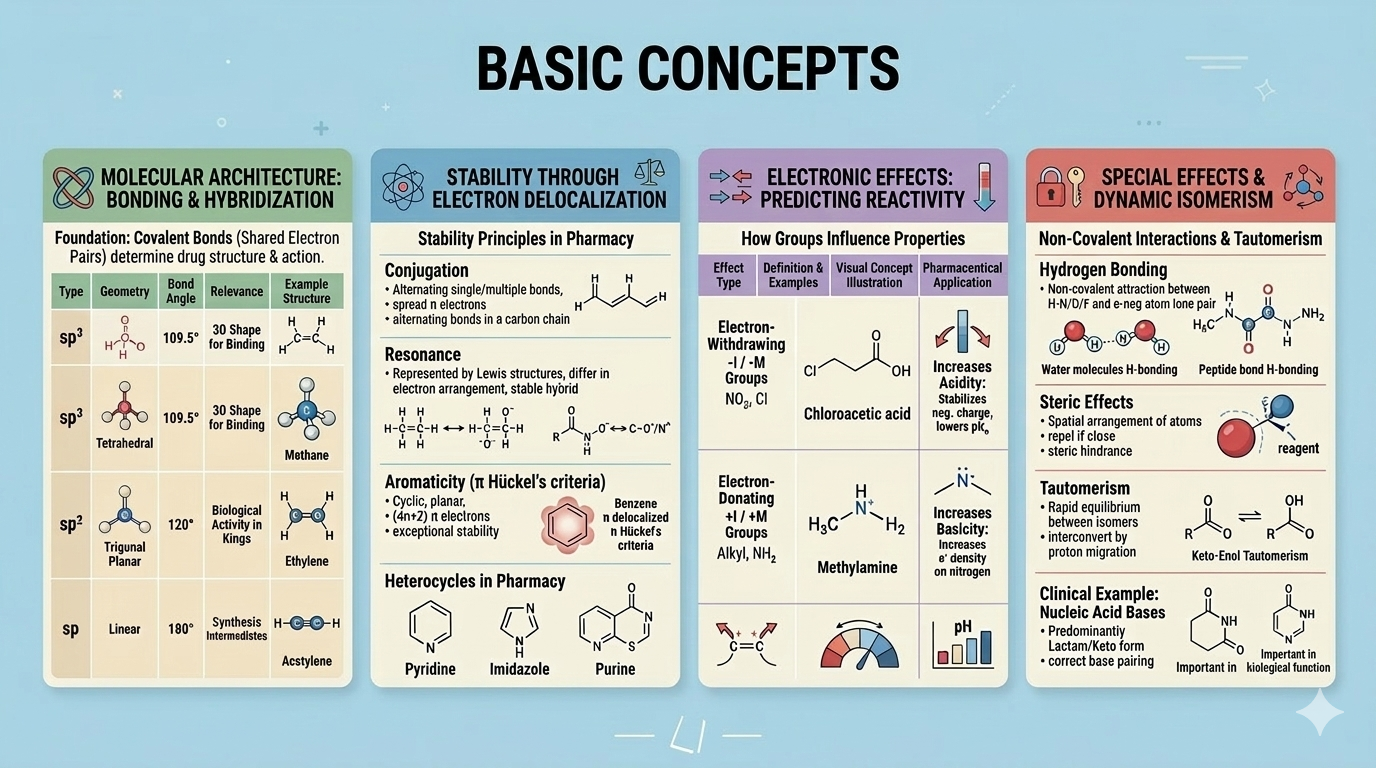
Prepared by the PharmaWallah student team. Verify results with your textbook or instructor. Report an error · Editorial policy
Unit 1: Basic Concepts
Introduction to Organic Chemistry in Pharmacy
Organic chemistry is the cornerstone of pharmaceutical sciences. Understanding the fundamental concepts of bonding, structure, and reactivity of organic molecules is essential for comprehending drug action, design, and synthesis. This unit establishes the foundational principles that govern the behavior of organic compounds, with particular emphasis on their relevance to pharmaceutical applications.
Chemical Bonding and Concept of Hybridization
Atomic Structure and Electronic Configuration
Atoms consist of a nucleus containing protons and neutrons, surrounded by electrons in specific energy levels or orbitals. The electronic configuration determines how atoms interact and form chemical bonds.
Quantum Numbers:
| Quantum Number | Symbol | Significance |
|---|---|---|
| Principal | n | Energy level (1, 2, 3...) |
| Azimuthal | l | Orbital shape (s, p, d, f) |
| Magnetic | m | Orbital orientation in space |
| Spin | s | Electron spin direction (+½ or -½) |
Atomic Orbitals:
- s orbital: Spherical shape, one per energy level
- p orbital: Dumbbell shape, three mutually perpendicular orbitals (px, py, pz)
- d and f orbitals: Complex shapes, important for transition metals
Chemical Bonding Types
1. Ionic Bonding: Formed by complete transfer of electrons from one atom to another. Electrostatic attraction holds the resulting ions together.
Characteristics:
- Occurs between metals and non-metals
- High melting and boiling points
- Soluble in polar solvents
- Conduct electricity in molten or dissolved state
Pharmaceutical Relevance: Many drug salts (e.g., sodium salts of weak acids) are ionic compounds with improved solubility and stability.
2. Covalent Bonding: Formed by sharing of electron pairs between atoms. Most organic compounds are held together by covalent bonds.
Characteristics:
- Occurs between non-metals
- Variable melting and boiling points
- Soluble in non-polar or moderately polar solvents
- Generally do not conduct electricity
Types of Covalent Bonds:
- Single bond: Sharing of one electron pair (σ bond)
- Double bond: Sharing of two electron pairs (one σ and one π bond)
- Triple bond: Sharing of three electron pairs (one σ and two π bonds)
3. Coordinate Covalent Bonding: Both shared electrons come from the same atom (donor), while the other atom (acceptor) provides an empty orbital.
Pharmaceutical Relevance: Drug-receptor interactions often involve coordinate bonding with metal ions in metalloenzymes.
Hybridization
Hybridization is the mixing of atomic orbitals to form new, equivalent hybrid orbitals that are suitable for bonding. This concept explains the geometry and bonding characteristics of organic molecules.
sp³ Hybridization:
| Property | Description |
|---|---|
| Orbitals mixed | One s + three p |
| Number of hybrid orbitals | Four |
| Geometry | Tetrahedral |
| Bond angle | 109.5° |
| Example | Methane (CH₄), ethane (C₂H₆) |
| Orbital composition | 25% s character, 75% p character |
Characteristics:
- Forms four equivalent sigma (σ) bonds
- Single bonds only
- Saturated compounds (alkanes)
Pharmaceutical Relevance: The tetrahedral geometry of sp³ hybridized carbon is fundamental to the three-dimensional structure of many drugs, influencing how they fit into receptor binding sites.
sp² Hybridization:
| Property | Description |
|---|---|
| Orbitals mixed | One s + two p |
| Number of hybrid orbitals | Three |
| Geometry | Trigonal planar |
| Bond angle | 120° |
| Example | Ethylene (C₂H₄), benzene |
| Unhybridized orbital | One p orbital (forms π bond) |
| Orbital composition | 33.3% s character, 66.7% p character |
Characteristics:
- Forms three sigma bonds and one pi (π) bond
- Double bond character
- Planar geometry around the double bond
Pharmaceutical Relevance: Many drug molecules contain sp² hybridized carbons in aromatic rings, carbonyl groups, and double bonds, which are crucial for their biological activity and spectroscopic properties.
sp Hybridization:
| Property | Description |
|---|---|
| Orbitals mixed | One s + one p |
| Number of hybrid orbitals | Two |
| Geometry | Linear |
| Bond angle | 180° |
| Example | Acetylene (C₂H₂) |
| Unhybridized orbitals | Two p orbitals (form two π bonds) |
| Orbital composition | 50% s character, 50% p character |
Characteristics:
- Forms two sigma bonds and two pi bonds
- Triple bond character
- Linear geometry
Pharmaceutical Relevance: Though less common, sp hybridized systems appear in some drug molecules and intermediates in drug synthesis.
Bond Properties and Hybridization
| Hybridization | s Character | Bond Length | Bond Strength | Acidity of C-H |
|---|---|---|---|---|
| sp³ | 25% | Longest | Weakest | Lowest |
| sp² | 33.3% | Intermediate | Intermediate | Intermediate |
| sp | 50% | Shortest | Strongest | Highest |
Explanation: Higher s character means the electrons are held closer to the nucleus, resulting in shorter, stronger bonds. The increased electronegativity of sp hybridized carbon also makes C-H bonds more acidic.
Pharmaceutical Application: Understanding bond properties helps predict drug stability, reactivity, and metabolic pathways.
Conjugation, Resonance, Hyperconjugation, and Aromaticity
Conjugation
Definition: Conjugation refers to the system of alternating single and multiple bonds (double or triple bonds) that allows for delocalization of electrons across multiple atoms. A conjugated system contains p-orbitals on three or more adjacent atoms that can overlap.
Characteristics of Conjugated Systems:
- Delocalization of π electrons over multiple atoms
- Increased stability compared to isolated double bonds
- Altered chemical reactivity
- Characteristic UV-visible absorption spectra
Types of Conjugation:
| Type | Description | Example |
|---|---|---|
| π-π conjugation | Alternating single and double bonds | 1,3-butadiene (CH₂=CH-CH=CH₂) |
| p-π conjugation | Lone pair adjacent to π bond | Aniline (C₆H₅-NH₂) |
| σ-π conjugation | σ bond adjacent to π bond | Hyperconjugation in alkyl-substituted alkenes |
Pharmaceutical Relevance:
- Many drug molecules contain conjugated systems (e.g., tetracyclines, penicillins)
- Conjugation affects drug color (longer conjugation shifts absorption to visible region)
- Conjugated systems are often responsible for drug fluorescence and spectroscopic properties
1,3-Butadiene as an Example:
- Four carbon atoms with alternating double bonds
- All carbon atoms are sp² hybridized
- Continuous overlap of p orbitals creates a delocalized system
- Bond lengths: C1-C2 = 1.34 Å (double bond character), C2-C3 = 1.48 Å (intermediate between single and double)
Resonance
Definition: Resonance is the phenomenon where a molecule can be represented by two or more Lewis structures that differ only in the arrangement of electrons, not atoms. The actual structure is a hybrid (resonance hybrid) of all contributing structures and is more stable than any single contributing structure.
Rules for Resonance:
- Only electrons move; atomic nuclei positions remain fixed
- The number of unpaired electrons must remain the same
- Resonance structures must be valid Lewis structures
- The energy of the actual molecule is lower than that of any contributing structure
- Major contributing structures have more atoms with complete octets, more covalent bonds, and less charge separation
Resonance Energy: The extra stability gained by a molecule due to resonance compared to a hypothetical non-resonance structure.
| System | Resonance Energy (kcal/mol) |
|---|---|
| Benzene | 36 |
| Naphthalene | 61 |
| Phenol | Varies with substitution |
| Carboxylate ion | Significant (equalization of C-O bonds) |
Examples in Pharmaceutical Context:
1. Benzene Ring:
- Six resonance structures
- All C-C bonds equal (1.39 Å, intermediate between single and double)
- Basis of many aromatic drug molecules
2. Amide Bond in Peptides and Proteins: Resonance between:
- Structure A: C=O and N with lone pair
- Structure B: C-O⁻ and N⁺=C with double bond character
Consequences:
- Partial double bond character makes the amide bond planar and rigid
- Restricted rotation around C-N bond (important for protein structure)
- Amide bonds are resistant to hydrolysis (stability of peptides)
3. Carboxylate Ion in Drug Salts:
- Two equivalent resonance structures
- Both C-O bonds equal (intermediate between single and double)
- Delocalization stabilizes the anion, making carboxylic acids weakly acidic
4. Phenol and Phenolic Drugs:
- Resonance delocalization of oxygen lone pair into the ring
- Increased acidity compared to alcohols
- Important for drugs like salicylic acid, morphine
Hyperconjugation
Definition: Hyperconjugation is the interaction between electrons in a σ bond (usually C-H or C-C) and an adjacent empty or partially filled p orbital or π orbital. It is also called "no-bond resonance" or "sigma conjugation."
Characteristics:
- Stabilizes molecules with alkyl groups attached to unsaturated systems
- Increases with the number of α-hydrogens
- Weaker than regular conjugation but still significant
- Explains stability order of carbocations and alkenes
Examples:
1. Stability of Alkenes: More substituted alkenes are more stable due to hyperconjugation.
| Alkene | Number of α C-H bonds | Relative Stability |
|---|---|---|
| (CH₃)₂C=C(CH₃)₂ | 12 | Most stable |
| CH₃-CH=CH-CH₃ | 6 | Intermediate |
| CH₂=CH₂ | 0 | Least stable |
2. Carbocation Stability: Tertiary carbocations are more stable than secondary, which are more stable than primary due to hyperconjugation from adjacent C-H and C-C bonds.
3. Toluene: Hyperconjugation between the methyl group and the aromatic ring explains:
- Slightly increased electron density in the ring
- Ortho/para directing effect in electrophilic substitution
- Weak acidity of methyl protons
Pharmaceutical Relevance:
- Explains stability patterns in drug molecules
- Influences reactivity of drug functional groups
- Affects metabolic pathways
Aromaticity
Definition: Aromaticity is a property of cyclic, planar molecules with a continuous ring of overlapping p orbitals and (4n+2) π electrons (Hückel's rule), resulting in exceptional stability.
Hückel's Rule for Aromaticity: A molecule is aromatic if it meets the following criteria:
- Cyclic structure
- Planar (all atoms in the same plane)
- Completely conjugated (continuous ring of p orbitals)
- Contains (4n+2) π electrons, where n = 0, 1, 2, 3...
Examples of Aromatic Systems:
| Compound | π Electrons | n | Type |
|---|---|---|---|
| Benzene | 6 | 1 | Aromatic |
| Naphthalene | 10 | 2 | Aromatic |
| Pyridine | 6 | 1 | Heteroaromatic |
| Pyrrole | 6 | 1 | Heteroaromatic (lone pair part of system) |
| Furan | 6 | 1 | Heteroaromatic |
| Cyclobutadiene | 4 | Not applicable | Anti-aromatic (unstable) |
| Cyclooctatetraene | 8 | Not planar | Non-aromatic |
Anti-aromaticity:
- Planar, cyclic, conjugated systems with 4n π electrons
- Highly unstable and reactive
- Rare in pharmaceutical compounds
Heteroaromatic Compounds: Aromatic rings containing atoms other than carbon (N, O, S) are extremely important in pharmaceutical chemistry.
| Heterocycle | Structure | Pharmaceutical Examples |
|---|---|---|
| Pyridine | C₅H₅N | Nicotine, niacin, isoniazid |
| Pyrimidine | C₄H₄N₂ | Cytosine, thymine, uracil (nucleic acids) |
| Purine | C₅H₄N₄ | Adenine, guanine, caffeine, theophylline |
| Imidazole | C₃H₄N₂ | Histamine, histidine, metronidazole |
| Pyrrole | C₄H₅N | Porphyrins (heme, chlorophyll) |
| Indole | C₈H₇N | Tryptophan, serotonin, reserpine |
Pharmaceutical Significance of Aromaticity:
- Aromatic rings are present in approximately 95% of all drug molecules
- Provides structural rigidity and defined geometry for receptor binding
- Contributes to drug absorption and distribution through lipophilicity
- Enables π-π stacking interactions with aromatic amino acids in proteins
- Responsible for UV absorbance used in drug analysis
- Influences metabolic pathways (oxidation by CYP450 enzymes)
Electronic Effects
Electronegativity
Definition: Electronegativity is the tendency of an atom to attract shared electrons in a chemical bond.
Pauling Electronegativity Values:
| Element | Electronegativity |
|---|---|
| Fluorine | 4.0 |
| Oxygen | 3.5 |
| Nitrogen | 3.0 |
| Chlorine | 3.0 |
| Carbon | 2.5 |
| Hydrogen | 2.1 |
| Sulfur | 2.5 |
| Phosphorus | 2.1 |
Trends in the Periodic Table:
- Increases left to right across a period
- Decreases top to bottom down a group
Pharmaceutical Relevance:
- Determines bond polarity and reactivity
- Influences drug-receptor interactions (polar interactions, hydrogen bonding)
- Affects drug solubility and partition coefficients
- Important in understanding drug metabolism (oxidation, reduction reactions)
Dipole Moment
Definition: Dipole moment (μ) is a measure of the polarity of a bond or molecule. It is the product of the magnitude of charge (δ) and the distance (d) between charges: μ = δ × d. It is expressed in Debye units (D).
Bond Dipole Moments:
| Bond | Dipole Moment (D) | Direction |
|---|---|---|
| C-F | 1.4 | F⁻ δ⁻ |
| C-O | 0.7 | O⁻ δ⁻ |
| C=O | 2.3 | O⁻ δ⁻ |
| C-N | 0.2 | N⁻ δ⁻ |
| O-H | 1.5 | O⁻ δ⁻ |
| N-H | 1.3 | N⁻ δ⁻ |
| C-Cl | 1.5 | Cl⁻ δ⁻ |
Molecular Dipole Moment: The vector sum of all bond dipoles in the molecule. Molecular geometry determines whether bond dipoles add or cancel.
Examples:
| Molecule | Geometry | Net Dipole Moment |
|---|---|---|
| CO₂ | Linear | 0 D (cancels) |
| H₂O | Bent | 1.85 D |
| CH₄ | Tetrahedral | 0 D |
| CH₃Cl | Tetrahedral | 1.9 D |
| CCl₄ | Tetrahedral | 0 D (cancels) |
| NH₃ | Trigonal pyramidal | 1.47 D |
Pharmaceutical Relevance:
- Determines overall polarity and lipophilicity of drugs
- Affects ability to cross biological membranes
- Influences drug solubility in different media
- Important for chromatographic separation and analysis
- Affects drug-receptor binding through electrostatic interactions
Inductive Effect
Definition: The inductive effect is the permanent polarization of a σ bond due to electronegativity differences between atoms. It involves the displacement of σ electrons along a chain of atoms.
Types of Inductive Effect:
| Type | Symbol | Description | Examples |
|---|---|---|---|
| -I effect | Electron-withdrawing | Groups that withdraw electrons through σ bonds | -NO₂, -CN, -F, -Cl, -Br, -I, -COOH, -CHO |
| +I effect | Electron-donating | Groups that donate electrons through σ bonds | -CH₃, -C₂H₅, other alkyl groups, -O⁻ |
Strength Order:
-I Effect (Electron-Withdrawing Strength): -NO₂ > -CN > -F > -Cl > -Br > -I > -OCH₃ > -OH > -C₆H₅ > -H
+I Effect (Electron-Donating Strength): -O⁻ > -COO⁻ > -C(CH₃)₃ > -CH(CH₃)₂ > -C₂H₅ > -CH₃ > -H
Characteristics:
- Decreases rapidly with distance (significant up to 3-4 atoms)
- Through σ bonds only
- Permanent effect (always present)
- Affects acidity, basicity, and reactivity
Pharmaceutical Applications:
1. Acidity of Carboxylic Acids: Electron-withdrawing groups (-I) increase acidity by stabilizing the carboxylate anion.
| Acid | pKa | Effect |
|---|---|---|
| CH₃COOH | 4.76 | Reference |
| Cl-CH₂COOH | 2.86 | -I effect of Cl increases acidity |
| Cl₂CH-COOH | 1.48 | Two Cl atoms further increase acidity |
| Cl₃C-COOH | 0.70 | Maximum effect with three Cl atoms |
2. Basicity of Amines: Electron-donating groups (+I) increase basicity; electron-withdrawing groups (-I) decrease basicity.
| Amine | pKb | Effect |
|---|---|---|
| NH₃ | 4.75 | Reference |
| CH₃NH₂ | 3.36 | +I effect increases basicity |
| (CH₃)₂NH | 3.27 | More +I effect |
| (CH₃)₃N | 4.20 | Steric effects reduce basicity |
| C₆H₅NH₂ | 9.38 | -I and resonance reduce basicity |
3. Drug Stability: Inductive effects influence the stability of drug molecules toward hydrolysis and other degradation pathways.
Mesomeric Effect (Resonance Effect)
Definition: The mesomeric effect (M effect) is the permanent polarization of a conjugated system caused by delocalization of π electrons or lone pairs through resonance.
Types of Mesomeric Effect:
| Type | Symbol | Description | Examples |
|---|---|---|---|
| +M effect | Electron-donating | Groups that donate electrons through resonance | -OH, -OR, -NH₂, -NR₂, -O⁻, halogens (to some extent) |
| -M effect | Electron-withdrawing | Groups that withdraw electrons through resonance | -NO₂, -CN, -COOH, -CHO, -COR, -SO₃H |
Mechanism:
+M Effect (Electron-Donating by Resonance): Groups with lone pairs donate electrons into the π system.
Example: Phenol (C₆H₅-OH)
- Oxygen lone pair delocalizes into the benzene ring
- Increases electron density at ortho and para positions
- Directs electrophilic substitution to ortho and para positions
-M Effect (Electron-Withdrawing by Resonance): Groups with multiple bonds withdraw electrons from the π system.
Example: Nitrobenzene (C₆H₅-NO₂)
- π electrons delocalize from ring into the nitro group
- Decreases electron density at ortho and para positions (meta directing)
- Stabilizes negative charge in intermediates
Comparison of Inductive and Mesomeric Effects:
| Property | Inductive Effect | Mesomeric Effect |
|---|---|---|
| Electron displacement | Through σ bonds | Through π bonds/conjugation |
| Distance dependence | Decreases rapidly (3-4 atoms) | Can extend throughout conjugated system |
| Permanence | Permanent | Permanent |
| Effect on aromatic substitution | Weak influence | Strong directing influence |
| Effect on acidity/basicity | Significant | Significant |
Combined Effects:
Sometimes inductive and mesomeric effects oppose each other. The net effect determines the overall electron density.
Example: Chlorobenzene:
- Inductive effect (-I): Withdraws electrons
- Mesomeric effect (+M): Donates electrons through resonance (lone pair delocalization)
- Net effect: Slight deactivation of ring, but ortho/para directing
Example: Aniline:
- Inductive effect (-I of NH₂? Actually NH₂ has slight -I but strong +M)
- Mesomeric effect (+M): Strong electron donation through resonance
- Net effect: Highly activated ring, ortho/para directing
Pharmaceutical Relevance:
- Determines reactivity of aromatic drug molecules
- Influences metabolic pathways (aromatic hydroxylation)
- Affects drug stability and degradation
- Important in understanding drug-receptor interactions
Electromeric Effect
Definition: The electromeric effect (E effect) is a temporary effect involving the complete transfer of a shared pair of π electrons to one of the atoms joined by a multiple bond under the influence of an attacking reagent. It is a polarization effect that occurs only at the moment of reaction.
Characteristics:
- Temporary effect (operates only during reaction)
- Complete transfer of electrons (unlike inductive effect which is partial)
- Occurs in compounds with multiple bonds (C=C, C=O, C≡N)
- Disappears when the attacking reagent is removed
Types of Electromeric Effect:
| Type | Direction of Electron Transfer | Example |
|---|---|---|
| +E effect | Electrons transferred to the attacking reagent | Addition to carbonyl by nucleophile |
| -E effect | Electrons transferred away from attacking reagent | Electrophilic addition to alkenes |
Mechanism:
In Carbonyl Compounds: When a nucleophile approaches the carbonyl carbon, the π electrons are completely transferred to the oxygen atom, creating a negative charge on oxygen and positive charge on carbon.
C=O + Nu:⁻ → C⁺-O⁻ (then Nu-C-O⁻)
In Alkenes: When an electrophile approaches, the π electrons are completely transferred to the approaching electrophile.
C=C + E⁺ → C⁺-C-E (then nucleophile attacks carbocation)
Difference from Inductive and Mesomeric Effects:
| Effect | Nature | Duration | Electron Displacement |
|---|---|---|---|
| Inductive | Permanent | Always present | Partial |
| Mesomeric | Permanent | Always present | Partial (delocalization) |
| Electromeric | Temporary | Only during reaction | Complete transfer |
Pharmaceutical Relevance:
- Explains reaction mechanisms of drug synthesis
- Understanding drug metabolism (oxidation, reduction)
- Predicting reactivity of drug functional groups
- Important in designing prodrugs and drug delivery systems
Special Effects in Organic Chemistry
Hydrogen Bonding
Definition: Hydrogen bonding is a special type of dipole-dipole attraction between a hydrogen atom bonded to a highly electronegative atom (N, O, or F) and another electronegative atom with a lone pair of electrons.
Requirements for Hydrogen Bonding:
- Hydrogen must be covalently bonded to a highly electronegative atom (donor)
- The acceptor must have a lone pair of electrons and high electronegativity
- Close proximity (typically 1.5-2.5 Å distance)
Types of Hydrogen Bonding:
| Type | Description | Example | Strength |
|---|---|---|---|
| Intermolecular H-bonding | Between different molecules | Water, alcohols, carboxylic acids | 2-10 kcal/mol |
| Intramolecular H-bonding | Within the same molecule | Salicylic acid, o-nitrophenol | 1-5 kcal/mol |
Examples of Hydrogen Bonding:
| Donor | Acceptor | Example | Bond Energy (kcal/mol) |
|---|---|---|---|
| O-H | O | Water, alcohols | 5-10 |
| O-H | N | Alcohols with amines | 4-7 |
| N-H | O | Peptide bonds, proteins | 2-5 |
| N-H | N | DNA base pairs | 2-4 |
| F-H | F | Hydrogen fluoride | 10-15 |
Consequences of Hydrogen Bonding:
| Property | Effect of H-bonding |
|---|---|
| Boiling point | Increases (requires energy to break H-bonds) |
| Melting point | Increases |
| Solubility | Increases in H-bonding solvents (water) |
| Viscosity | Increases |
| Acidity | Affected by intramolecular H-bonding |
| Spectroscopic properties | Shifts in IR and NMR |
Comparison: Intermolecular vs. Intramolecular H-bonding
| Property | Intermolecular | Intramolecular |
|---|---|---|
| Boiling point | Increases | Little effect |
| Solubility in water | Increases | May decrease (less available for water) |
| Volatility | Decreases | Increases |
| Dilution effect | H-bonding decreases | No change |
Pharmaceutical Significance:
1. Drug-Receptor Interactions: Hydrogen bonding is one of the most important forces in drug-receptor binding. Examples:
- Penicillins binding to bacterial transpeptidase
- Morphine binding to opioid receptors
- DNA intercalating drugs
- Enzyme-inhibitor complexes
2. Drug Solubility and Absorption:
- Drugs with H-bonding groups are more water-soluble
- Intramolecular H-bonding can increase lipophilicity (masking polar groups)
- Affects oral absorption and blood-brain barrier penetration
3. Protein and DNA Structure:
- α-helix and β-sheet structures in proteins are stabilized by H-bonding
- DNA double helix is held together by H-bonds between base pairs
- Drug binding to proteins and DNA often involves H-bonds
4. Drug Stability:
- H-bonding can stabilize or destabilize drug molecules
- Affects crystal forms (polymorphism) and shelf-life
5. Examples of Drugs with Important H-bonding:
| Drug | H-bonding Feature | Significance |
|---|---|---|
| Aspirin | Intramolecular H-bond between COOH and OAc | Affects stability and reactivity |
| Penicillins | Amide and carboxyl H-bonding | Binding to bacterial enzymes |
| Morphine | Multiple OH and NH groups | Opioid receptor binding |
| DNA-binding drugs | H-bond with base pairs | Anticancer activity |
Steric Effect
Definition: Steric effects arise from the spatial arrangement of atoms and the fact that atoms occupy space. When atoms or groups are brought close together, their electron clouds repel each other, leading to steric hindrance or steric strain.
Types of Steric Effects:
| Type | Description | Consequence |
|---|---|---|
| Steric hindrance | Physical blocking of a reaction site by bulky groups | Slows or prevents reaction |
| Steric strain | Destabilization due to crowding of atoms | Increases energy, decreases stability |
| Steric shielding | Protection of a functional group by surrounding bulk | Prevents unwanted reactions |
| Steric attraction | Favorable van der Waals interactions between groups | Can stabilize certain conformations |
Quantifying Steric Effects:
| Parameter | Description | Application |
|---|---|---|
| Taft's steric parameter (Es) | Measure of steric effects in reactions | Correlating structure with reactivity |
| A-value (conformational energy) | Energy difference between axial and equatorial positions | Cyclohexane conformations |
| Sterimol parameters | Multi-parameter steric descriptors | QSAR studies |
Examples of Steric Effects:
1. Nucleophilic Substitution (SN2) Reactions: Reactivity order: CH₃X > 1° > 2° > 3° (tertiary halides do not undergo SN2 due to steric hindrance)
2. Ester Hydrolysis: Bulky groups near the ester linkage slow down hydrolysis (important for prodrug design)
3. Acid and Base Strength:
- Ortho-substituted benzoic acids show anomalous acidity due to steric inhibition of resonance
- Bulky amines have altered basicity due to steric hindrance to solvation
4. Cis-trans Isomerism: Steric interactions determine the relative stability of isomers
Pharmaceutical Significance:
1. Drug-Receptor Binding:
- Steric complementarity is essential for drug-receptor interaction
- "Lock and key" or "induced fit" models involve steric factors
- Bulky groups can prevent binding or enhance selectivity
2. Enzyme Specificity:
- Enzymes have sterically defined active sites
- Steric factors determine substrate selectivity
- Drug design must consider steric compatibility with target enzymes
3. Drug Metabolism:
- Steric hindrance can protect metabolically labile sites
- Bulky groups may prevent oxidative metabolism
- Prodrug design uses steric factors to control activation
4. Stereoselectivity:
- Steric effects determine which stereoisomer is formed or is active
- Many drugs show stereoselective binding due to steric factors
5. Examples of Steric Effects in Drugs:
| Drug | Steric Feature | Consequence |
|---|---|---|
| Propranolol | Bulky isopropylamine group | β-receptor selectivity |
| Atorvastatin | Multiple bulky groups | HMG-CoA reductase inhibition |
| Erythromycin | Large macrolide ring | Antibacterial activity |
| Cyclosporine | Bulky cyclic peptide | Immunosuppressant activity |
Tautomerism
Definition: Tautomerism is a special type of isomerism where isomers (tautomers) are in rapid equilibrium and interconvert by the migration of a proton and a shift of bond electrons.
Characteristics:
- Dynamic equilibrium between two forms
- Usually involves proton transfer
- Both forms exist simultaneously
- Separation of individual tautomers is usually not possible
- Equilibrium position depends on structure and conditions
Types of Tautomerism:
| Type | Description | Example |
|---|---|---|
| Keto-enol | Equilibrium between carbonyl and enol forms | Acetone, ethyl acetoacetate |
| Lactam-lactim | Cyclic amide vs. cyclic imidic acid | Barbiturates, purines, pyrimidines |
| Amide-imidic acid | Amide vs. imidic acid | Peptide bonds, urea |
| Nitroso-oxime | Nitroso vs. oxime | Various |
| Azo-hydrazone | Azo vs. hydrazone | Some dyes |
Keto-Enol Tautomerism
Mechanism: The keto form (C=O) and enol form (C=C-OH) interconvert via proton transfer, often catalyzed by acids or bases.
Equilibrium Position:
| Compound | % Enol at Equilibrium | Reason |
|---|---|---|
| Acetone | 0.0001% | Simple ketone, no stabilization |
| Cyclohexanone | Very small | Simple ketone |
| Acetaldehyde | Very small | Simple aldehyde |
| Ethyl acetoacetate | 7.5% (pure), 0.4% (in water) | Conjugation stabilizes enol |
| Acetylacetone | 76% (pure), 15% (in water) | Conjugation and intramolecular H-bond |
| Phenol | 100% | Aromatic stabilization of enol form |
Factors Affecting Keto-Enol Equilibrium:
| Factor | Effect on Enol Content |
|---|---|
| Conjugation | Increases (stabilizes enol) |
| Intramolecular H-bonding | Increases |
| Aromaticity | Greatly increases (phenol) |
| Polarity of solvent | Decreases (polar solvents favor keto) |
| Temperature | Increases with temperature |
| Substitution at α-carbon | Variable |
Lactam-Lactim Tautomerism
Definition: Lactam-lactim tautomerism is a special case of amide-imidic acid tautomerism in cyclic systems. The lactam form (cyclic amide) is usually favored over the lactim form (cyclic imidic acid with OH).
Mechanism: Proton transfer between nitrogen (lactam) and oxygen (lactim).
Examples:
1. Barbiturates:
- Exist primarily in lactam form
- Important for sedative-hypnotic activity
- Lactim form would have different properties
2. Purines and Pyrimidines:
- Adenine, guanine, cytosine, thymine, uracil
- Exist predominantly in lactam (keto) form
- Critical for DNA base pairing and structure
Base | Lactam (Keto) Form | Lactim (Enol) Form | | Guanine | C=O (predominant) | C-OH (minor) | | Thymine | C=O (predominant) | C-OH (minor) | | Uracil | C=O (predominant) | C-OH (minor) | | Cytosine | NH₂ (amine) | NH (imine) - different tautomerism |
Pharmaceutical Significance of Tautomerism:
1. Tetracyclines (Keto-Enol Tautomerism):
Tetracyclines exhibit multiple tautomeric forms due to their complex structure with multiple carbonyl and hydroxyl groups.
Significance:
- Tautomeric forms affect metal binding (calcium, magnesium)
- Influences antibacterial activity
- Affects stability and degradation
- Different tautomers may have different tissue distribution
Therapeutic Implications:
- Metal chelation affects absorption (avoid dairy products)
- Phototoxicity related to tautomeric forms
- Degradation products may be toxic
2. Barbiturates (Lactam-Lactim Tautomerism):
Significance:
- Lactam form is biologically active
- Lactim form would have different CNS penetration
- Equilibrium affects duration of action
- pH-dependent tautomerism influences ionization and absorption
3. Nucleic Acid Bases (Lactam-Lactim Tautomerism):
Critical Importance:
- Tautomeric forms determine base-pairing specificity
- Rare tautomers can cause mutations (mispairing)
- Drug design must consider tautomeric preferences
- Anticancer drugs may exploit tautomerism
Example: 5-Fluorouracil:
- Fluorine substitution alters tautomeric equilibrium
- Incorporated into RNA and DNA
- Anticancer and antiviral activity
4. Sulfonamides (Amide-Imidic Acid Tautomerism):
Significance:
- Affects ionization and solubility
- Influences antibacterial activity
- Protein binding depends on tautomeric form
5. Heterocyclic Drugs:
Many drugs contain heterocyclic rings that exhibit tautomerism:
- Imidazoles (antifungals)
- Pyrazoles (anti-inflammatory)
- Triazoles (antifungals, anticonvulsants)
- Thiazoles (vitamin B1, antibiotics)
Analytical Implications:
- Tautomerism affects spectroscopic properties (UV, IR, NMR)
- Chromatographic behavior may show multiple peaks
- pKa determination must account for tautomerism
- Stability studies need to monitor tautomeric changes
Summary Tables
Table 1: Hybridization and Geometry
| Hybridization | Orbitals Mixed | Number | Geometry | Bond Angle | Example | s Character |
|---|---|---|---|---|---|---|
| sp³ | s + 3p | 4 | Tetrahedral | 109.5° | CH₄ | 25% |
| sp² | s + 2p | 3 | Trigonal planar | 120° | C₂H₄ | 33.3% |
| sp | s + p | 2 | Linear | 180° | C₂H₂ | 50% |
Table 2: Electronic Effects Comparison
| Effect | Symbol | Electron Movement | Through | Duration | Strength |
|---|---|---|---|---|---|
| Inductive | ±I | Partial | σ bonds | Permanent | Decreases with distance |
| Mesomeric | ±M | Partial | π bonds/conjugation | Permanent | Throughout conjugated system |
| Electromeric | ±E | Complete | π bonds | Temporary (reaction) | Complete transfer |
Table 3: Electron-Withdrawing and Electron-Donating Groups
| Group | Inductive Effect | Mesomeric Effect | Net Effect on Ring |
|---|---|---|---|
| -NO₂ | -I (strong) | -M (strong) | Strongly deactivating, meta directing |
| -CN | -I (strong) | -M (moderate) | Deactivating, meta directing |
| -COOH | -I (moderate) | -M (moderate) | Deactivating, meta directing |
| -CHO | -I (moderate) | -M (moderate) | Deactivating, meta directing |
| -F, -Cl, -Br, -I | -I (moderate to weak) | +M (weak to moderate) | Deactivating, ortho/para directing |
| -OH | -I (weak) | +M (strong) | Activating, ortho/para directing |
| -OR | -I (weak) | +M (strong) | Activating, ortho/para directing |
| -NH₂ | -I (very weak) | +M (strong) | Strongly activating, ortho/para directing |
| -CH₃ | +I (weak) | Hyperconjugation | Weakly activating, ortho/para directing |
Table 4: Aromatic Systems in Pharmaceuticals
| System | π Electrons | n | Examples in Drugs |
|---|---|---|---|
| Benzene | 6 | 1 | Aspirin, paracetamol, ibuprofen |
| Naphthalene | 10 | 2 | Propranolol, naproxen |
| Pyridine | 6 | 1 | Nicotine, isoniazid, niacin |
| Pyrimidine | 6 | 1 | Barbiturates, nucleic acids |
| Purine | 10 | 2 | Caffeine, theophylline, acyclovir |
| Imidazole | 6 | 1 | Metronidazole, histamine |
| Indole | 10 | 2 | Tryptophan, serotonin, reserpine |
Table 5: Tautomerism in Pharmaceuticals
| Tautomerism Type | Drug Class | Example | Significance |
|---|---|---|---|
| Keto-enol | Tetracyclines | Tetracycline | Metal binding, activity |
| Lactam-lactim | Barbiturates | Phenobarbital | CNS activity |
| Lactam-lactim | Nucleic acid bases | Guanine | DNA base pairing |
| Keto-enol | β-Diketones | Curcumin | Antioxidant activity |
| Amide-imidic acid | Sulfonamides | Sulfamethoxazole | Antibacterial activity |
| Keto-enol | Vitamins | Vitamin C | Antioxidant properties |
References
-
Brown, W. H., & Bursten, M. L. (2014). Introduction to organic chemistry (8th ed.). Wiley. (Chapters 1-3: Bonding, Hybridization, and Electronic Effects)
-
Vollhardt, K. P. C., & Schore, N. E. (2014). Organic chemistry: Structure and function (7th ed.). W. H. Freeman and Company. (Chapters 1-3, 14-15: Structure, Bonding, Aromaticity, and Conjugation)
-
Carey, F. A. (2007). Advanced organic chemistry: Part A: Structure and mechanisms (5th ed.). Wiley. (Chapters 1-3: Chemical Bonding, Stereochemistry, and Conformational Analysis)
-
Silverman, R. B. (2014). The organic chemistry of drug design and drug action (2nd ed.). Academic Press. (Chapter 2: Drug Discovery and Development, including electronic effects in drug design)
-
Lemke, T. L., & Williams, D. A. (2013). Foye's principles of medicinal chemistry (7th ed.). Lippincott Williams & Wilkins. (Chapter 2: Fundamental Concepts of Organic Chemistry in Medicinal Chemistry)
-
Clayden, J., Greeves, N., & Warren, S. (2012). Organic chemistry (2nd ed.). Oxford University Press. (Chapters 1-5, 11-12: Structure, Bonding, and Aromaticity)
-
Patrick, G. L. (2013). An introduction to medicinal chemistry (5th ed.). Oxford University Press. (Chapter 3: Proteins as Drug Targets, including binding interactions)
-
Smith, M. B., & March, J. (2007). March's advanced organic chemistry: Reactions, mechanisms, and structure (6th ed.). Wiley. (Chapters 1-2: Structure and Stereochemistry)
-
Anslyn, E. V., & Dougherty, D. A. (2006). Modern physical organic chemistry. University Science Books. (Chapters 2-3: Strain and Stability, Bonding)
-
Eliel, E. L., Wilen, S. H., & Doyle, M. P. (2001). Basic organic stereochemistry. Wiley-Interscience. (Chapters on Conformational Analysis and Stereoelectronic Effects)
Recommended Textbooks for Further Reading:
- Brown, W. H., & Bursten, M. L. (2014). Introduction to organic chemistry (8th ed.). Wiley. (Excellent for foundational concepts)
- Vollhardt, K. P. C., & Schore, N. E. (2014). Organic chemistry: Structure and function (7th ed.). W. H. Freeman and Company. (Strong emphasis on structure-function relationships)
- Lemke, T. L., & Williams, D. A. (2013). Foye's principles of medicinal chemistry (7th ed.). Lippincott Williams & Wilkins. (Connects organic chemistry to pharmaceutical applications)
End of unit 1 of 4
Check what you've learned
5 quick questions from this unit. They're optional: try them if you like, then mark the unit as read and move on.