

Unit 2: Functional Organic Compounds
Hydrocarbons, alkyl halides, alcohols, phenols, ethers, aldehydes, ketones, carboxylic acids, esters, amines, and amides — structures, properties, and pharmaceutical relevance.
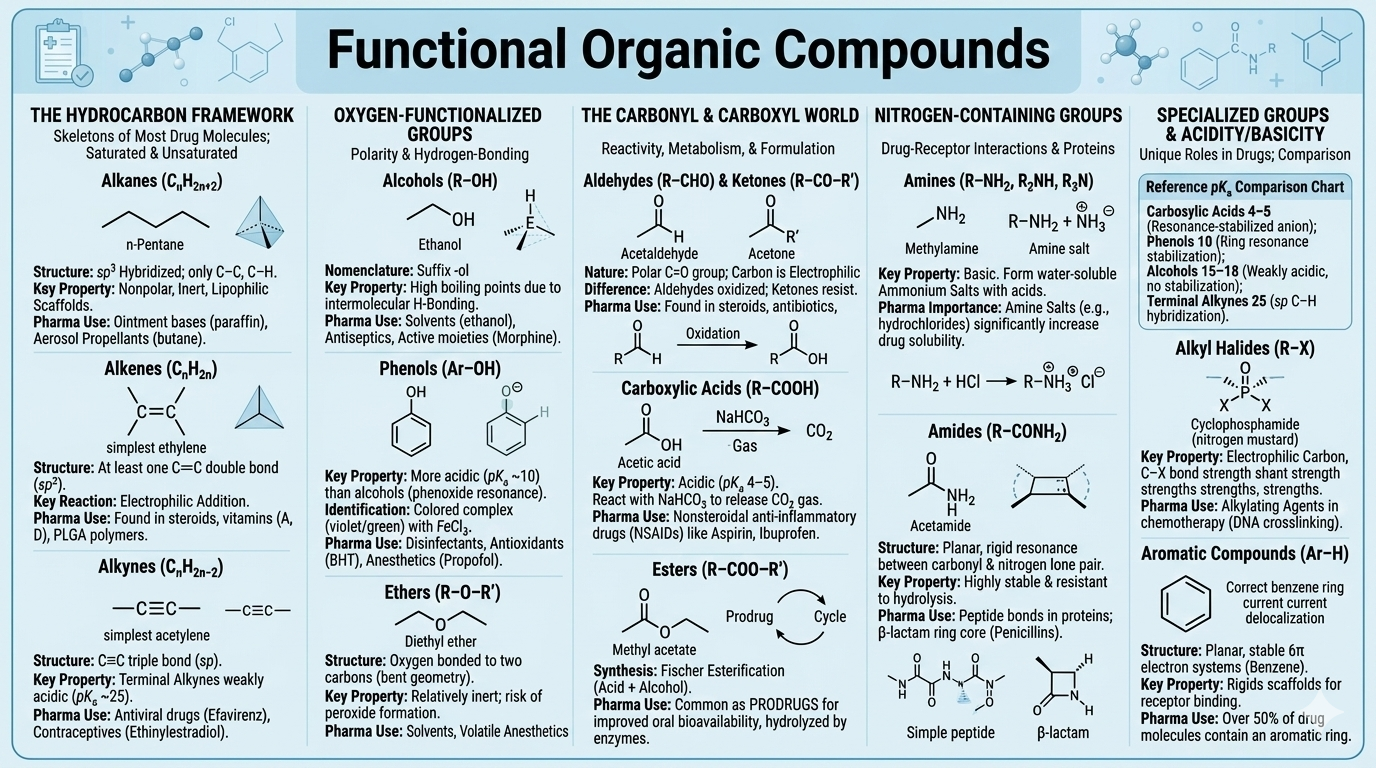
Prepared by the PharmaWallah student team. Verify results with your textbook or instructor. Report an error · Editorial policy
Unit 2: Functional Organic Compounds
Introduction
Functional groups are specific atoms or groups of atoms within molecules that are responsible for characteristic chemical reactions and properties. Understanding the synthesis, structure, nomenclature, properties, and reactions of these functional groups is fundamental to pharmaceutical sciences, as most drugs contain one or more functional groups that determine their biological activity, pharmacokinetics, and formulation characteristics.
This unit covers the major classes of organic compounds with emphasis on their pharmaceutical relevance.
1. Alkanes
Structure and Bonding
Alkanes are saturated hydrocarbons containing only carbon-carbon single bonds (C–C) and carbon-hydrogen bonds (C–H). All carbon atoms are sp³ hybridized, forming tetrahedral geometry with bond angles approximately 109.5°.
General Formula: CₙH₂ₙ₊₂ (for acyclic alkanes)
Classification:
| Type | Description | Example |
|---|---|---|
| Straight-chain (normal) | Carbon atoms connected in a continuous chain | n-Pentane (CH₃-CH₂-CH₂-CH₂-CH₃) |
| Branched-chain | Carbon chain with branches | Isopentane (CH₃-CH(CH₃)-CH₂-CH₃) |
| Cycloalkanes | Carbon atoms arranged in a ring | Cyclohexane (C₆H₁₂) |
Nomenclature (IUPAC)
Rules for Alkanes:
- Identify the longest continuous carbon chain (parent chain).
- Number the chain from the end nearest a substituent (branch).
- Name substituents (alkyl groups) as prefixes in alphabetical order.
- Use prefixes di-, tri-, tetra- for multiple identical substituents.
- For cycloalkanes, add prefix "cyclo-" to the alkane name.
Common Alkyl Groups:
| Group | Structure | Name |
|---|---|---|
| Methyl | –CH₃ | Methyl |
| Ethyl | –CH₂CH₃ | Ethyl |
| Propyl | –CH₂CH₂CH₃ | Propyl |
| Isopropyl | –CH(CH₃)₂ | Isopropyl |
| Butyl | –CH₂CH₂CH₂CH₃ | Butyl |
| sec-Butyl | –CH(CH₃)CH₂CH₃ | sec-Butyl |
| Isobutyl | –CH₂CH(CH₃)₂ | Isobutyl |
| tert-Butyl | –C(CH₃)₃ | tert-Butyl |
Pharmaceutical Relevance: Many drug molecules contain alkane portions as lipophilic scaffolds, influencing membrane permeability and hydrophobic interactions with receptors.
Physical Properties
| Property | Trend | Explanation |
|---|---|---|
| Boiling point | Increases with molecular weight; branched alkanes have lower bp than straight-chain | Greater surface area → stronger London dispersion forces |
| Melting point | Increases with molecular weight; odd-even carbon number effect | Packing efficiency in crystal lattice |
| Solubility | Insoluble in water; soluble in nonpolar organic solvents | Nonpolar nature; cannot form hydrogen bonds |
| Density | <1 g/mL (float on water) | Low density due to weak intermolecular forces |
Synthesis of Alkanes
1. Hydrogenation of Alkenes/Alkynes: Addition of hydrogen (H₂) across double/triple bonds using metal catalysts (Pd, Pt, Ni).
R–CH=CH–R + H₂ → R–CH₂–CH₂–R
Pharmaceutical Application: Used in synthesis to saturate double bonds, often to improve metabolic stability.
2. Wurtz Reaction: Coupling of two alkyl halides with sodium metal in dry ether.
2 R–X + 2 Na → R–R + 2 NaX
Limitation: Only symmetrical alkanes (same R groups) are obtained; with different halides, mixture of products.
3. Corey-House Synthesis (Lithium dialkylcuprate): Reaction of lithium dialkylcuprate (R₂CuLi) with an alkyl halide to give coupled product.
R₂CuLi + R'–X → R–R' + RCu + LiX
Advantage: Can couple different alkyl groups (unsymmetrical alkanes).
4. Reduction of Alkyl Halides: Using reducing agents like Zn/HCl, LiAlH₄, or catalytic hydrogenation.
R–X + 2[H] → R–H + HX
5. Decarboxylation of Carboxylic Acids: Heating sodium salt of carboxylic acid with soda lime (NaOH + CaO).
R–COONa + NaOH → R–H + Na₂CO₃
6. Kolbe's Electrolytic Method: Electrolysis of sodium or potassium salts of carboxylic acids yields alkanes.
2 R–COOK + 2 H₂O → R–R + 2 CO₂ + 2 KOH + H₂
Chemical Properties (Reactions)
Alkanes are generally unreactive due to strong C–C and C–H bonds and lack of functional groups. Major reactions:
1. Combustion: Complete oxidation to CO₂ and H₂O with release of energy.
CₙH₂ₙ₊₂ + (3n+1)/2 O₂ → n CO₂ + (n+1) H₂O + heat
2. Halogenation (Free Radical Substitution): Reaction with halogens (Cl₂, Br₂) under UV light or heat proceeds via free radical mechanism.
R–H + X₂ → R–X + HX
Mechanism:
- Initiation: X₂ → 2 X• (homolytic cleavage)
- Propagation: R–H + X• → R• + HX; R• + X₂ → R–X + X•
- Termination: Combination of radicals
Reactivity: F₂ > Cl₂ > Br₂ > I₂; 3° > 2° > 1° > CH₄ (due to radical stability)
3. Pyrolysis (Cracking): Heating alkanes at high temperatures in absence of air breaks C–C bonds, yielding smaller alkenes and alkanes.
4. Isomerization: Under acidic catalysts, straight-chain alkanes can rearrange to branched isomers (increases octane rating).
Pharmaceutical Applications of Alkanes
| Application | Example | Role |
|---|---|---|
| Excipients | Liquid paraffin, soft paraffin (petrolatum) | Bases for ointments, laxatives |
| Propellants | Butane, propane | Aerosol propellants |
| Solvents | Hexane, heptane | Extraction of oils, purification |
| Lipophilic moiety in drugs | Many steroids, terpenes | Hydrophobic interactions, membrane penetration |
| Antidotes | Paraffin oil | Treatment of lipid-soluble poisonings |
2. Alkenes
Structure and Bonding
Alkenes contain at least one carbon-carbon double bond (C=C). The double bond consists of one sigma (σ) bond (sp²-sp² overlap) and one pi (π) bond (p-orbital overlap). Carbon atoms involved are sp² hybridized with trigonal planar geometry and bond angles ~120°.
General Formula: CₙH₂ₙ (acyclic, one double bond)
Nomenclature (IUPAC)
Rules:
- Select the longest chain that contains the double bond.
- Number the chain so that the double bond gets the lowest possible number (indicated by the smaller numbered carbon of the double bond).
- Use the suffix -ene (or -diene, -triene for multiple double bonds).
- Indicate the position of the double bond by the number before the suffix (e.g., but-2-ene).
- For geometrical isomers, use cis/trans or E/Z designation.
Common Alkenyl Groups:
| Group | Structure | Name |
|---|---|---|
| Vinyl | CH₂=CH– | Vinyl |
| Allyl | CH₂=CH–CH₂– | Allyl |
Physical Properties
| Property | Description |
|---|---|
| Boiling point | Slightly higher than corresponding alkanes due to slightly polarizable π bond |
| Solubility | Insoluble in water; soluble in nonpolar solvents |
| Polarity | Nonpolar overall, but π electrons can interact with polarizable groups |
| Stability | Internal alkenes more stable than terminal; trans more stable than cis (less steric strain) |
Synthesis of Alkenes
1. Dehydrohalogenation of Alkyl Halides: Elimination of HX from alkyl halides using strong base (e.g., KOH/ethanol).
R–CH₂–CH₂–X + Base → R–CH=CH₂ + HX
Mechanism: E2 (bimolecular elimination) – concerted removal of β-H and leaving group. Follows Zaitsev's rule: more substituted alkene is major product.
2. Dehydration of Alcohols: Removal of water from alcohols using acid catalyst (H₂SO₄, H₃PO₄) and heat.
R–CH₂–CH₂–OH → R–CH=CH₂ + H₂O
Mechanism: E1 (for tertiary, secondary) or E2 (for primary) depending on conditions.
3. Cracking of Alkanes: High temperature (500–700°C) breaks C–C bonds, producing alkenes.
4. Wittig Reaction: Reaction of carbonyl compound with a phosphonium ylide to give alkene and triphenylphosphine oxide.
R₂C=O + Ph₃P=CH–R' → R₂C=CH–R' + Ph₃P=O
Advantage: Precise control over double bond position.
5. Partial Hydrogenation of Alkynes: Using Lindlar's catalyst (Pd/CaCO₃ poisoned with quinoline) gives cis-alkenes; using Na/NH₃ (liquid) gives trans-alkenes.
6. Pyrolysis of Esters (Chugaev Reaction): Heating xanthate esters gives alkene via cis-elimination.
Chemical Properties (Reactions)
The π bond is electron-rich and susceptible to electrophilic attack.
1. Electrophilic Addition Reactions:
| Reaction Type | Reagent | Product | Notes |
|---|---|---|---|
| Hydrogenation | H₂ / catalyst | Alkane | Syn addition |
| Halogenation | X₂ (Br₂, Cl₂) | Vicinal dihalide | Anti addition via bromonium ion |
| Hydrohalogenation | HX | Alkyl halide | Follows Markovnikov's rule (H adds to less substituted C) |
| Hydration | H₂O / H⁺ | Alcohol | Markovnikov addition; via carbocation |
| Oxymercuration | Hg(OAc)₂, then NaBH₄ | Alcohol | Markovnikov, no rearrangement |
| Hydroboration | BH₃, then H₂O₂/OH⁻ | Alcohol | Anti-Markovnikov, syn addition |
| Epoxidation | Peracids (RCO₃H) | Epoxide | Oxygen insertion |
Markovnikov's Rule: In addition of HX to unsymmetrical alkene, H attaches to the carbon with more H atoms (less substituted), and X attaches to more substituted carbon. Reason: formation of more stable carbocation.
Anti-Markovnikov addition occurs with HBr in presence of peroxides (free radical mechanism).
2. Oxidation Reactions:
| Oxidizing Agent | Product |
|---|---|
| Cold dilute KMnO₄ (Baeyer test) | 1,2-diol (syn addition) |
| Hot KMnO₄ or O₃ | Cleavage to carbonyl compounds (aldehydes, ketones, acids) |
| O₃ followed by reductive work-up (Zn/H₂O) | Aldehydes or ketones |
| Peracids | Epoxides |
3. Polymerization: Alkenes undergo addition polymerization to form polymers.
n CH₂=CH₂ → [–CH₂–CH₂–]ₙ (polyethylene)
Pharmaceutical Relevance: Polymerization is used to create drug delivery systems (e.g., PLGA nanoparticles).
4. Allylic Substitution: At high temperature or with NBS (N-bromosuccinimide), allylic bromination occurs via radical mechanism.
5. Diels-Alder Reaction: [4+2] cycloaddition between a conjugated diene and a dienophile (alkene) to form a six-membered ring. Important in natural product synthesis.
Pharmaceutical Applications of Alkenes
| Application | Example | Role |
|---|---|---|
| Natural products | Terpenes, steroids, prostaglandins | Contain alkene moieties; biological activity |
| Drug synthesis intermediates | Many APIs | Key building blocks |
| Anticancer agents | Vinblastine, etoposide | Alkene groups essential for activity |
| Antibiotics | Penicillins (side chain) | Structural feature |
| Vitamins | Vitamin A, vitamin D | Conjugated alkenes |
| Polymer drug delivery | PLGA, PLA | Copolymers from lactide (cyclic diester) |
3. Alkynes
Structure and Bonding
Alkynes contain a carbon-carbon triple bond (C≡C). The triple bond consists of one σ bond (sp-sp overlap) and two π bonds (perpendicular p-orbital overlaps). Carbon atoms are sp hybridized with linear geometry (bond angle 180°).
General Formula: CₙH₂ₙ₋₂ (acyclic, one triple bond)
Nomenclature (IUPAC)
Rules:
- Select the longest chain containing the triple bond.
- Number the chain to give the triple bond the lowest possible number.
- Use suffix -yne (or -diyne, etc.).
- Indicate position of triple bond by number before suffix.
Common Names:
- Acetylene (HC≡CH)
- Methylacetylene (propyne)
- Phenylacetylene (C₆H₅–C≡CH)
Physical Properties
| Property | Description |
|---|---|
| Boiling point | Slightly higher than alkanes and alkenes due to linear shape and better packing? Actually similar to alkenes. |
| Acidity | Terminal alkynes (RC≡C–H) are weakly acidic (pKa ~25) due to high s-character (50%) stabilizing the anion. |
| Solubility | Insoluble in water; soluble in organic solvents. |
Synthesis of Alkynes
1. Dehydrohalogenation of Vicinal or Geminal Dihalides: Double elimination of HX using strong base (NaNH₂, KOH).
R–CHX–CH₂X + 2 NaNH₂ → R–C≡CH + 2 NaX + 2 NH₃
2. Alkylation of Terminal Alkynes: Terminal alkynes can be deprotonated with strong base (NaNH₂) to form acetylide ion, which undergoes nucleophilic substitution with primary alkyl halides.
RC≡C⁻ Na⁺ + R'–X → RC≡C–R' + NaX
3. From Calcium Carbide: Industrial production of acetylene: CaC₂ + 2 H₂O → HC≡CH + Ca(OH)₂
Chemical Properties (Reactions)
1. Acidity and Formation of Acetylide Ions: Terminal alkynes (RC≡C–H) react with strong bases (NaNH₂, NaH) to form acetylide ions, which are strong nucleophiles.
2. Electrophilic Additions: Similar to alkenes but can add one or two equivalents.
- Hydrogenation: With Lindlar's catalyst → cis-alkene; with Na/NH₃ → trans-alkene; with excess H₂ and catalyst → alkane.
- Halogenation: Adds two X₂ to give tetrahalide (via dihaloalkene intermediate).
- Hydrohalogenation: Adds HX (Markovnikov) to give vinyl halide, then second addition to geminal dihalide.
3. Hydration: With HgSO₄/H₂SO₄ (Kucherov reaction) gives carbonyl compounds (enol tautomerizes to ketone or aldehyde). Terminal alkynes give methyl ketones (except acetylene gives acetaldehyde).
RC≡CH + H₂O → [RC(OH)=CH₂] → R–CO–CH₃
4. Oxidation: With hot KMnO₄, triple bond cleaves to carboxylic acids.
5. Formation of Metal Acetylides: Terminal alkynes form explosive precipitates with Ag⁺ or Cu⁺ (used for identification).
6. Diels-Alder Reaction: Alkynes can act as dienophiles to give aromatic compounds after oxidation.
Pharmaceutical Applications of Alkynes
| Application | Example | Role |
|---|---|---|
| Antiviral drugs | Efavirenz (NNRTI for HIV) | Contains alkyne group essential for activity |
| Antifungals | Terbinafine | Allylamine antifungal with alkyne moiety |
| Contraceptives | Ethinylestradiol | 17α-ethinyl group prolongs half-life |
| Anticancer | Erlotinib, gefitinib | Alkyne-containing quinazoline derivatives |
| Sedatives | Ethchlorvynol | Alkyne-containing carbinol |
| Diagnostic agents | ¹⁴C-labeled compounds | Alkyne precursors for radiolabeling |
4. Alcohols
Structure and Bonding
Alcohols contain a hydroxyl group (–OH) attached to an sp³ hybridized carbon. The oxygen is also sp³ hybridized with two lone pairs, bent geometry around O.
General Formula: R–OH
Classification:
| Type | Structure | Example |
|---|---|---|
| Primary (1°) | R–CH₂OH | Ethanol |
| Secondary (2°) | R₂CHOH | Isopropanol |
| Tertiary (3°) | R₃COH | tert-Butyl alcohol |
| Phenols | Ar–OH | Phenol (covered separately) |
Nomenclature (IUPAC)
Rules:
- Select the longest carbon chain containing the –OH group.
- Number the chain to give the –OH the lowest possible number.
- Replace the final -e of the alkane name with -ol.
- For polyols, use -diol, -triol, etc., retaining the final -e (e.g., ethane-1,2-diol).
- When –OH is not the principal functional group, use prefix "hydroxy-".
Common Names: Methyl alcohol, ethyl alcohol, etc.
Physical Properties
| Property | Explanation |
|---|---|
| Boiling point | Much higher than corresponding alkanes due to intermolecular hydrogen bonding |
| Solubility | Lower alcohols (C1–C3) miscible with water; solubility decreases with increasing chain length |
| Acidity | Alcohols are weakly acidic (pKa ~15–18), but much weaker than water |
| Basicity | Oxygen lone pairs can accept protons in strong acid |
Synthesis of Alcohols
1. Hydration of Alkenes:
- Acid-catalyzed hydration (Markovnikov)
- Oxymercuration-demercuration (Markovnikov, no rearrangement)
- Hydroboration-oxidation (anti-Markovnikov)
2. Reduction of Carbonyl Compounds:
- Aldehydes reduce to primary alcohols
- Ketones reduce to secondary alcohols
- Using NaBH₄ (mild) or LiAlH₄ (strong)
3. Grignard Reaction: Grignard reagent (RMgX) reacts with carbonyl compounds:
- Formaldehyde → primary alcohol
- Other aldehydes → secondary alcohol
- Ketones → tertiary alcohol
- Esters → tertiary alcohol (with two identical R groups)
4. Hydrolysis of Alkyl Halides: Sₙ1 or Sₙ2 reaction with water or OH⁻ (but elimination competes).
5. Fermentation: Industrial production of ethanol from sugars using yeast.
6. From Other Alcohols: Via ester hydrolysis, etc.
Chemical Properties (Reactions)
1. Reactions Involving O–H Bond:
- Acidity: Reaction with active metals (Na, K) gives alkoxides. 2 ROH + 2 Na → 2 RO⁻Na⁺ + H₂
- Esterification with carboxylic acids (acid-catalyzed) gives esters.
- Oxidation: Primary alcohols oxidize to aldehydes then carboxylic acids; secondary to ketones; tertiary resist oxidation.
- Common oxidants: PCC (stops at aldehyde), KMnO₄, K₂Cr₂O₇/H⁺
- Reaction with acyl chlorides/anhydrides gives esters.
2. Reactions Involving C–O Bond:
- Dehydration to alkenes (acid catalyst, heat). Reactivity: 3° > 2° > 1°.
- Conversion to alkyl halides with HX, PX₃, SOCl₂.
- Tosylate formation (with TsCl/pyridine) makes a good leaving group.
3. Other Reactions:
- Pinacol rearrangement: Vicinal diols rearrange to carbonyl compounds under acid.
- Formation of ethers via Williamson ether synthesis (alkoxide + alkyl halide).
Pharmaceutical Applications of Alcohols
| Application | Example | Role |
|---|---|---|
| Solvents | Ethanol, isopropanol | In liquid formulations, tinctures |
| Antiseptics | Ethanol (70%), isopropanol | Disinfectants |
| Active pharmaceutical ingredients | Many drugs contain –OH | Chloramphenicol, morphine, steroids |
| Prodrugs | Esters of alcohols | Improve bioavailability |
| Excipients | Glycerin, propylene glycol | Humectants, solvents |
| Chiral auxiliaries | Menthol | Flavoring, counter-irritant |
5. Phenols
Structure and Bonding
Phenols have a hydroxyl group directly attached to an aromatic ring. The oxygen lone pairs are conjugated with the aromatic π system, affecting acidity and reactivity.
General Formula: Ar–OH
Nomenclature (IUPAC)
- Phenol (C₆H₅OH) is the parent compound.
- Substituted phenols are named with prefixes (e.g., 4-nitrophenol, 2-methylphenol = o-cresol).
- Common names: o-, m-, p-cresol, catechol (1,2-dihydroxybenzene), resorcinol (1,3-dihydroxybenzene), hydroquinone (1,4-dihydroxybenzene).
Physical Properties
| Property | Description |
|---|---|
| Boiling point | Higher than hydrocarbons due to H-bonding, but lower than alcohols of similar MW? Actually phenols have higher bp due to ring and H-bonding. |
| Solubility | Slightly soluble in water; increased by H-bonding; sodium phenoxide is water-soluble. |
| Acidity | Phenols are more acidic (pKa ~10) than alcohols due to resonance stabilization of phenoxide ion. |
| Toxicity | Many phenols are antiseptic but also toxic; phenol itself is corrosive. |
Synthesis of Phenols
1. Hydrolysis of Diazonium Salts: Aromatic amines → diazonium salt (NaNO₂/HCl) → heated with water → phenol.
Ar–NH₂ → Ar–N₂⁺ → Ar–OH
2. From Cumene (Cumene Process): Industrial method: cumene (isopropylbenzene) oxidized to cumene hydroperoxide, then acid-cleaved to phenol and acetone.
3. Alkali Fusion of Sulfonates: Aromatic sulfonic acids fused with NaOH at high temperature give phenoxides, then acidified.
4. From Aryl Halides: Under harsh conditions (high pressure, Cu catalyst, NaOH) – Dow process.
Chemical Properties (Reactions)
1. Acidity and Salt Formation: Phenols react with NaOH to form water-soluble phenoxides, but not with NaHCO₃ (weaker acid than carboxylic acids).
2. Electrophilic Aromatic Substitution: –OH is strongly activating and ortho/para directing. Reactions include:
- Halogenation (even without catalyst, occurs readily)
- Nitration (with dilute HNO₃ gives ortho/para; with concentrated, oxidation may occur)
- Sulfonation
- Friedel-Crafts (but may complex with AlCl₃)
3. Oxidation: Phenols are easily oxidized to quinones (e.g., hydroquinone → benzoquinone). Important in biological redox systems.
4. Reaction with FeCl₃: Phenols give colored complexes (violet, green, etc.) – a test for phenols.
5. Kolbe-Schmitt Reaction: Phenoxide with CO₂ under pressure gives salicylic acid (ortho-hydroxybenzoic acid) – key for aspirin synthesis.
6. Reimer-Tiemann Reaction: Phenol + CHCl₃ + NaOH → salicylaldehyde (ortho-formylphenol).
7. Coupling with Diazonium Salts: Forms azo dyes (colored compounds) – important in some drug synthesis.
8. Ether Formation (Williamson): Phenoxide with alkyl halide gives aryl alkyl ethers.
Pharmaceutical Applications of Phenols
| Application | Example | Role |
|---|---|---|
| Antiseptics | Phenol, chloroxylenol, thymol | Disinfectants |
| Analgesics | Paracetamol (acetaminophen) | Contains phenolic –OH (but amidic) |
| NSAIDs | Salicylic acid, aspirin | Phenolic precursor |
| Antioxidants | Butylated hydroxytoluene (BHT) | Preservative in pharmaceuticals/foods |
| Anesthetics | Propofol | IV anesthetic (2,6-diisopropylphenol) |
| Laxatives | Bisacodyl | Phenolic derivative |
| Antivirals | Acyclovir (guanine analog) | Phenolic-like OH in base |
6. Ethers
Structure and Bonding
Ethers have an oxygen atom bonded to two carbon atoms (R–O–R'). Oxygen is sp³ hybridized with two lone pairs, bent geometry (~110° bond angle).
General Formula: R–O–R'
Classification:
- Symmetrical (R = R')
- Unsymmetrical (R ≠ R')
- Cyclic ethers (epoxides, tetrahydrofuran, dioxane)
Nomenclature (IUPAC)
Common Names: Name the two alkyl groups alphabetically followed by "ether" (e.g., ethyl methyl ether).
IUPAC: Treat the smaller alkoxy group as a substituent (alkoxyalkane). Example: CH₃–O–CH₂CH₃ is methoxyethane.
For cyclic ethers: oxirane (epoxide), oxetane, tetrahydrofuran (oxolane), etc.
Physical Properties
| Property | Description |
|---|---|
| Boiling point | Lower than alcohols of similar MW (no O–H hydrogen bonding) but higher than alkanes due to dipole-dipole interactions. |
| Solubility | Slightly soluble in water due to H-bond accepting ability of oxygen lone pairs. |
| Polarity | Moderate dipole moment (C–O bond polar). |
| Reactivity | Relatively inert; good solvents. Ethers are prone to peroxide formation on exposure to air/light. |
Synthesis of Ethers
1. Williamson Ether Synthesis: Reaction of alkoxide (or phenoxide) with a primary alkyl halide (Sₙ2).
R–O⁻ Na⁺ + R'–X → R–O–R' + NaX
Limitation: Best with primary halides; secondary/tertiary halides give elimination.
2. Dehydration of Alcohols: Intermolecular dehydration of alcohols using conc. H₂SO₄ at 140°C gives symmetrical ethers (for primary alcohols only).
2 ROH → R–O–R + H₂O
3. Alkoxymercuration-Demercuration: Alkene + alcohol + Hg(OAc)₂, then NaBH₄ gives ether (Markovnikov addition).
4. Industrial Method: From alkenes + alcohol (acid catalyst) for alkyl ethers.
Chemical Properties (Reactions)
1. Cleavage by Acids: Ethers are cleaved by strong acids (HI, HBr) via Sₙ1 or Sₙ2 mechanism, giving alkyl halides and alcohols.
R–O–R' + HX → R–X + R'–OH (further reaction may give two R–X)
2. Peroxide Formation: Ethers with α-hydrogens (especially diethyl ether, THF) form explosive peroxides when exposed to air/light. Stabilized by adding antioxidants (BHT) or storing over KOH.
3. Reaction with Lewis Acids: Ethers form complexes with Lewis acids (BF₃, AlCl₃) – important in Friedel-Crafts reactions as solvent.
4. Epoxide Ring Opening: Epoxides (three-membered cyclic ethers) are highly strained and undergo ring-opening reactions with nucleophiles (acid or base catalyzed). Important in drug synthesis.
Pharmaceutical Applications of Ethers
| Application | Example | Role |
|---|---|---|
| Anesthetics | Diethyl ether (historical), enflurane, isoflurane | Inhalation anesthetics |
| Solvents | Diethyl ether, THF, dioxane | Reaction media, extraction solvents |
| Excipients | Polyethylene glycols (PEGs) | Polyethers used in formulations |
| Antihistamines | Diphenhydramine (Benadryl) | Contains ether linkage (C–O–C) |
| Proton pump inhibitors | Omeprazole | Contains ether and sulfoxide |
| Antimicrobials | Erythromycin | Macrolide antibiotic with ether bonds |
| Anticonvulsants | Phenytoin prodrugs | Ether-linked prodrugs |
7. Amines
Structure and Bonding
Amines are derivatives of ammonia (NH₃) with one or more hydrogen atoms replaced by alkyl or aryl groups. Nitrogen is sp³ hybridized with a lone pair, giving a trigonal pyramidal geometry (bond angle ~107°).
Classification:
| Type | Structure | Example |
|---|---|---|
| Primary (1°) | R–NH₂ | Methylamine |
| Secondary (2°) | R₂NH | Dimethylamine |
| Tertiary (3°) | R₃N | Trimethylamine |
| Quaternary ammonium salt | R₄N⁺ X⁻ | Tetramethylammonium chloride |
| Arylamines | Ar–NH₂ | Aniline |
Nomenclature (IUPAC)
Common Names: Name the alkyl groups attached to nitrogen, followed by "amine" (e.g., ethylmethylamine, trimethylamine). For aromatic, aniline, N-substituted anilines.
IUPAC: Treat amino as substituent (aminocompound). For primary amines, replace -e of alkane with -amine (e.g., methanamine). Alternatively, use prefix "amino-" when other functional groups present.
Physical Properties
| Property | Description |
|---|---|
| Boiling point | Higher than alkanes but lower than alcohols of similar MW (N–H hydrogen bonding weaker than O–H) |
| Solubility | Lower amines soluble in water due to H-bonding; solubility decreases with size |
| Basicity | Amines are basic (lone pair on N) – form salts with acids. Aliphatic amines: pKb ~3-5 (stronger bases than ammonia); aromatic amines much weaker (pKb ~9) due to resonance delocalization of lone pair into ring. |
| Odor | Many amines have fishy odor; some are pleasant (putrescine, cadaverine are foul). |
Synthesis of Amines
1. Alkylation of Ammonia or Amines: Reaction of alkyl halides with excess ammonia gives primary, secondary, tertiary amines and quaternary salts (mixture). Not selective.
2. Gabriel Synthesis: For primary amines: Potassium phthalimide reacts with alkyl halide (Sₙ2), then hydrazine hydrolysis yields primary amine. Selective for 1° amines.
3. Reduction of Nitro Compounds: Nitroarenes reduced to arylamines using Sn/HCl, Fe/HCl, or catalytic hydrogenation.
Ar–NO₂ → Ar–NH₂
4. Reduction of Nitriles: Nitriles (R–C≡N) reduced with LiAlH₄ or H₂/catalyst to primary amines (R–CH₂–NH₂).
5. Reduction of Amides: Amides reduced with LiAlH₄ to amines (primary from primary amides, secondary from secondary amides, tertiary from tertiary amides).
6. Reductive Amination: Carbonyl compound (aldehyde/ketone) + ammonia/amine + reducing agent (NaBH₃CN, H₂/catalyst) yields amine. Important for drug synthesis.
7. Hofmann Degradation: Primary amides treated with Br₂/NaOH give primary amines with loss of one carbon.
R–CONH₂ → R–NH₂
8. Curtius, Schmidt, Lossen rearrangements – also yield amines from carboxylic acid derivatives.
Chemical Properties (Reactions)
1. Basicity and Salt Formation: Amines react with acids to form water-soluble ammonium salts.
R–NH₂ + HCl → R–NH₃⁺ Cl⁻
Pharmaceutical Importance: Many drugs are formulated as salts (e.g., hydrochloride, sulfate) to improve solubility and stability.
2. Acylation: Primary and secondary amines react with acid chlorides, anhydrides, or esters to form amides.
R–NH₂ + R'–COCl → R'–CONH–R + HCl
3. Alkylation: Further alkylation leads to higher amines and quaternary salts.
4. Reaction with Nitrous Acid (HNO₂):
- Primary aliphatic amines: give alcohols + N₂ (gas evolution)
- Primary aromatic amines: form diazonium salts (stable at 0–5°C) – key for synthesis of azo dyes and other compounds
- Secondary amines: form N-nitrosamines (R₂N–N=O) – many are carcinogenic
- Tertiary amines: form nitrosoammonium salts or ring nitrosation
5. Electrophilic Aromatic Substitution in Arylamines: Aniline is strongly activating and ortho/para directing, but amino group must be protected (as amide) to avoid overreaction or oxidation under acidic conditions.
6. Oxidation: Amines can be oxidized to hydroxylamines, nitroso, nitro compounds, or N-oxides (tertiary amines).
7. Quaternary Ammonium Compounds: Formed by exhaustive alkylation; have surfactant properties (used as disinfectants, antiseptics).
Pharmaceutical Applications of Amines
| Application | Example | Role |
|---|---|---|
| Alkaloids | Morphine, quinine, atropine | Contain amine groups; biological activity |
| Antihistamines | Diphenhydramine, cetirizine | Aminoalkyl ethers |
| Local anesthetics | Lidocaine, procaine | Contain amine and amide/ester |
| Antidepressants | Fluoxetine (Prozac), amitriptyline | Secondary/tertiary amines |
| Antibiotics | Sulfonamides, aminoglycosides | Contain amino groups |
| Antimalarials | Chloroquine | 4-aminoquinoline |
| Sympathomimetics | Epinephrine, pseudoephedrine | Primary/secondary amines |
| Quaternary antiseptics | Benzalkonium chloride | Surfactant disinfectant |
8. Aldehydes and Ketones
Structure and Bonding
Both contain the carbonyl group (C=O). The carbonyl carbon is sp² hybridized, trigonal planar, with bond angles ~120°. The C=O bond is polar due to electronegativity difference.
General Formula:
- Aldehydes: R–CHO (at least one H attached to carbonyl)
- Ketones: R–CO–R'
Nomenclature (IUPAC)
Aldehydes:
- Replace final -e of alkane with -al (e.g., methanal, ethanal)
- When –CHO is not the principal group, use prefix "oxo-" or "formyl-"
- Common names: formaldehyde, acetaldehyde, benzaldehyde
Ketones:
- Replace -e with -one; indicate position if needed (e.g., propan-2-one)
- Common names: acetone, acetophenone, benzophenone
Physical Properties
| Property | Description |
|---|---|
| Boiling point | Higher than alkanes but lower than alcohols (no O–H hydrogen bonding, but dipole-dipole) |
| Solubility | Lower aldehydes/ketones soluble in water (H-bond accepting); solubility decreases with chain length |
| Polarity | Polar due to C=O dipole |
| Reactivity | Carbonyl carbon electrophilic; α-hydrogens acidic |
Synthesis of Aldehydes and Ketones
Aldehydes:
- Oxidation of primary alcohols (using PCC, or Swern oxidation)
- Reduction of acid chlorides (Rosemund reduction – H₂/Pd-BaSO₄)
- Ozonolysis of alkenes (with reductive work-up)
- Friedel-Crafts acylation of arenes with CO/HCl (Gattermann-Koch) for aromatic aldehydes
- From gem-dihalides (hydrolysis)
Ketones:
- Oxidation of secondary alcohols (using Cr(VI) reagents)
- Friedel-Crafts acylation of arenes with acid chlorides/anhydrides
- Ozonolysis of alkenes (with oxidative work-up gives ketones)
- From carboxylic acids via organolithium or Grignard (limited)
- Hydration of alkynes (Hg²⁺/H⁺ gives ketones, except acetylene gives aldehyde)
Chemical Properties (Reactions)
1. Nucleophilic Addition to Carbonyl: The carbonyl carbon is electrophilic and undergoes addition with nucleophiles.
| Nucleophile | Product | Notes |
|---|---|---|
| H₂O (hydrate) | Gem-diol (hydrate) | Equilibrium; stable for few aldehydes (formaldehyde) |
| ROH (hemiacetal/hemiketal) | Hemiacetal, then acetal | Important in carbohydrate chemistry |
| HCN | Cyanohydrin | Useful for amino acid synthesis |
| Grignard | Alcohol | After protonation |
| NaHSO₃ | Bisulfite addition product | Used for purification |
| NH₃ derivatives (RNH₂, NH₂OH, etc.) | Imines, oximes, hydrazones | Characterization, drug intermediates |
2. Oxidation: Aldehydes easily oxidized to carboxylic acids (by air, mild oxidants like Tollens' reagent, Fehling's solution). Ketones resist oxidation (except under vigorous conditions, giving cleavage products).
3. Reduction:
- To alcohols: NaBH₄ (mild), LiAlH₄ (strong)
- To alkanes: Wolff-Kishner (hydrazine, base) or Clemmensen reduction (Zn/Hg, HCl) for ketones
4. Reactions at α-Carbon (Enolization): Aldehydes and ketones with α-hydrogens exist in equilibrium with enol form. Important for:
- Halogenation (haloform reaction)
- Aldol condensation (with base or acid)
- Alkylation via enamines or enolates
5. Cannizzaro Reaction: Aldehydes without α-hydrogens (e.g., formaldehyde, benzaldehyde) undergo disproportionation in concentrated base to alcohol and carboxylic acid.
6. Knoevenagel, Claisen, Dieckmann condensations – important in synthesis.
Pharmaceutical Applications of Aldehydes and Ketones
| Application | Example | Role |
|---|---|---|
| Active ingredients | Many drugs contain aldehyde/ketone | Steroids (ketone), prostaglandins |
| Antiseptics | Formaldehyde (formalin) | Disinfectant, preservative |
| Antibiotics | Tetracyclines (ketone groups) | Part of pharmacophore |
| Antimalarials | Artemisinin (contains peroxide and ketone) | Endoperoxide bridge |
| Antidiabetic | Metformin (biguanide) | Not carbonyl, but related |
| Solvents | Acetone | Industrial solvent |
| Precursors | Many drug syntheses | Carbonyl intermediates |
9. Carboxylic Acids
Structure and Bonding
Carboxylic acids contain the carboxyl group (–COOH), which combines carbonyl (C=O) and hydroxyl (–OH). The carboxyl carbon is sp² hybridized, trigonal planar. The O–H bond is more acidic due to resonance stabilization of the carboxylate anion.
General Formula: R–COOH
Nomenclature (IUPAC)
- Replace final -e of alkane with -oic acid (e.g., ethanoic acid)
- Common names: formic, acetic, propionic, butyric, benzoic acid
- Dicarboxylic acids: -dioic acid (e.g., hexanedioic acid = adipic acid)
Physical Properties
| Property | Description |
|---|---|
| Boiling point | Very high due to strong hydrogen bonding (dimers in vapor phase) |
| Solubility | Lower acids miscible with water; solubility decreases with chain length; salts are water-soluble |
| Acidity | pKa ~4-5 (stronger than alcohols, phenols); electron-withdrawing groups increase acidity |
| Odor | Lower acids have pungent odor; higher acids have faint odor |
Synthesis of Carboxylic Acids
1. Oxidation of Primary Alcohols or Aldehydes: Using KMnO₄, K₂Cr₂O₇/H⁺, or HNO₃.
2. Hydrolysis of Nitriles: Nitriles (R–CN) hydrolyzed with acid or base to carboxylic acids.
R–CN + 2 H₂O → R–COOH + NH₃
3. Carbonation of Grignard Reagents: Grignard reagent + CO₂ → carboxylate salt → carboxylic acid after acidification.
R–MgX + CO₂ → R–COO⁻ MgX⁺ → R–COOH
4. Oxidation of Alkylbenzenes: Side-chain oxidation of alkylbenzenes with hot KMnO₄ gives benzoic acids.
5. Hydrolysis of Esters, Amides, Acid Chlorides: Acid or base hydrolysis yields carboxylic acid.
6. From Methyl Ketones (Haloform Reaction): Methyl ketones + halogen + base → carboxylic acid + haloform (CHX₃).
Chemical Properties (Reactions)
1. Acidity and Salt Formation: Carboxylic acids react with bases (NaOH, NaHCO₃, Na₂CO₃) to form carboxylate salts. The reaction with NaHCO₃ distinguishes them from phenols (which do not react).
2. Formation of Acid Derivatives:
- Acid chlorides: With SOCl₂, PCl₃, PCl₅
- Esters: With alcohols (Fischer esterification, acid-catalyzed)
- Amides: With ammonia or amines (via acid chloride or direct heating of ammonium salt)
- Anhydrides: From two carboxylic acids with dehydration
3. Reduction: LiAlH₄ reduces –COOH to primary alcohol (–CH₂OH). NaBH₄ does not reduce carboxylic acids.
4. Decarboxylation:
- Thermal decarboxylation of β-keto acids, malonic acid derivatives
- Kolbe electrolysis
- Hunsdiecker reaction (silver salt + Br₂ gives alkyl halide with loss of CO₂)
5. Substitution at α-Carbon (Hell-Volhard-Zelinsky): Carboxylic acids with α-hydrogens treated with Br₂/PBr₃ give α-bromo acids, useful for synthesis.
Pharmaceutical Applications of Carboxylic Acids
| Application | Example | Role |
|---|---|---|
| NSAIDs | Aspirin (acetylsalicylic acid), ibuprofen, naproxen | Carboxylic acid group essential for COX inhibition |
| Antibiotics | Penicillins, cephalosporins | Carboxyl group in β-lactam ring |
| Vitamins | Ascorbic acid (vitamin C) | Enediol lactone, but acidic |
| Antihyperlipidemics | Statins (e.g., atorvastatin) | Carboxylic acid moiety |
| Anticonvulsants | Valproic acid | Carboxylic acid |
| Excipients | Benzoic acid, sorbic acid | Preservatives |
| Prodrugs | Ester prodrugs of carboxylic acids | Improve bioavailability |
10. Esters
Structure and Bonding
Esters have the structure R–COO–R'. Derived from carboxylic acids by replacing –OH with –OR'. The carbonyl carbon is sp² hybridized; the O attached to R' is sp³.
Nomenclature (IUPAC)
- Name the alkyl group (R') first, then the carboxylate part (replace -ic acid with -ate). Example: methyl acetate (from acetic acid and methanol), ethyl benzoate.
Physical Properties
| Property | Description |
|---|---|
| Boiling point | Lower than carboxylic acids (no H-bond donation) but higher than hydrocarbons due to dipole |
| Solubility | Slightly soluble in water (can H-bond accept); decreases with size |
| Odor | Many esters have pleasant fruity odors (used in flavors, fragrances) |
Synthesis of Esters
1. Fischer Esterification: Carboxylic acid + alcohol + acid catalyst (H₂SO₄), reversible.
RCOOH + R'OH ⇌ RCOOR' + H₂O
2. From Acid Chlorides or Anhydrides: Reaction with alcohols or phenols (base often used).
3. Transesterification: Exchange of alkoxy groups between esters and alcohols (catalyzed by acid or base).
4. From Carboxylate Salts + Alkyl Halides: Sₙ2 reaction (especially for methyl/primary halides).
Chemical Properties (Reactions)
1. Hydrolysis:
- Acidic hydrolysis: reversible, yields acid + alcohol
- Basic hydrolysis (saponification): irreversible, yields carboxylate salt + alcohol
2. Reduction: LiAlH₄ reduces esters to two alcohols (from acyl and alkoxy parts).
RCOOR' + 4[H] → RCH₂OH + R'OH
3. Reaction with Grignard Reagents: Grignard adds twice to esters, giving tertiary alcohols (after protonation).
4. Transesterification: Exchange with another alcohol.
5. Claisen Condensation: Esters with α-hydrogens undergo condensation with base to form β-keto esters.
6. Aminolysis: Esters react with ammonia or amines to form amides.
Pharmaceutical Applications of Esters
| Application | Example | Role |
|---|---|---|
| Prodrugs | Many ester prodrugs (e.g., enalapril, oseltamivir) | Improve oral absorption |
| Local anesthetics | Benzocaine, procaine | Ester-containing |
| Anticholinergics | Atropine derivatives | Esters of tropine |
| Antispasmodics | Dicyclomine | Ester linkage |
| NSAIDs | Aspirin (acetyl ester of salicylic acid) | Prodrug |
| Excipients | Ethyl acetate, isopropyl myristate | Solvents, permeation enhancers |
| Flavors/fragrances | Methyl salicylate (wintergreen) | Topical analgesic |
11. Amides
Structure and Bonding
Amides have the structure R–CO–NH₂ (primary), R–CO–NHR' (secondary), or R–CO–NR'₂ (tertiary). The amide bond has partial double-bond character due to resonance between carbonyl and nitrogen lone pair, making it planar and relatively rigid.
Nomenclature (IUPAC)
- Replace -oic acid with -amide (e.g., acetamide, benzamide).
- For substituted amides, name N-alkyl groups as prefixes (e.g., N-methylacetamide).
Physical Properties
| Property | Description |
|---|---|
| Boiling point | Very high due to strong intermolecular hydrogen bonding (except tertiary amides which cannot donate H-bonds but can accept) |
| Solubility | Lower amides soluble in water; decreases with size |
| Polarity | Highly polar; important in biological systems |
| Stability | Resistant to hydrolysis compared to esters; amide bonds in proteins are stable under physiological conditions |
Synthesis of Amides
1. From Carboxylic Acids: Direct reaction with ammonia or amines at high temperature gives ammonium salt, which dehydrates to amide upon heating. Not efficient; better via acid derivatives.
2. From Acid Chlorides or Anhydrides: Reaction with ammonia or amines (exothermic, often with base to neutralize HCl).
RCOCl + 2 NH₃ → RCONH₂ + NH₄Cl
3. From Esters: Aminolysis of esters with ammonia or amines (slower than acid chlorides).
4. From Nitriles (Partial Hydrolysis): Nitriles partially hydrolyzed with acid or base to amides (controlled conditions).
5. Beckmann Rearrangement: Ketoximes with acid rearrange to N-substituted amides.
Chemical Properties (Reactions)
1. Hydrolysis: Amides hydrolyze to carboxylic acids + ammonia/amine under strong acid or base (requires heating).
2. Dehydration: Primary amides with dehydrating agents (P₂O₅, SOCl₂) yield nitriles.
3. Reduction: LiAlH₄ reduces amides to amines (primary amides → primary amines; secondary → secondary amines; tertiary → tertiary amines).
4. Hofmann Degradation: Primary amides with Br₂/NaOH give primary amines with one less carbon (rearrangement).
5. Acidity of NH: Primary and secondary amides have weakly acidic N–H (pKa ~15-17) due to resonance stabilization of anion.
Pharmaceutical Applications of Amides
| Application | Example | Role |
|---|---|---|
| Local anesthetics | Lidocaine, bupivacaine | Amide-type (more stable than esters) |
| Analgesics | Paracetamol (acetaminophen) | Amide (actually anilide) |
| Antibiotics | Penicillins, cephalosporins | β-lactam amides |
| Anticonvulsants | Phenytoin, carbamazepine | Amide/imide groups |
| Anticancer | Imatinib (Gleevec) | Contains amide bonds |
| Peptides and proteins | All proteins | Amide (peptide) bonds |
| Diuretics | Furosemide | Contains amide/sulfonamide |
| Antifungals | Fluconazole | Amide not primary, but heterocycle |
12. Alkyl Halides
Structure and Bonding
Alkyl halides (haloalkanes) have the general formula R–X, where X = F, Cl, Br, I. The carbon-halogen bond is polar due to electronegativity difference.
Classification:
- Primary (1°): R–CH₂–X
- Secondary (2°): R₂CH–X
- Tertiary (3°): R₃C–X
- Vinyl halides: CH₂=CH–X (less reactive)
- Aryl halides: Ar–X (less reactive in Sₙ2)
Nomenclature (IUPAC)
- Treat halogen as substituent (fluoro-, chloro-, bromo-, iodo-). Number the chain to give the lowest number to halogen.
Physical Properties
| Property | Description |
|---|---|
| Boiling point | Higher than alkanes due to polarity; increases with size and atomic weight of halogen |
| Density | More dense than water for bromides and iodides; fluorides and chlorides less dense |
| Solubility | Insoluble in water; soluble in organic solvents |
| Reactivity | C–X bond strength decreases: F > Cl > Br > I (so alkyl iodides most reactive) |
Synthesis of Alkyl Halides
1. From Alcohols: Reaction with HX (substitution), PX₃, SOCl₂.
2. Halogenation of Alkanes: Free radical halogenation (Cl₂, Br₂) gives mixture, not selective.
3. Addition of HX to Alkenes: Markovnikov addition.
4. Halogen Exchange (Finkelstein Reaction): R–Cl + NaI (in acetone) → R–I + NaCl (driven by precipitation of NaCl).
5. From Carboxylic Acids (Hunsdiecker Reaction): Silver salt of carboxylic acid + Br₂ → alkyl bromide (with one less carbon).
Chemical Properties (Reactions)
1. Nucleophilic Substitution (Sₙ1 and Sₙ2): Alkyl halides undergo substitution with various nucleophiles (OH⁻, RO⁻, CN⁻, NH₃, etc.). Reactivity depends on structure and conditions.
2. Elimination (E1 and E2): With strong bases, elimination competes with substitution, giving alkenes.
3. Reaction with Metals:
- With Mg (in dry ether) → Grignard reagent (R–MgX)
- With Li → organolithium
- With Na (Wurtz reaction) → coupled product
4. Reduction: To alkanes with Zn/HCl or LiAlH₄.
Pharmaceutical Applications of Alkyl Halides
| Application | Example | Role |
|---|---|---|
| Alkylating agents in chemotherapy | Cyclophosphamide, chlorambucil | Nitrogen mustards (alkyl halides) crosslink DNA |
| Anesthetics | Halothane, enflurane | Halogenated hydrocarbons |
| Antiseptics | Chlorhexidine (contains Cl) | Biguanide disinfectant |
| Solvents | Chloroform, methylene chloride | Extraction, reaction solvents (use limited due to toxicity) |
| Intermediates | Many drug syntheses | Alkyl halides as building blocks |
13. Aromatic Compounds
Structure and Bonding
Aromatic compounds contain benzene rings or other aromatic systems. Benzene (C₆H₆) is cyclic, planar, with 6 π electrons delocalized over six carbon atoms (sp² hybridized). The ring current imparts special stability and reactivity.
Nomenclature (IUPAC)
- Monosubstituted benzenes: named as alkylbenzenes (e.g., methylbenzene = toluene) or with substituent as prefix (chlorobenzene, nitrobenzene).
- Disubstituted: use ortho (1,2-), meta (1,3-), para (1,4-). Numbering: choose lowest possible numbers.
- Common names: aniline, phenol, toluene, xylene, etc.
Physical Properties
| Property | Description |
|---|---|
| Boiling point | Higher than aliphatic hydrocarbons of similar MW due to π-stacking |
| Solubility | Insoluble in water; soluble in organic solvents |
| Stability | Highly stable due to resonance energy (~36 kcal/mol for benzene) |
Synthesis of Aromatic Compounds
Aromatic compounds are typically obtained from petroleum or coal tar. Synthetically, we can:
- Electrophilic Aromatic Substitution to introduce substituents onto an existing aromatic ring.
- From alkynes (trimerization) : 3 alkynes cyclize to benzene derivatives with catalyst.
- From phenols via reduction etc.
Chemical Properties (Reactions)
1. Electrophilic Aromatic Substitution (EAS) : The key reaction of aromatic compounds. Mechanism: electrophile attacks ring forming arenium ion (σ-complex), then loss of proton restores aromaticity.
Common EAS reactions:
- Nitration (HNO₃/H₂SO₄)
- Halogenation (Cl₂, Br₂ with FeX₃ catalyst)
- Sulfonation (H₂SO₄ or SO₃)
- Friedel-Crafts alkylation (R–X + AlCl₃)
- Friedel-Crafts acylation (R–COCl + AlCl₃)
Directing Effects:
- Activating groups (e.g., –OH, –OR, –NH₂, –NHR, –NR₂, –CH₃) are ortho/para directors.
- Deactivating groups (e.g., –NO₂, –CN, –SO₃H, –CHO, –COR, –COOH) are meta directors.
- Halogens are deactivating but ortho/para directors (due to +M effect).
2. Nucleophilic Aromatic Substitution: Occurs under harsh conditions or via benzyne mechanism for unactivated aryl halides; activated by electron-withdrawing groups ortho/para.
3. Side-Chain Reactions of Alkylbenzenes:
- Oxidation of alkyl side chain to benzoic acid (hot KMnO₄)
- Halogenation at benzylic position (NBS, light) – free radical
- Elimination/addition on side chain
Pharmaceutical Applications of Aromatic Compounds
| Application | Example | Role |
|---|---|---|
| Core structure in many drugs | Over 50% of drugs contain aromatic ring | Provides planar, rigid framework for receptor binding |
| NSAIDs | Ibuprofen, naproxen | Aromatic rings essential |
| Antihistamines | Loratadine, fexofenadine | Aromatic/heteroaromatic |
| Antidepressants | Fluoxetine, sertraline | Contain aromatic rings |
| Antibiotics | Sulfonamides, tetracyclines | Aromatic/heteroaromatic |
| Anticancer | Imatinib, erlotinib | Multiple aromatic/heteroaromatic rings |
| Analgesics | Paracetamol, aspirin | Phenol or aromatic ester |
Summary Tables
Table 1: Overview of Functional Groups and Their Pharmaceutical Importance
| Functional Group | General Formula | Key Property | Pharmaceutical Examples |
|---|---|---|---|
| Alkane | R–H | Hydrophobic, inert | Paraffin, lipophilic moieties |
| Alkene | R–CH=CH–R' | π bond reactive | Steroids, terpenes |
| Alkyne | R–C≡C–R' | Linear, acidic terminal H | Ethinylestradiol, terbinafine |
| Alcohol | R–OH | H-bond donor/acceptor | Ethanol, morphine |
| Phenol | Ar–OH | Acidic, antioxidant | Paracetamol, propofol |
| Ether | R–O–R' | H-bond acceptor | Diphenhydramine, PEG |
| Amine | R–NH₂, R₂NH, R₃N | Basic, nucleophilic | Alkaloids, local anesthetics |
| Aldehyde | R–CHO | Electrophilic, oxidizable | Formaldehyde (preservative) |
| Ketone | R–CO–R' | Electrophilic | Steroids, NSAIDs |
| Carboxylic acid | R–COOH | Acidic, H-bonding | Ibuprofen, aspirin |
| Ester | R–COO–R' | Hydrolyzable | Prodrugs, benzocaine |
| Amide | R–CONH₂, etc. | Stable, H-bonding | Peptides, lidocaine |
| Alkyl halide | R–X | Electrophilic | Alkylating agents |
| Aromatic | Ar–H | Planar, π-stacking | Majority of drugs |
Table 2: Comparison of Acidity/Basicity
| Compound Class | pKa (approx.) | Explanation |
|---|---|---|
| Carboxylic acids | 4-5 | Resonance-stabilized anion |
| Phenols | 10 | Phenoxide stabilized by ring resonance |
| Alcohols | 15-18 | Alkoxide less stabilized |
| Water | 15.7 | Reference |
| Terminal alkynes | 25 | sp C–H acidic |
| Amines (conjugate acid) | 9-11 (ammonium) | Aliphatic amines basic |
| Aniline (conjugate acid) | 4.6 | Resonance reduces basicity |
Table 3: Common Reactions in Drug Synthesis
| Reaction Type | Functional Groups Involved | Pharmaceutical Relevance |
|---|---|---|
| Esterification | Acid + alcohol | Prodrug formation |
| Amide formation | Acid chloride + amine | Peptide coupling |
| Reductive amination | Aldehyde/ketone + amine | Many drug intermediates |
| Alkylation | Alkyl halide + nucleophile | Introducing side chains |
| Acylation | Acid chloride + nucleophile | Protecting amines |
| Hydrolysis | Ester, amide | Prodrug activation |
| Oxidation | Alcohol → carbonyl; aldehyde → acid | Metabolism simulation |
| Reduction | Carbonyl → alcohol | Synthesis of alcohols |
References
-
Brown, W. H., & Bursten, M. L. (2014). Introduction to organic chemistry (8th ed.). Wiley. (Chapters on functional group chemistry)
-
Vollhardt, K. P. C., & Schore, N. E. (2014). Organic chemistry: Structure and function (7th ed.). W. H. Freeman and Company. (Chapters 4-12 covering functional groups)
-
Carey, F. A. (2007). Advanced organic chemistry: Part A: Structure and mechanisms (5th ed.). Wiley. (In-depth coverage of functional group reactivity)
-
Silverman, R. B. (2014). The organic chemistry of drug design and drug action (2nd ed.). Academic Press. (Chapter 3: Functional groups in drug action)
-
Lemke, T. L., & Williams, D. A. (2013). Foye's principles of medicinal chemistry (7th ed.). Lippincott Williams & Wilkins. (Chapters on drug classes by functional group)
-
Clayden, J., Greeves, N., & Warren, S. (2012). Organic chemistry (2nd ed.). Oxford University Press. (Comprehensive coverage of functional groups)
-
Patrick, G. L. (2013). An introduction to medicinal chemistry (5th ed.). Oxford University Press. (Chapter 2: Functional groups and drug-receptor interactions)
-
Smith, M. B., & March, J. (2007). March's advanced organic chemistry: Reactions, mechanisms, and structure (6th ed.). Wiley. (Reference for reaction mechanisms)
Recommended Textbooks for Further Reading:
- Brown, W. H., & Bursten, M. L. (2014). Introduction to organic chemistry (8th ed.). Wiley. (Clear explanations and pharmaceutical examples)
- Vollhardt, K. P. C., & Schore, N. E. (2014). Organic chemistry: Structure and function (7th ed.). W. H. Freeman and Company. (Strong on functional group transformations)
- Lemke, T. L., & Williams, D. A. (2013). Foye's principles of medicinal chemistry (7th ed.). Lippincott Williams & Wilkins. (Connects organic chemistry to drug molecules)
End of unit 2 of 4
Check what you've learned
5 quick questions from this unit. They're optional: try them if you like, then mark the unit as read and move on.